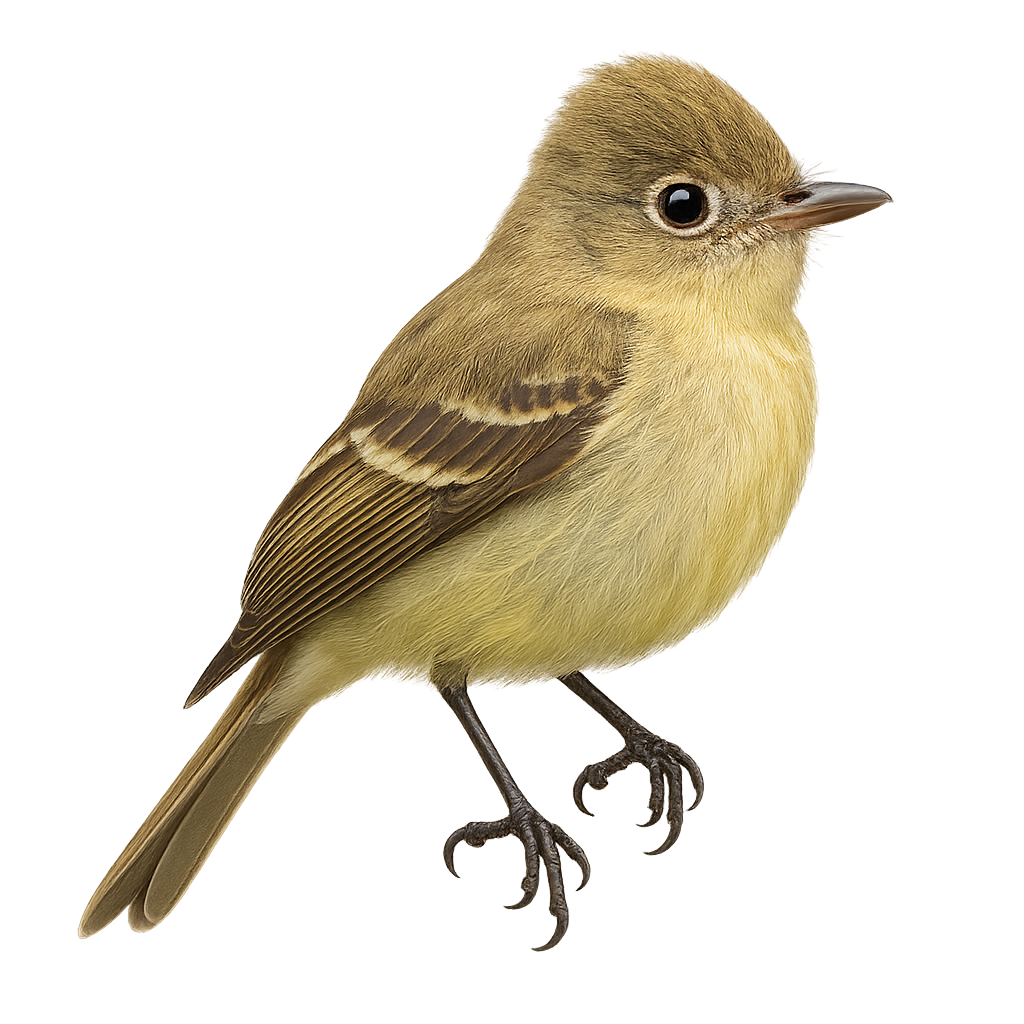
The Western Flycatcher, or Empidonax difficilis, is a small passerine bird belonging to the Tyrannidae family. It is primarily found along the western coast of North America, from southern Alaska to northern Mexico. This flycatcher is recognizable by its olive-green back and pale yellow belly, as well as its two white wing bars. It inhabits coniferous forests and moist wooded areas, where it primarily feeds on insects caught in flight. Its song is a key element in distinguishing it from other species in the Empidonax genus, as its appearance is very similar to its congeners.
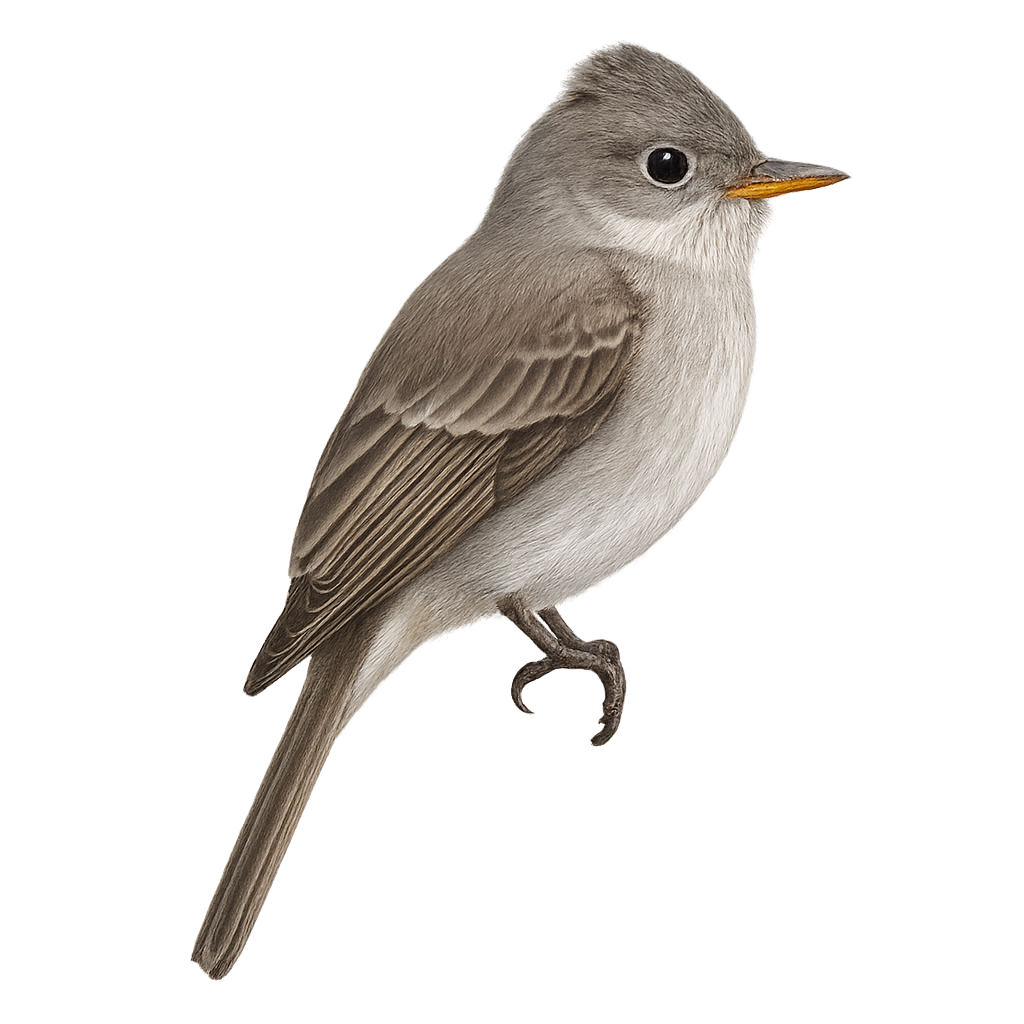
The Greater Pewee, or Contopus pertinax, is a medium-sized bird belonging to the Tyrannidae family. It is primarily found in the pine and oak forests of mountainous regions in Central America and northern Mexico. Its plumage is generally gray-brown with a lighter chest, and it is distinguished by its slightly raised crest. This pewee is often seen perched on exposed branches, from where it launches to catch flying insects. Its song is a clear, melodious whistle, often heard at dawn. Although primarily insectivorous, it may occasionally feed on small fruits. It is a solitary bird but can be observed in small groups during migration.
The Least Flycatcher is a small passerine bird belonging to the Tyrannidae family, known for its distinctive "chebec" call. It inhabits deciduous forests and wooded areas across North America. With its olive-gray plumage, white belly, and two white wing bars, it is easily recognizable. This migratory bird primarily feeds on insects, which it catches in flight. Often seen perched, it watches for prey with keen eyes. Despite its small size, the Least Flycatcher plays a crucial role in forest ecosystems by helping control insect populations.
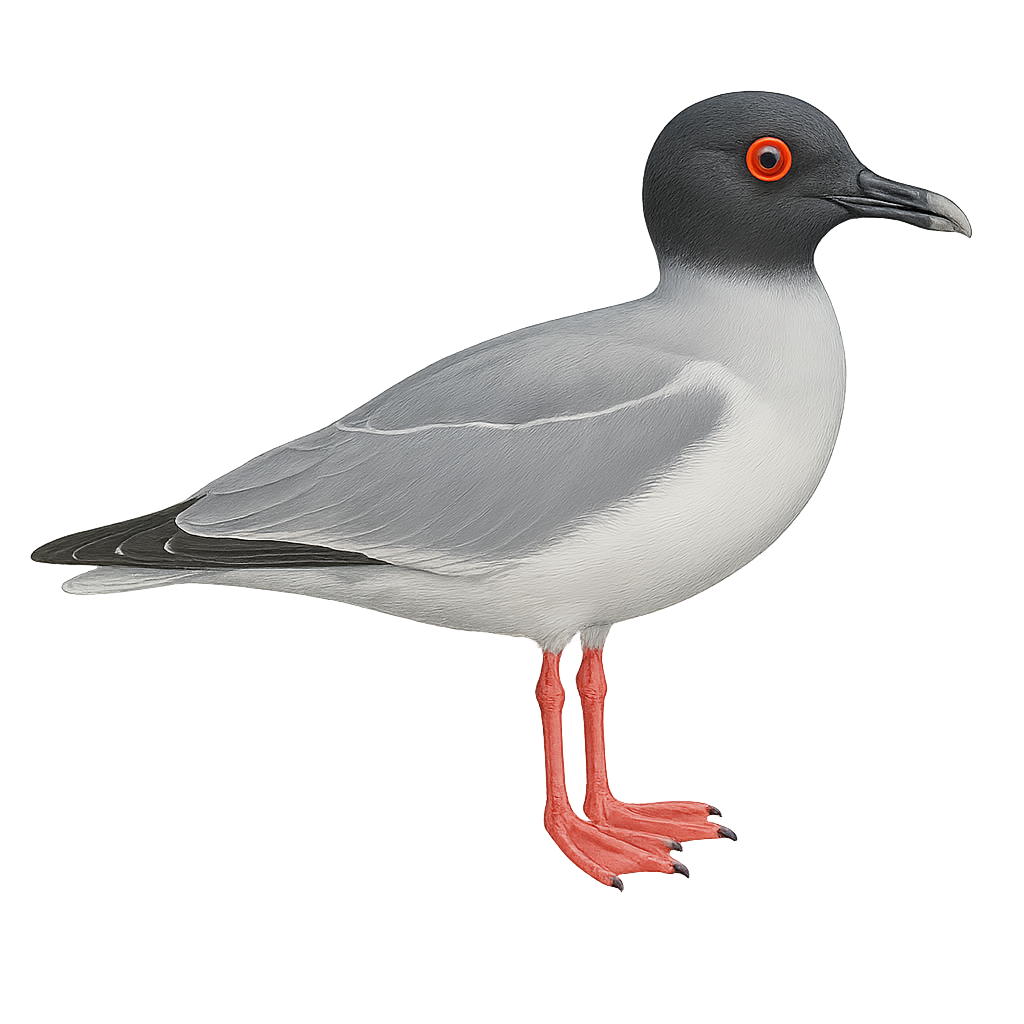
The Swallow-tailed Gull, Creagrus furcatus, is a unique seabird primarily found in the Galápagos Islands. It is distinguished by its forked tail and grey and white plumage. Its black bill is tipped with red, and its eyes are surrounded by a red ring, giving it a piercing look. This gull is nocturnal, a rarity among seabirds, and feeds mainly on fish and squid caught in flight. It nests on rocky cliffs, usually laying a single egg. Its behavior is relatively tolerant towards humans, allowing for close observation.
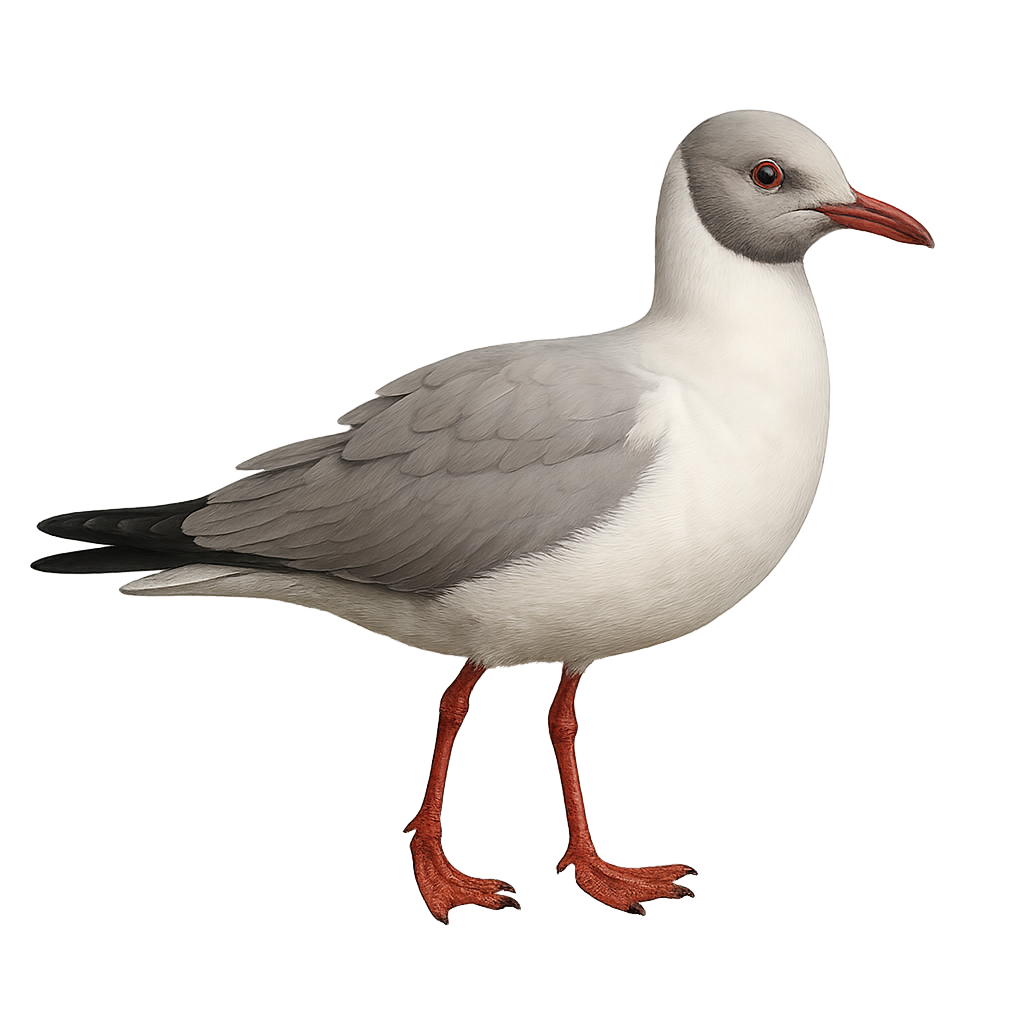
The Grey-headed Gull, Chroicocephalus cirrocephalus, is an elegant and distinctive bird, recognizable by its pale grey head contrasting with its white body and light grey wings. It primarily inhabits coastal areas, estuaries, and inland lakes in Africa and South America. During the breeding season, it forms noisy colonies, often in association with other gull and tern species. Its diet is varied, including fish, insects, and human waste. This species is known for its graceful flight and characteristic high-pitched calls. Although its conservation status is currently "least concern," it remains sensitive to human disturbances and habitat degradation.
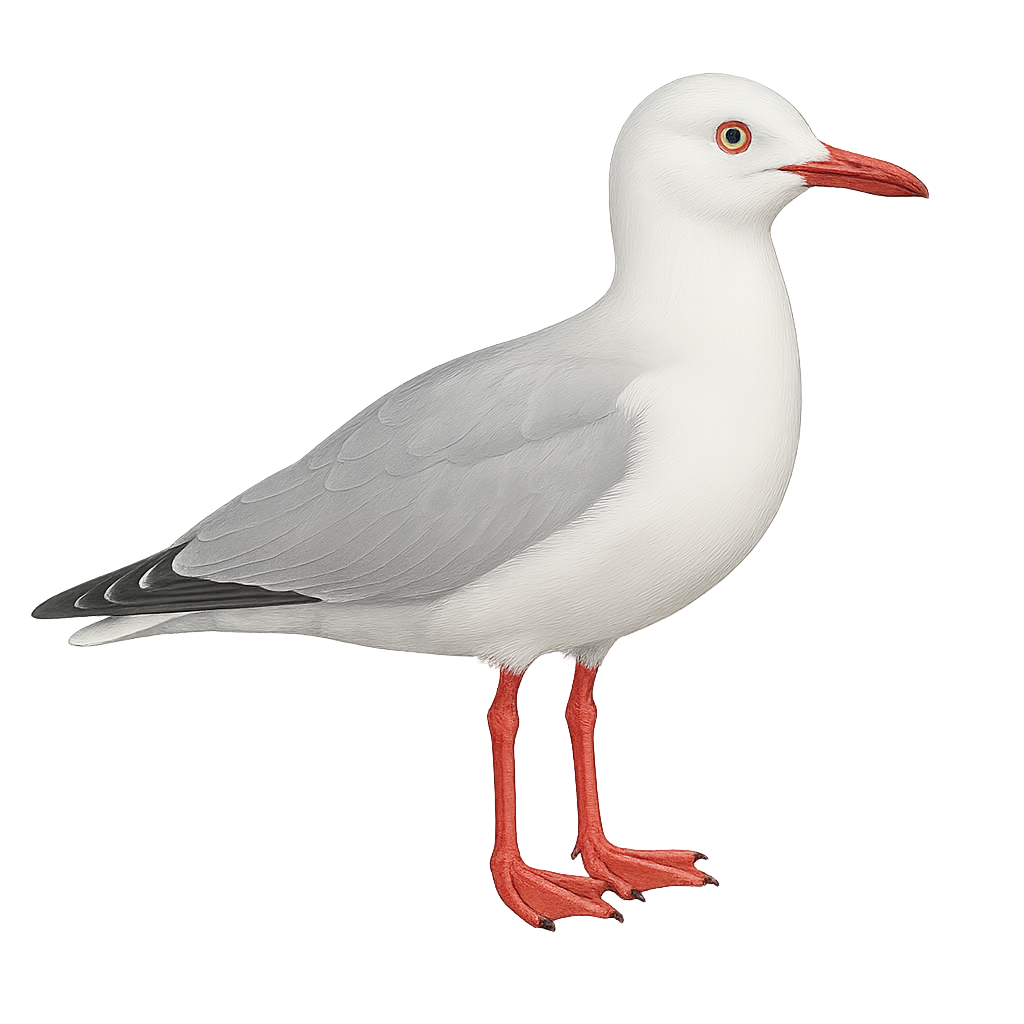
The Silver Gull, Chroicocephalus novaehollandiae, is a medium-sized seabird known for its bright white plumage, grey wings, and red legs. It is widespread in Australia and New Zealand, frequenting coasts, harbors, and inland waters. An opportunistic feeder, it consumes fish, invertebrates, and human waste. Its call is loud and distinctive. It nests in colonies, often on islands or isolated beaches, typically laying two to three eggs. Although often in contact with humans, it remains somewhat wary.
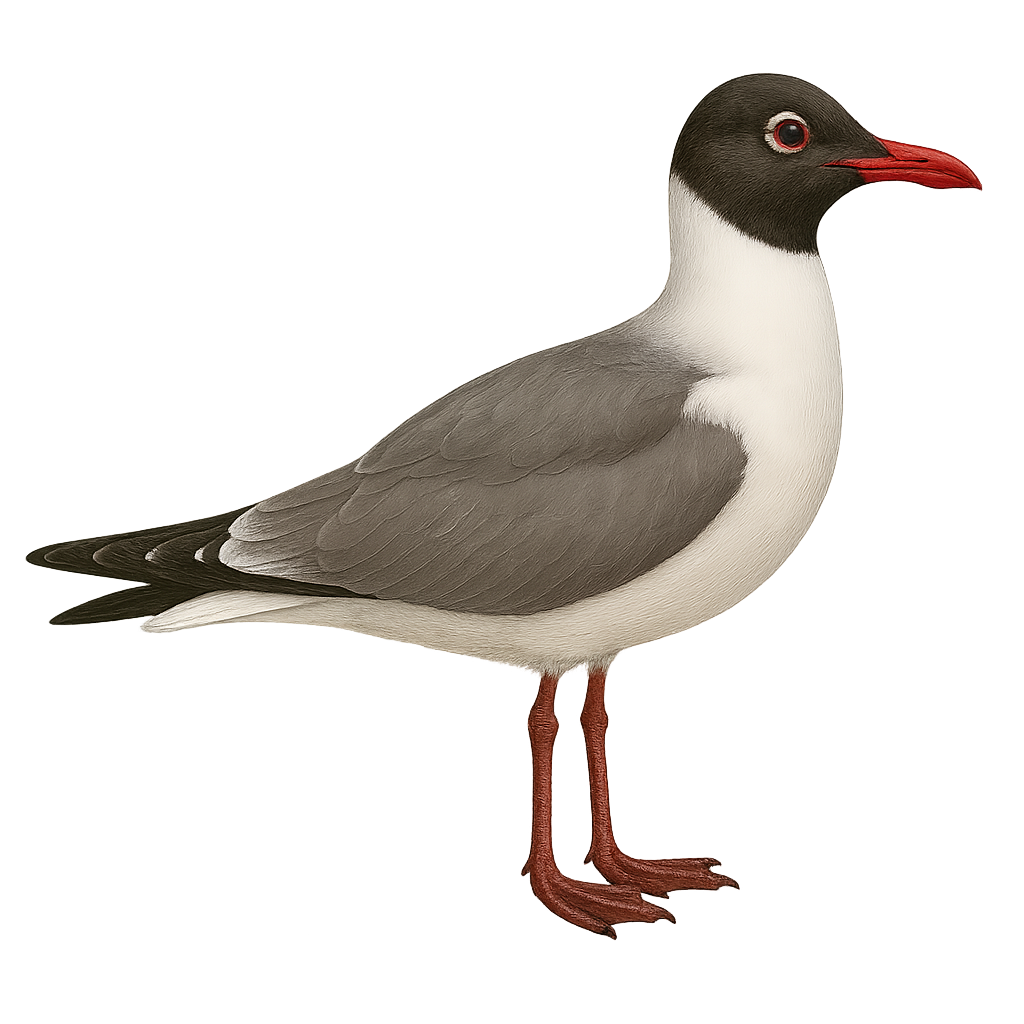
The Laughing Gull, Leucophaeus atricilla, is a medium-sized bird known for its distinctive plumage and characteristic call. During the breeding season, it sports a black head, gray back, and wings with black tips. The rest of its body is white, and its bright red bill contrasts with its plumage. Outside the breeding season, its head turns white with gray spots. It primarily inhabits coasts and islands, feeding on fish, crustaceans, and waste. Sociable by nature, it often gathers in large colonies. Its adaptability to urban environments makes it a common sight along the Atlantic coasts and the Gulf of Mexico.
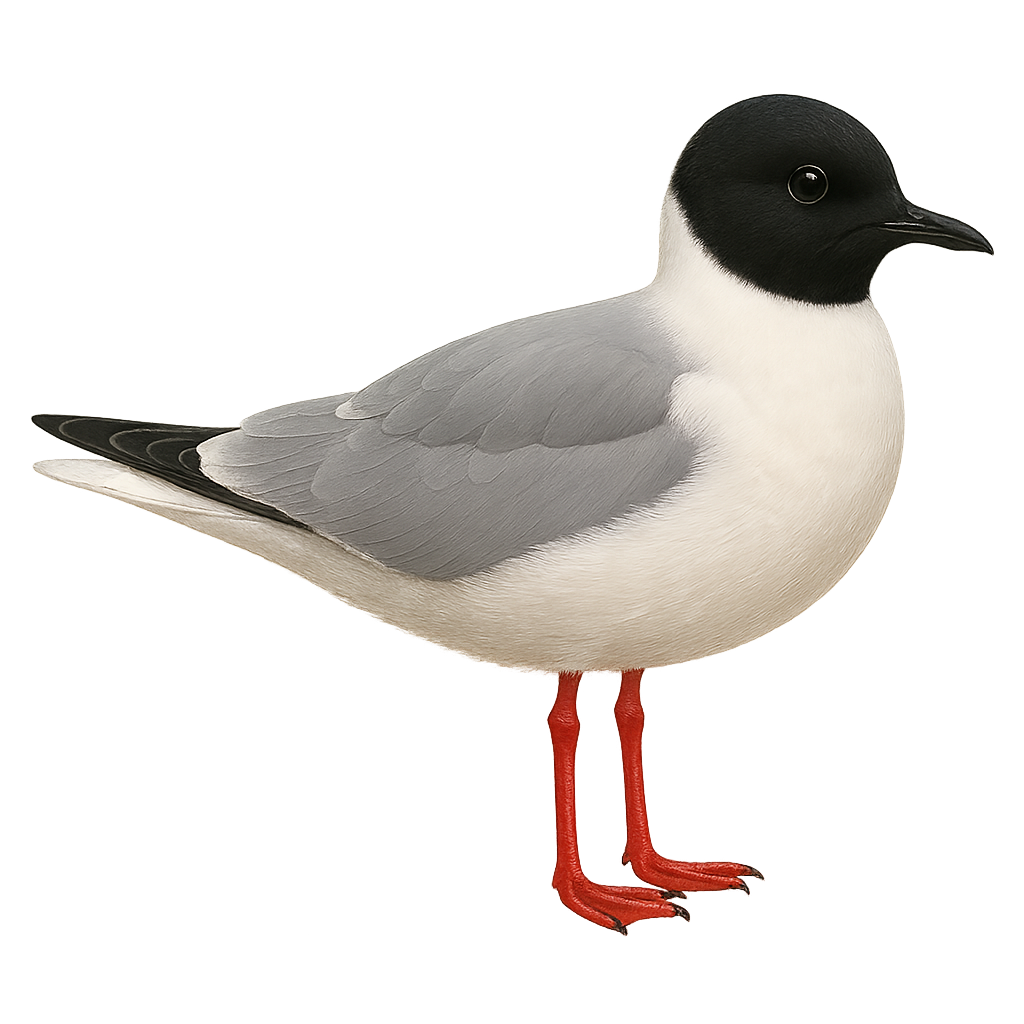
The Bonaparte's Gull, Chroicocephalus philadelphia, is a medium-sized bird, measuring about 28 to 38 cm in length with a wingspan of 76 to 84 cm. It is distinguished by its black head during the breeding season, slender black bill, and reddish legs. Outside the breeding season, its head turns white with a dark ear spot. It frequents lakes, rivers, and coasts, feeding mainly on small fish, insects, and crustaceans. A migratory bird, it breeds in the boreal regions of North America and winters along the Atlantic and Pacific coasts. Its flight is agile and swift, often compared to that of a tern.
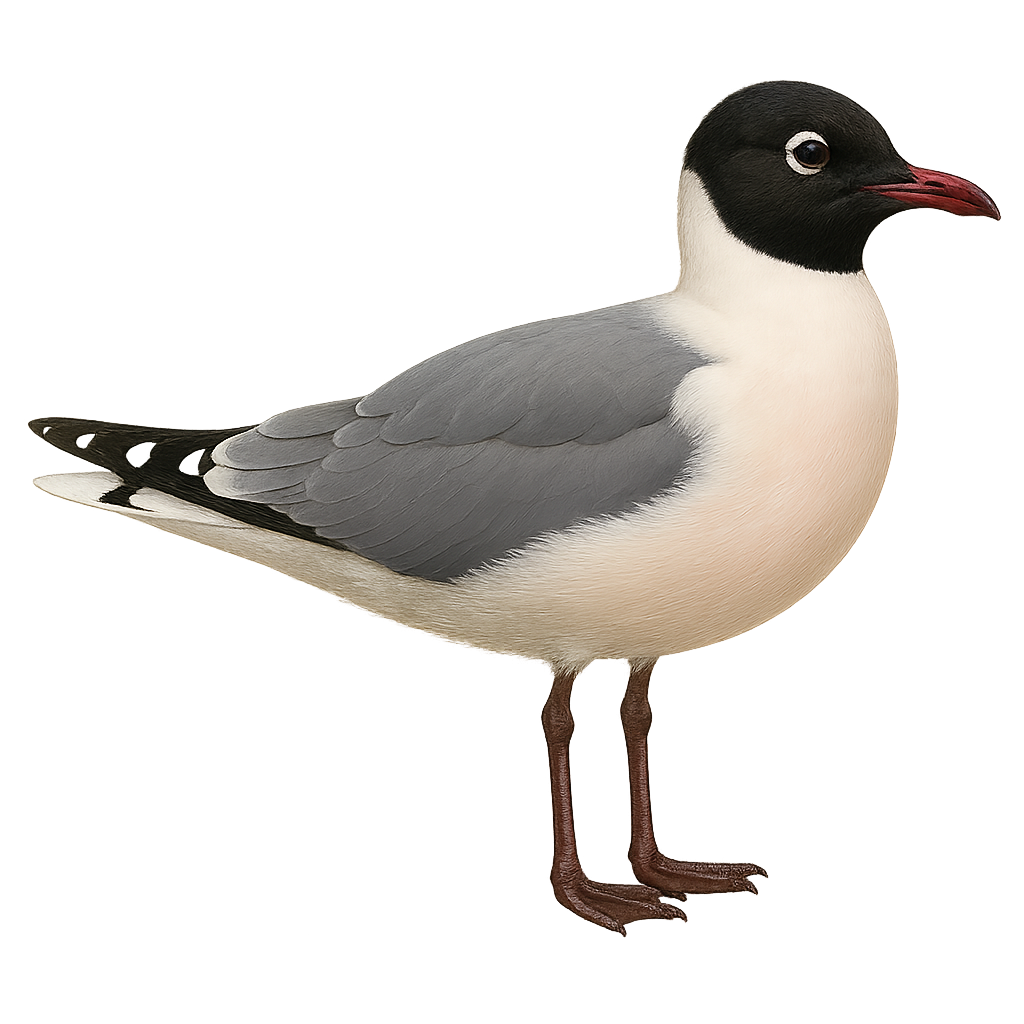
The Franklin's Gull, Leucophaeus pipixcan, is a medium-sized bird known for its black head during the breeding season, red bill, and red legs. Its plumage is mainly white with gray wings and black wingtips. Often seen in large flocks, especially during migration, it originates from the North American prairies and migrates to South America for the winter. It primarily feeds on insects, small fish, and crustaceans, catching them in flight or while swimming. The Franklin's Gull is known for its sharp calls and graceful flights. It nests in colonies in marshes and shallow lakes, building floating nests with aquatic vegetation.
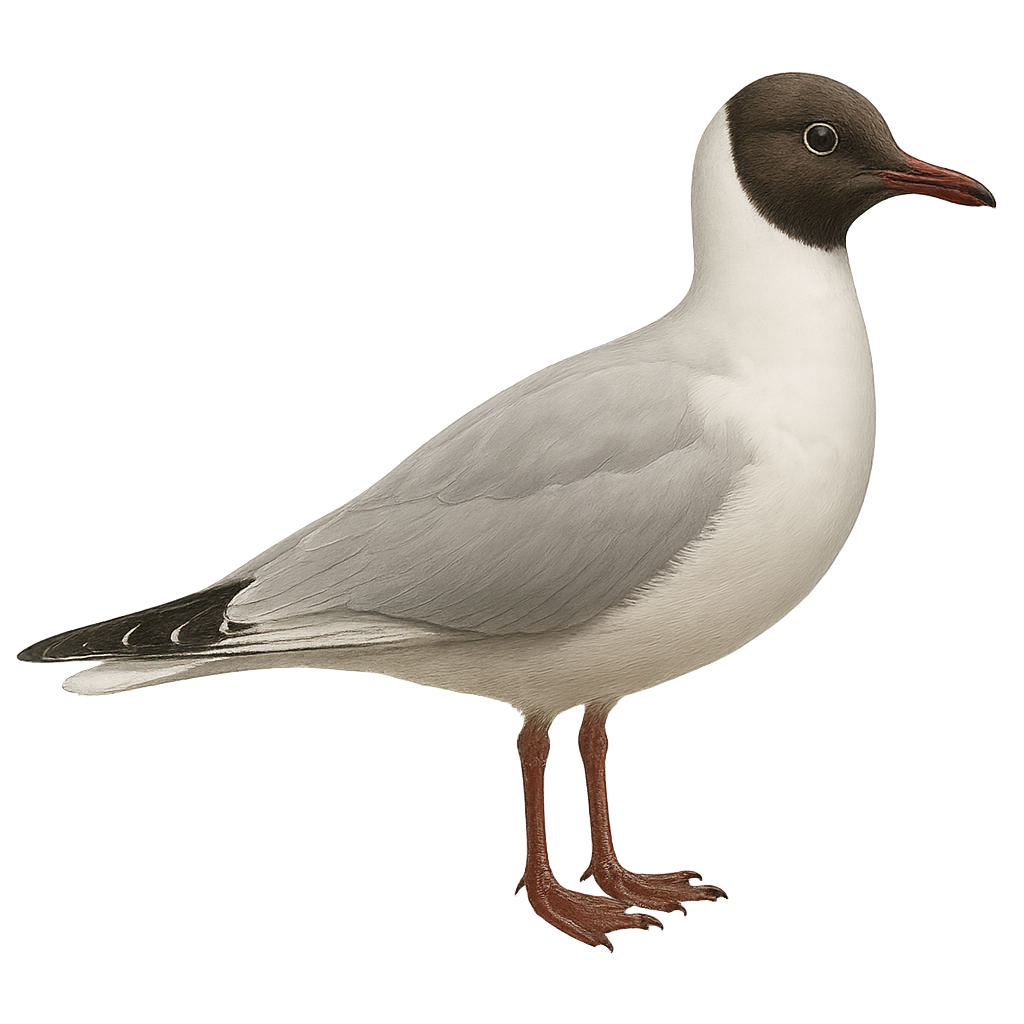
The Brown-hooded Gull, or Chroicocephalus maculipennis, is a medium-sized bird known for its chocolate-brown head during the breeding season and its white and grey plumage. It primarily inhabits wetlands, lakes, and coastal areas in South America. Its diet is varied, including fish, insects, and small crustaceans. Often seen in groups, it gracefully flies over water or rests on shores. Although its conservation status is currently of least concern, it is sensitive to environmental changes, particularly pollution and habitat destruction.
The Little Gull, Hydrocoloeus minutus, is the smallest gull species, measuring about 25 to 30 cm in length with a wingspan of 60 to 78 cm. It is characterized by its delicate plumage, with a pearl-gray back and white wings tipped with black. During the breeding season, its head turns black, contrasting with its white body. It inhabits wetlands, lakes, and estuaries, feeding mainly on small fish and aquatic insects. A migratory bird, it breeds in northern regions and winters further south. Its flight is light and graceful, often compared to that of a swallow. Though discreet, it is appreciated by birdwatchers for its elegance and social behavior.
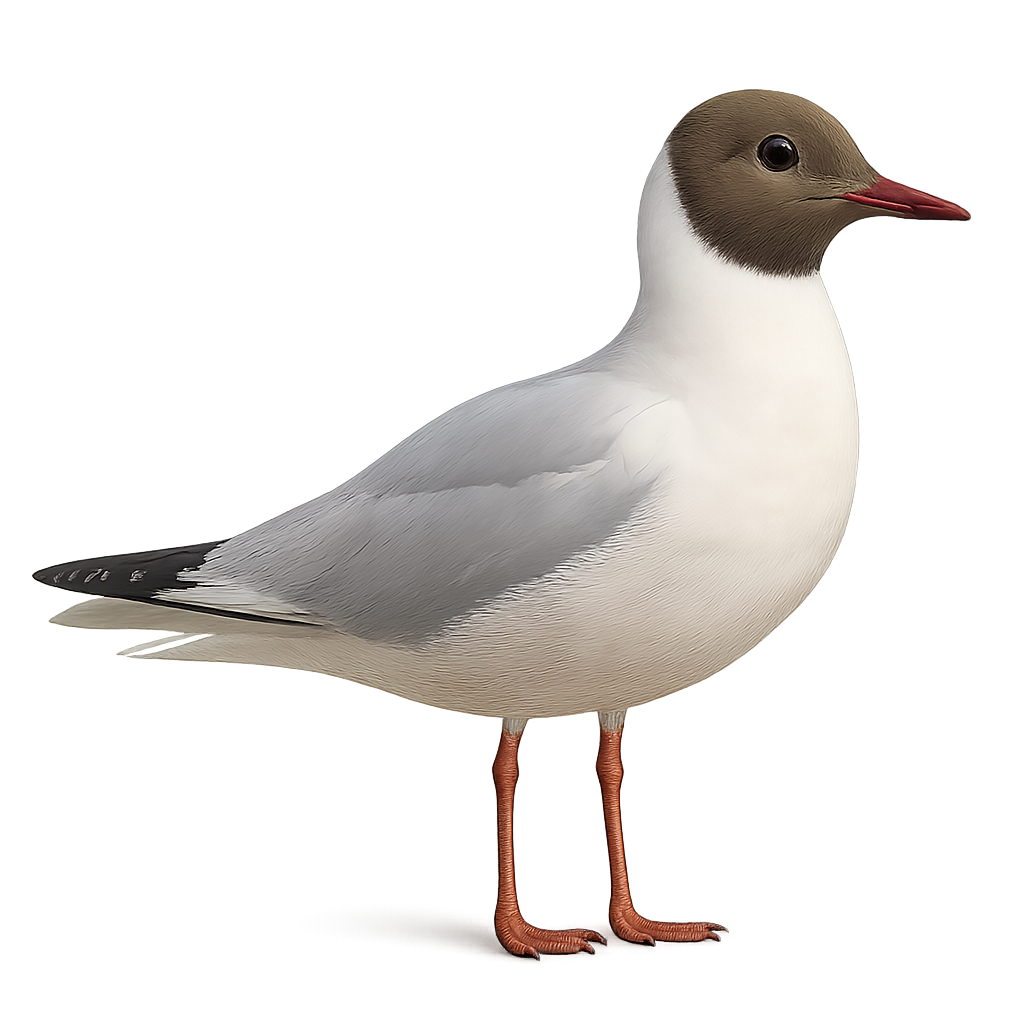
The black-headed gull is a small gull easily recognized by its black head (in summer), white plumage, and light gray wings. It is primarily found in Europe and Asia and is often seen near bodies of water, in harbors, and estuaries. It is omnivorous, feeding on small fish, insects, and sometimes human scraps. This gull is also known for its aerial acrobatics, often seen flying and diving into the water to catch its food.
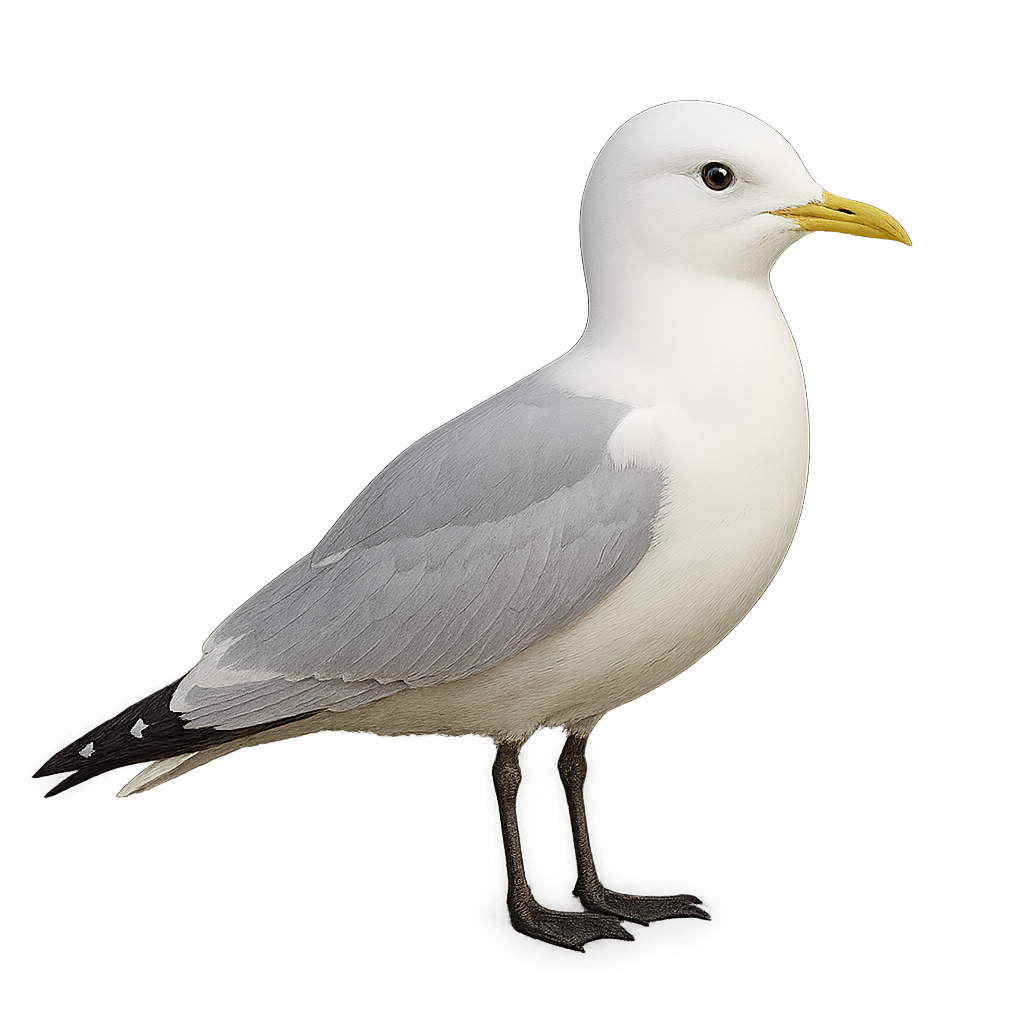
The Black-legged Kittiwake is a medium-sized gull, measuring about 40 to 45 cm in length, with a wingspan of 90 to 110 cm. It is easily recognizable by its white plumage with light gray wings and a black head during the breeding season. What particularly distinguishes this gull is the shape of its tail, which is deeply forked, hence its name "tridactyla." It primarily inhabits coastal regions of the North Atlantic, notably in rocky areas, cliffs, and subarctic islands. The Black-legged Kittiwake feeds mainly on fish, crustaceans, and marine insects. It is often seen flying over the water in search of food or resting on rocks. Although the population of this species is stable, it may be threatened by human disturbances, particularly the disruption of breeding colonies and marine pollution.
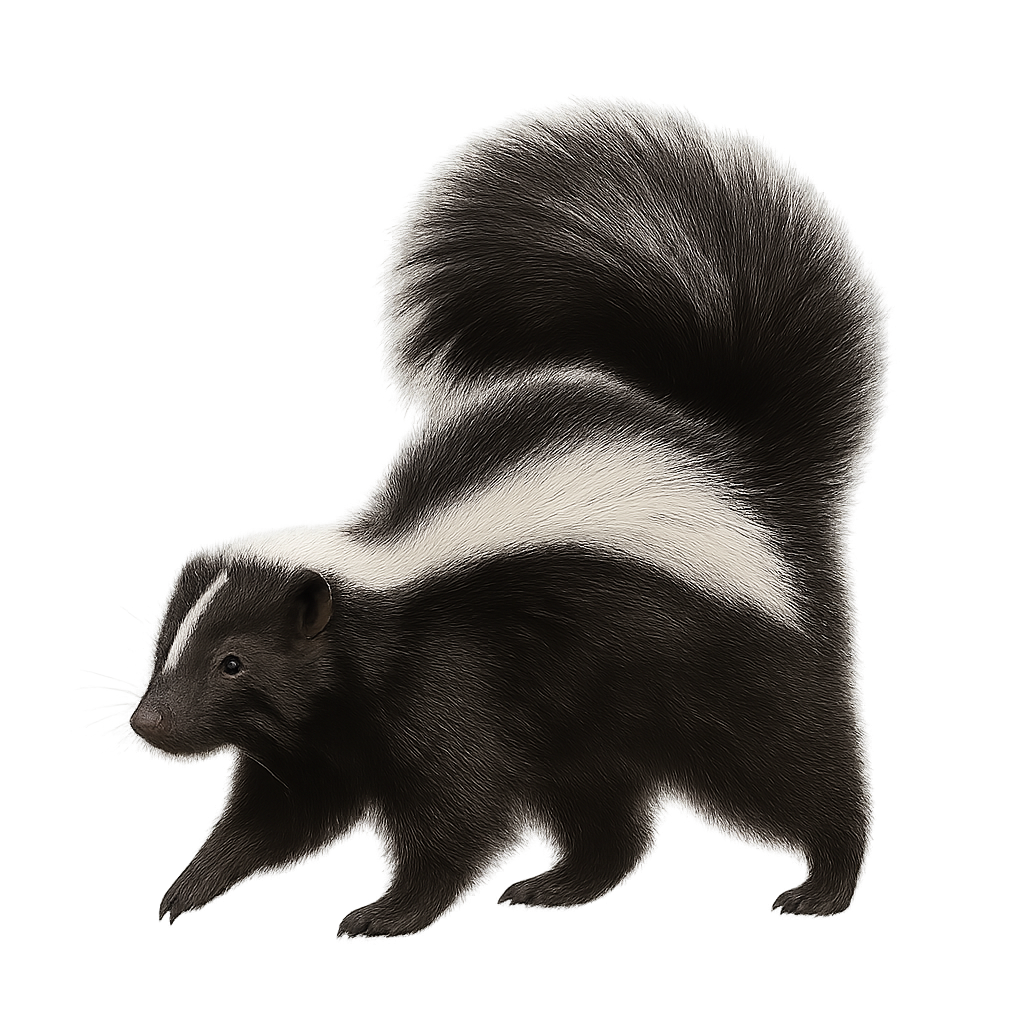
The striped skunk, or Mephitis mephitis, is a mammal renowned for its ability to spray a foul-smelling liquid when threatened. It features a black coat with two distinct white stripes running down its back. Primarily nocturnal, it feeds on insects, small mammals, fruits, and plants. It inhabits various environments, from forests to urban areas. Although often seen as a pest, it plays a crucial ecological role in controlling insect and rodent populations. The striped skunk is generally solitary, except during the breeding season.
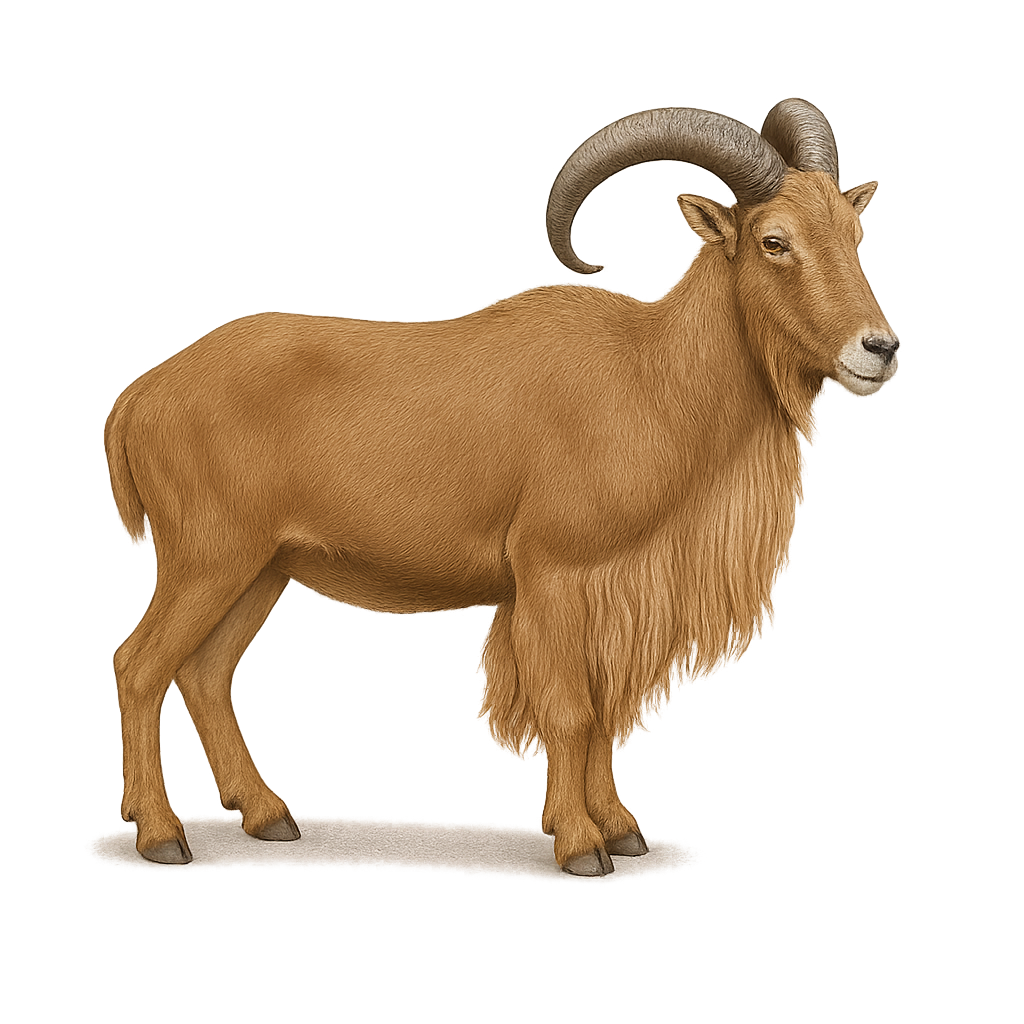
The Barbary sheep, or Ammotragus lervia, is a robust caprid native to the mountains of North Africa. It is characterized by a mane of long hair that runs down its neck and forelegs. Its coat is typically tawny, allowing it to blend into the arid, rocky landscapes it inhabits. Adapted to desert environments, it can survive with minimal water, extracting necessary moisture from its food. Males have large, backward-curving horns used in dominance battles. The Barbary sheep lives in small groups and primarily feeds on grasses, leaves, and shrubs.
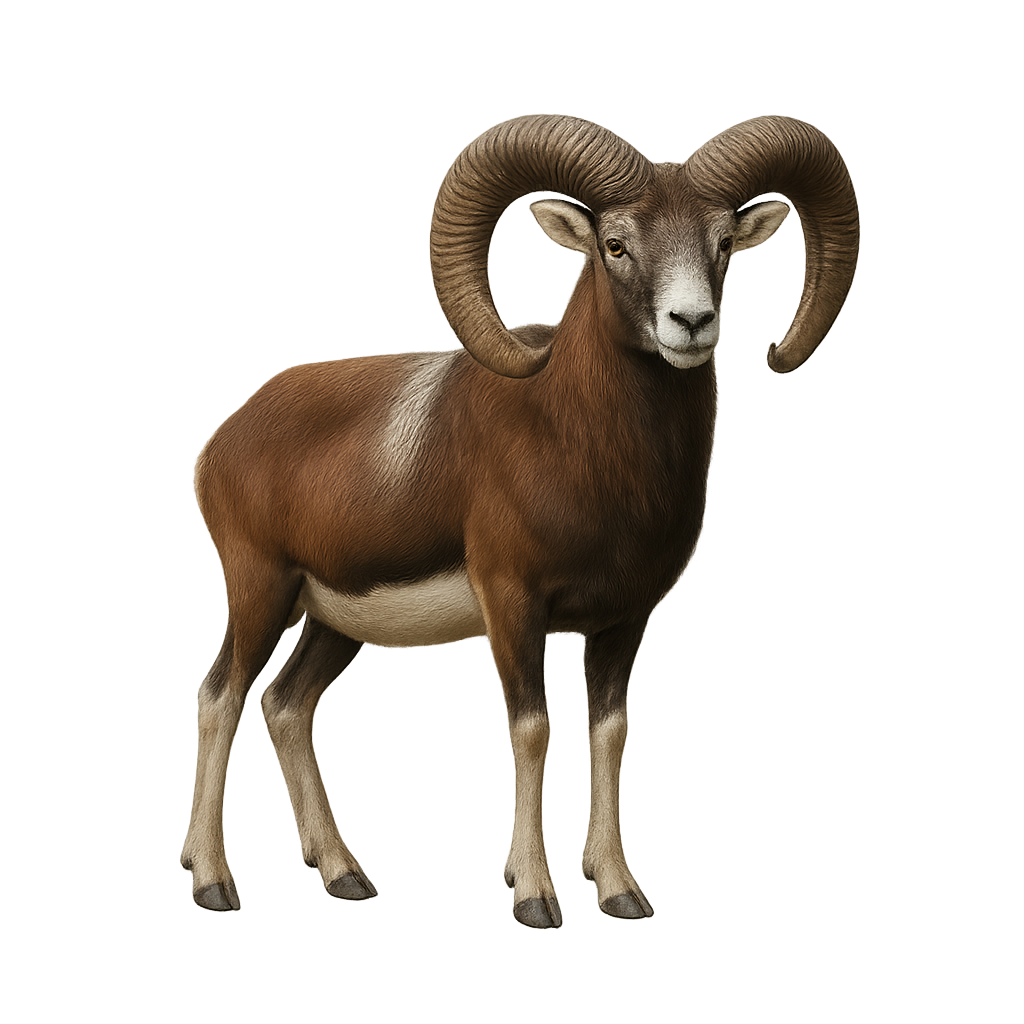
The Armenian Mouflon, Ovis orientalis gmelini, is a medium-sized mammal belonging to the Bovidae family. It is characterized by its spiral horns, more developed in males than in females. Its coat is generally brown with lighter shades on the belly and legs. This mouflon is mainly found in the mountainous regions of Armenia and Iran, where it adapts to rugged terrains and variable climatic conditions. It lives in herds, often separated by sex, and primarily feeds on grasses, herbs, and shrubs. The Armenian Mouflon plays an important ecological role as an herbivore, contributing to the regulation of vegetation in its natural habitat.
The bighorn sheep, or Ovis canadensis, is a mammal native to the mountainous regions of North America. Known for its large, spiraled horns, it primarily inhabits rocky terrains. Males, called rams, are particularly striking with horns that can weigh up to 30 pounds. Females, or ewes, have smaller, less curved horns. These animals live in herds and are well adapted to rugged landscapes thanks to their specialized hooves. Their coat ranges from light brown to gray, with a distinctive white patch on the rump. They primarily feed on grasses, plants, and shrubs.
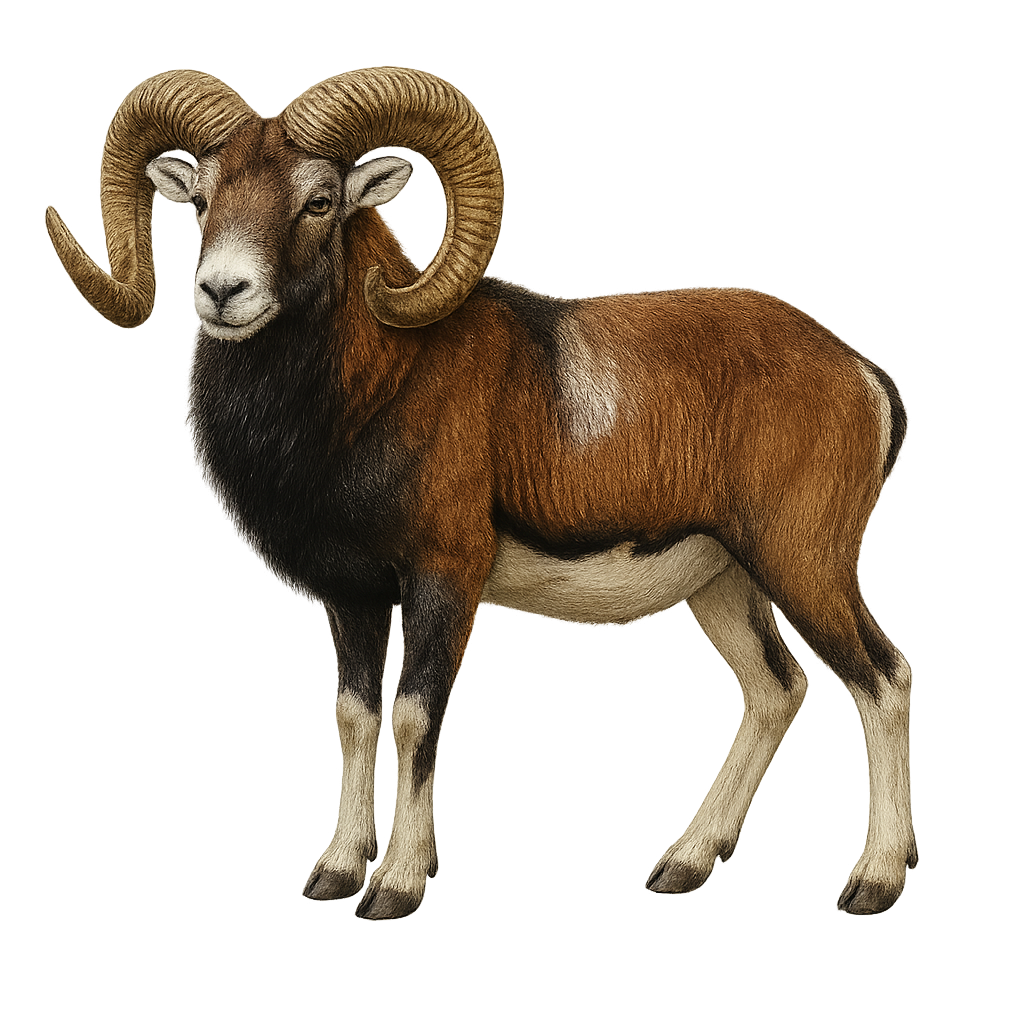
The Corsican Mouflon is a subspecies of the Mouflon, native to the island of Corsica, where it primarily inhabits mountains and rocky areas. It measures about 70 cm in height at the withers and weighs between 40 and 70 kg. What distinguishes the Corsican Mouflon are its horns, which are particularly large and spirally curved in males, while females have smaller horns. Its coat is generally reddish-brown with lighter shades on the belly and a darker mane along the back. The Corsican Mouflon is an agile animal and an excellent climber, capable of moving easily through the steep and rocky terrain of its natural habitat. It feeds primarily on grasses, shrubs, leaves, and roots. While its population remains relatively stable on the island, it faces threats related to habitat loss and hunting. These animals are solitary or live in small groups, primarily during the breeding season.
The Asian mouflon, or Ovis orientalis, is a mammal from the Bovidae family, native to the mountains of Western Asia. It is recognizable by its large, spiraled horns, especially prominent in males. Its coat ranges from brown to gray, with lighter shades on the belly and legs. Mouflons live in herds, often segregated by sex, and navigate rugged, rocky terrains. They are herbivores, primarily feeding on grasses and low-growing plants. Their social behavior is complex, with established hierarchies within groups. Males compete during the rutting season to assert dominance and gain access to females.
The snow sheep, or Ovis nivicola, is a robust mammal primarily inhabiting the mountainous regions of the Russian Far East. It is characterized by its thick, woolly coat, which is well-suited to the harsh climatic conditions of its habitat. Males have large, spiraled horns, while females have smaller ones. Their diet mainly consists of grasses, lichens, and mosses. These animals are well adapted to high altitudes, where they find refuge on rocky and steep slopes. Their behavior is generally suspicious, making them difficult to approach. They live in small groups, often consisting of females and young, while adult males may be solitary or form separate groups.
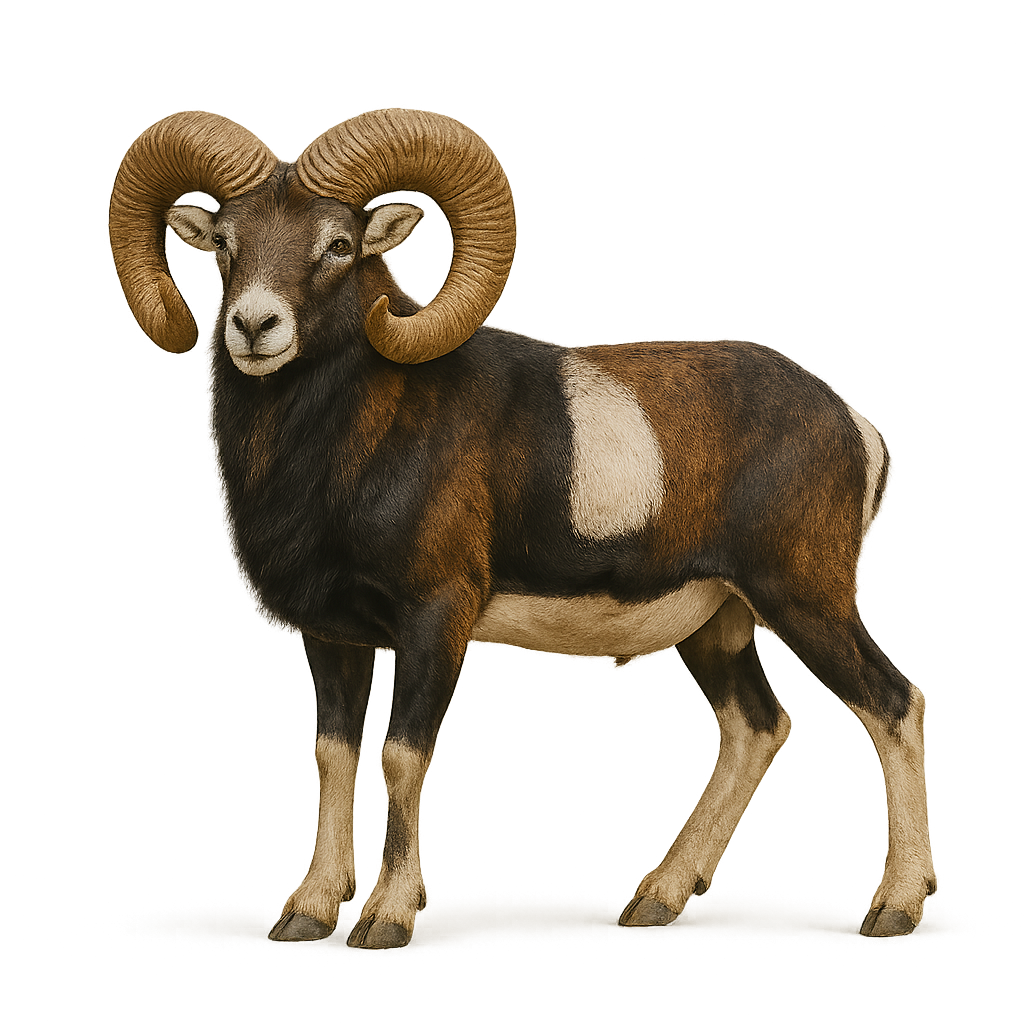
The Mouflon oriental is a small wild sheep found primarily in the mountains of Europe, the Middle East, and Central Asia. It measures between 70 and 80 cm in height at the withers and weighs between 40 and 80 kg, with males generally being larger and more imposing than females. What distinguishes the Mouflon oriental is the presence of large, curved horns in males, while females have smaller and less pronounced horns. Their coat is generally reddish-brown in the summer, with a white belly and a darker mane along the back, which becomes thicker and fuller in the winter. The Mouflon oriental primarily inhabits mountainous areas, forests, and meadows, where it feeds on grasses, leaves, shrubs, and roots. It is an excellent climber and moves easily across rocky and steep terrain. While its population remains stable, the Mouflon oriental may be threatened by habitat loss, hunting, and competition with domesticated livestock.
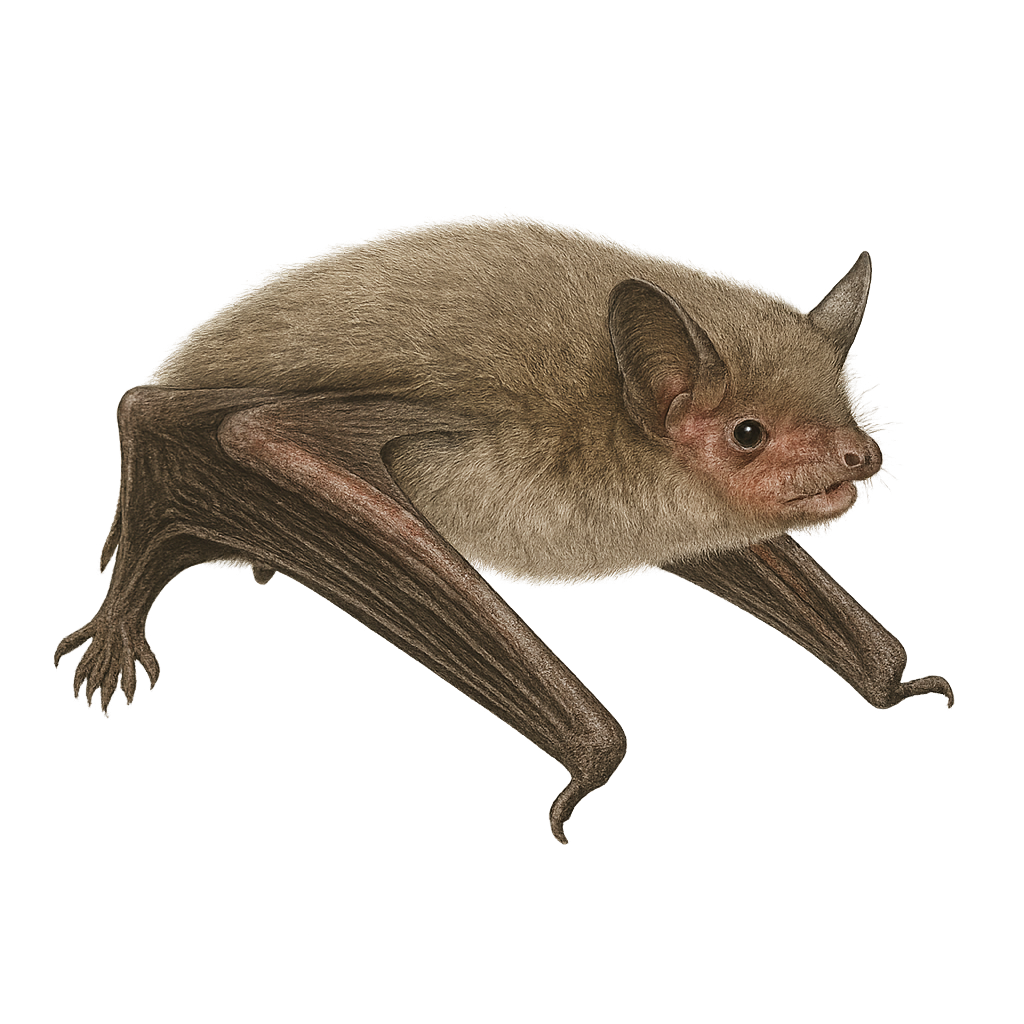
The Daubenton's bat is a medium-sized bat, easily recognizable by its brown-grey fur on the back and lighter on the belly. Its ears are short and rounded, and its wings are long and narrow, adapted for fast and agile flight. This species is often seen flying low over water bodies, where it primarily hunts aquatic insects. It uses echolocation to navigate and locate its prey. The Daubenton's bat is a nocturnal animal, spending its days in shelters such as tree cavities, buildings, or bridges. It is widely distributed in Europe and Asia, preferring habitats near water.
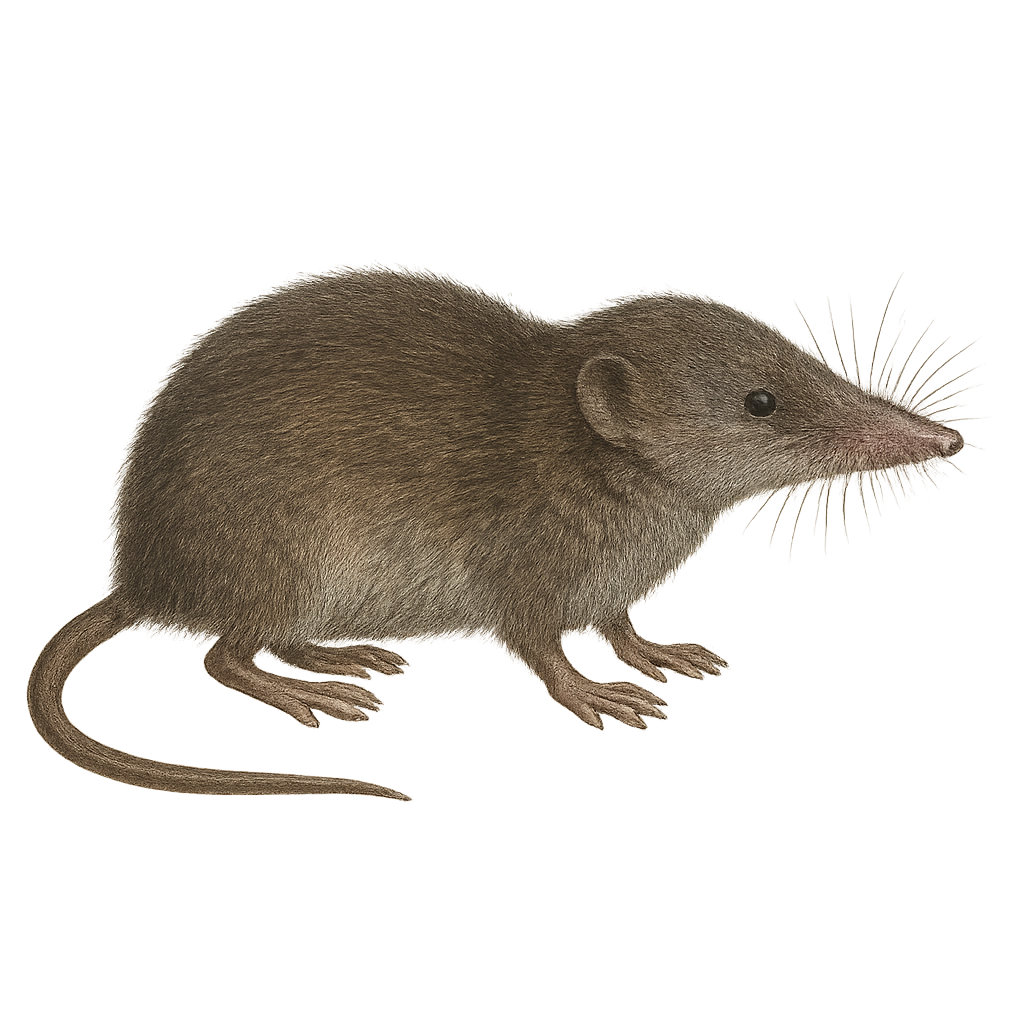
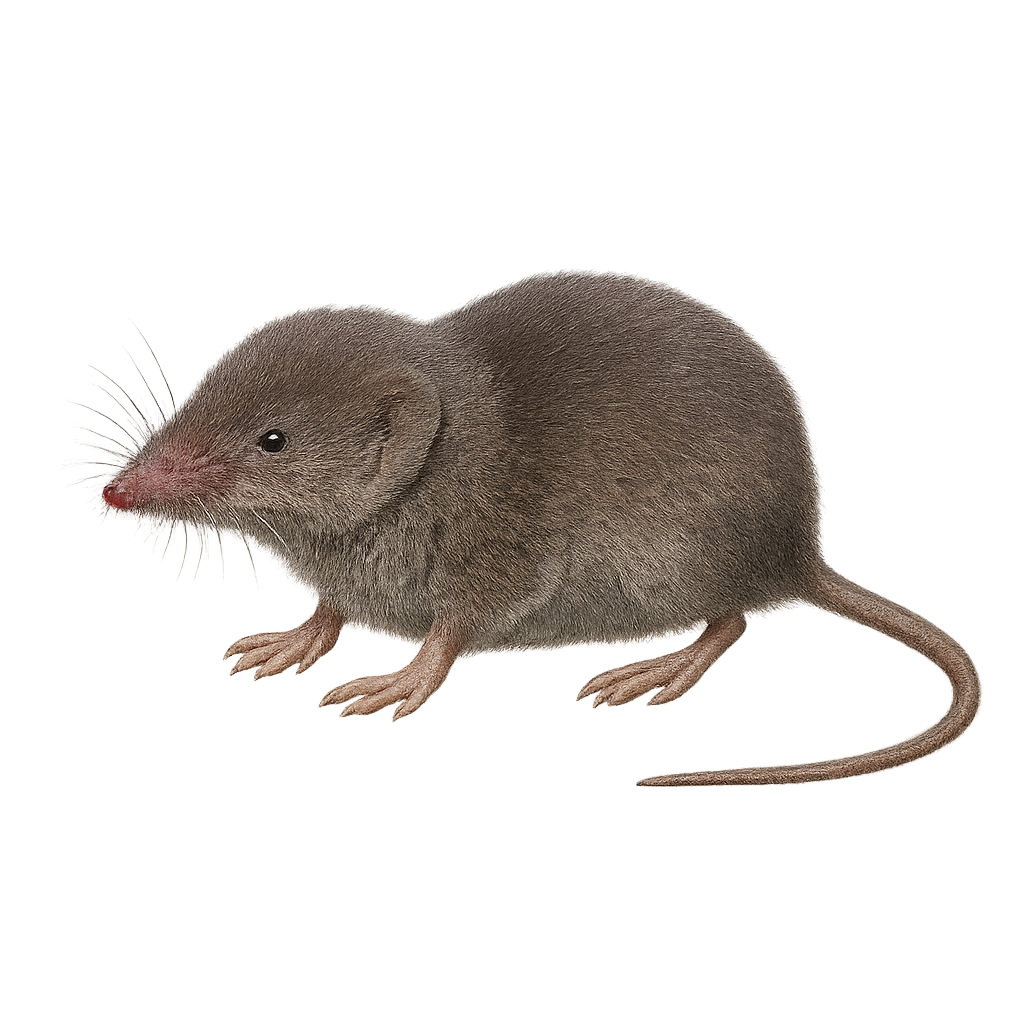
The common shrew, or Sorex araneus, is a small insectivorous mammal found primarily in Europe. It measures about 5 to 8 cm in length, excluding its tail, which adds an additional 3 to 5 cm. Its fur is typically dark brown on the back and lighter on the belly, allowing it to blend into its natural surroundings. It has a pointed snout and characteristic red-tipped teeth. The common shrew is a very active animal, spending most of its time foraging for food, mainly insects, spiders, and worms. It has a very fast metabolism, meaning it needs to eat frequently to survive.
The crowned shrew, Sorex coronatus, is a small insectivorous mammal found mainly in Central Europe. It measures about 5 to 8 cm in length, with a tail of about 4 to 5 cm. Its fur is brown on the back and lighter on the belly. It is distinguished by its elongated head and pointed snout, typical of shrews. It inhabits various environments, including forests, meadows, and wetlands. It primarily feeds on insects, larvae, and small invertebrates. Although active year-round, it is particularly active at night. The crowned shrew plays an important role in the ecosystem by regulating insect populations.
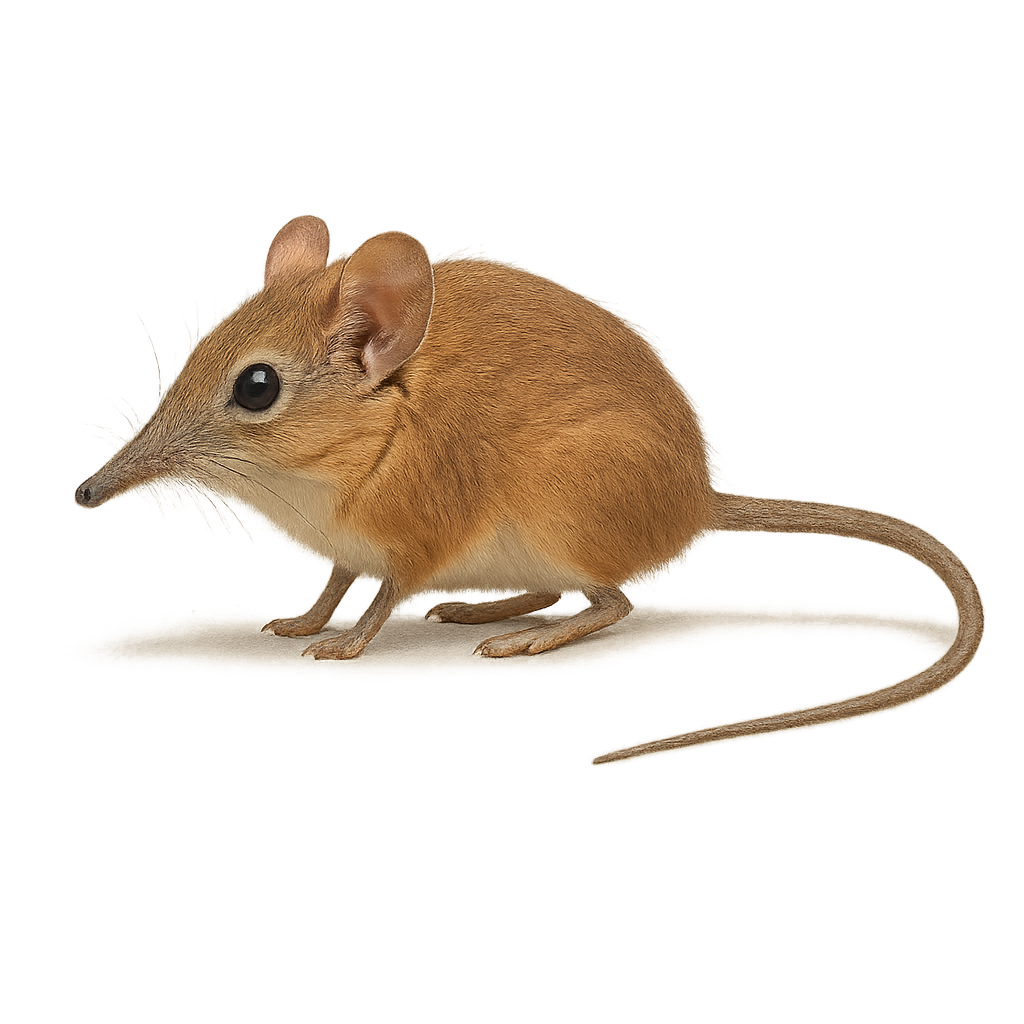
Elephantulus rufescens is a small insectivorous mammal endemic to East Africa, measuring 10–15 cm with reddish fur and a distinctive elongated snout. It inhabits dry savannas, scrub, and forest edges, feeding on ants and small invertebrates using its long hind legs and sensitive muzzle.
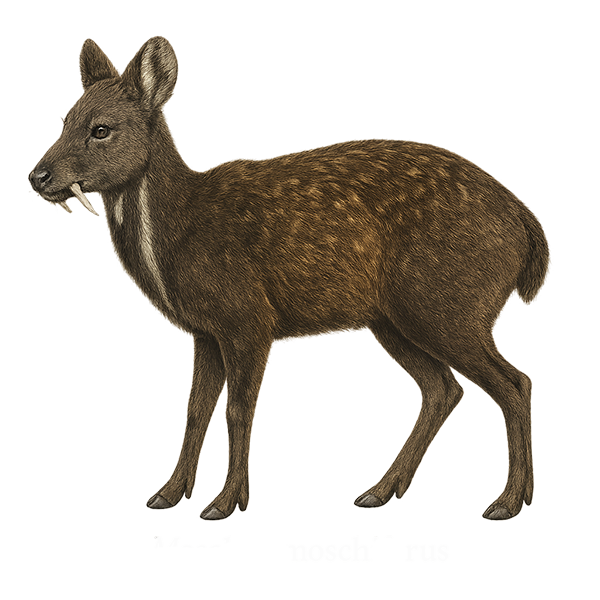
The Siberian Musk Deer, scientifically known as Moschus moschiferus, is a small deer species notable for its lack of antlers and the presence of long canine teeth in males. These animals are primarily nocturnal and inhabit the coniferous forests and mountainous regions of Northern Asia, particularly in Russia, Mongolia, and China. Their thick, brown fur provides excellent camouflage in their natural habitat. Male musk deer produce a fragrant substance, musk, which has been used in perfumery for centuries. Although their population is declining due to hunting for musk and habitat loss, they remain a fascinating and iconic species of the Siberian forests.
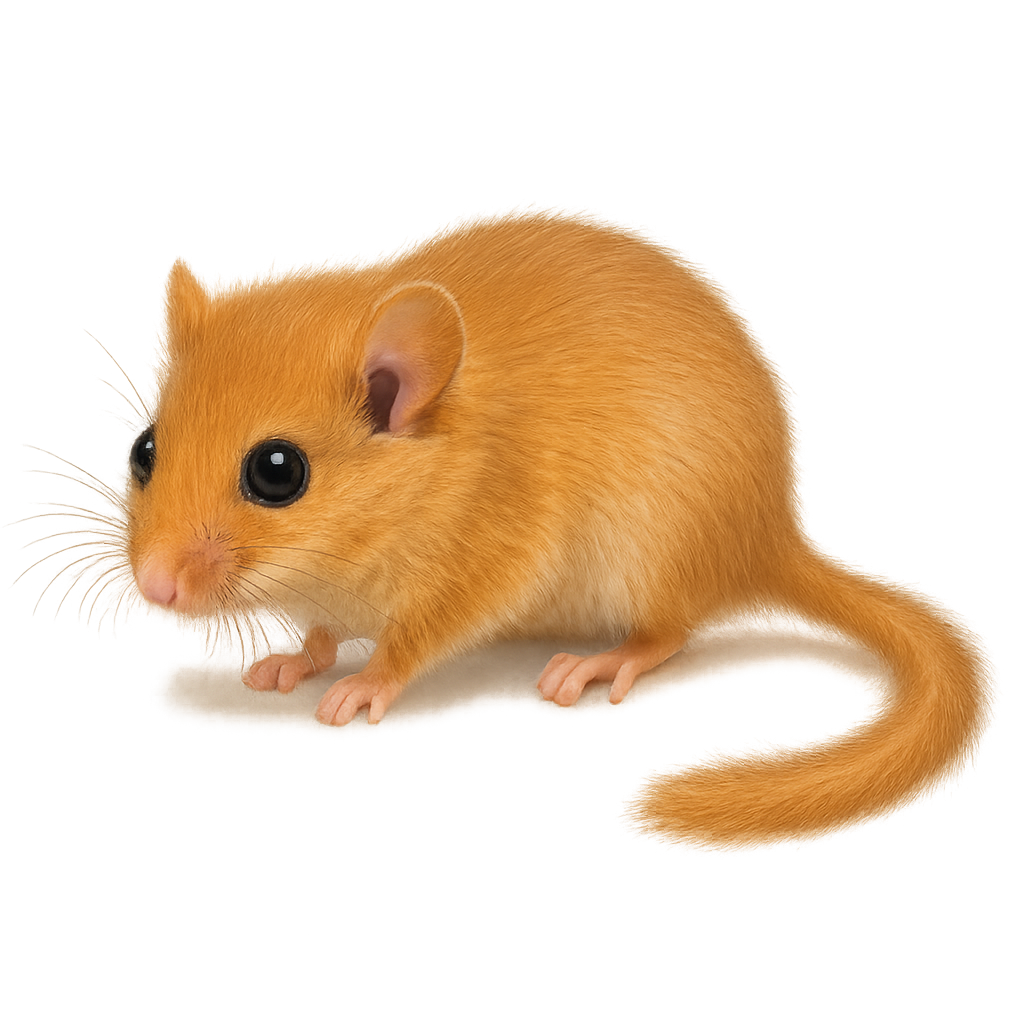
The Common Dormouse is a small nocturnal rodent, often compared to a miniature squirrel, found mainly in forests, hedgerows, and gardens across Europe. It measures about 7 to 9 cm in length, with a tail of 5 to 7 cm, and weighs between 15 and 30 g. Its coat is typically brown or gray with a light belly, and it has large black eyes and round ears. The Common Dormouse is an arboreal and nocturnal animal that primarily feeds on fruits, seeds, nuts, and sometimes insects. It is an excellent climber, often living in trees or natural cavities. This small rodent is known for its hibernation behavior: it enters torpor during the winter months, retreating into its nest to survive the cold temperatures. Although it is widespread, it is threatened by habitat loss and human disturbances.
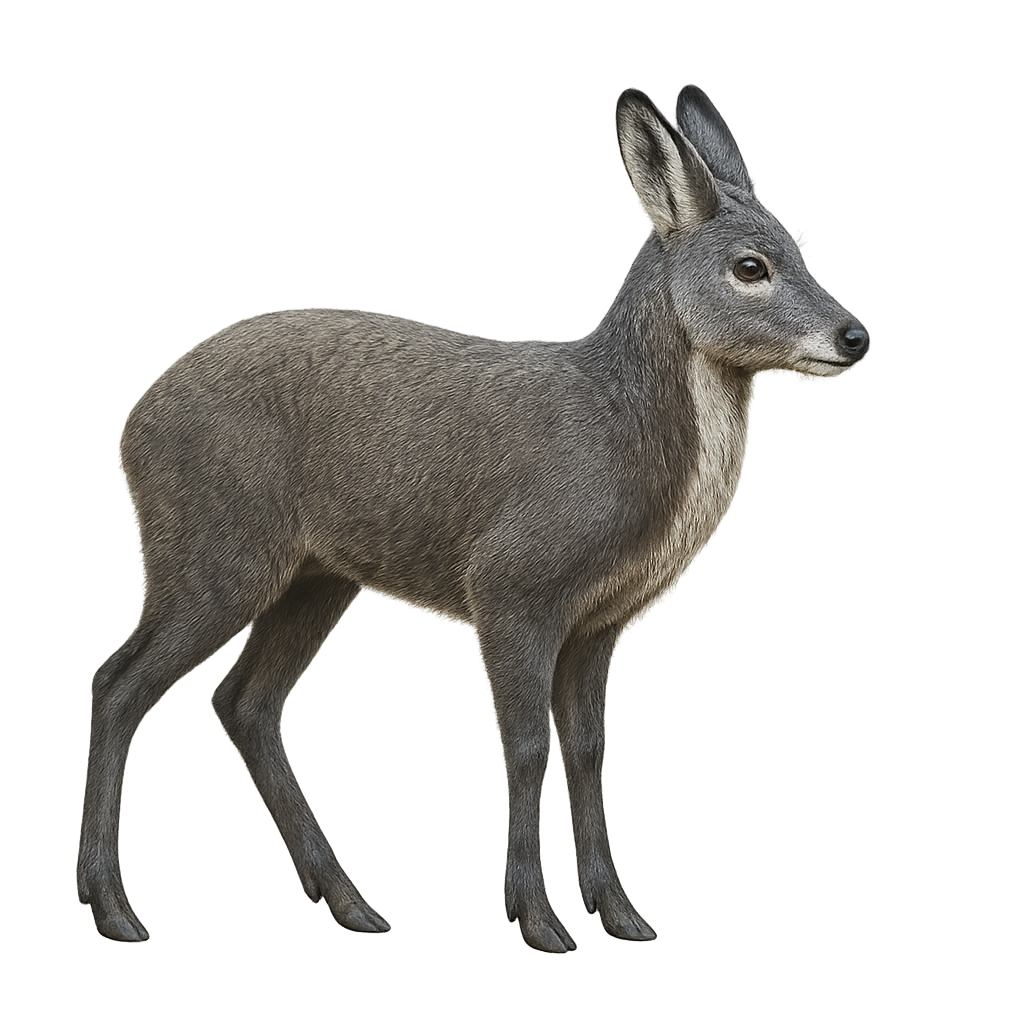
The forest musk deer, or Moschus berezovskii, is a small deer native to the mountainous forests of China and Vietnam. This mammal is particularly known for its musk gland, used in perfumery. It is characterized by its small size, long slender legs, and prominent canines in males. Its thick brown fur allows it to camouflage effectively in its natural habitat. Primarily nocturnal, it feeds on leaves, grasses, and lichens. Although discreet, it plays a crucial role in its ecosystem by participating in seed dispersal. Unfortunately, it is threatened by illegal hunting and habitat destruction, leading to a decline in its population.
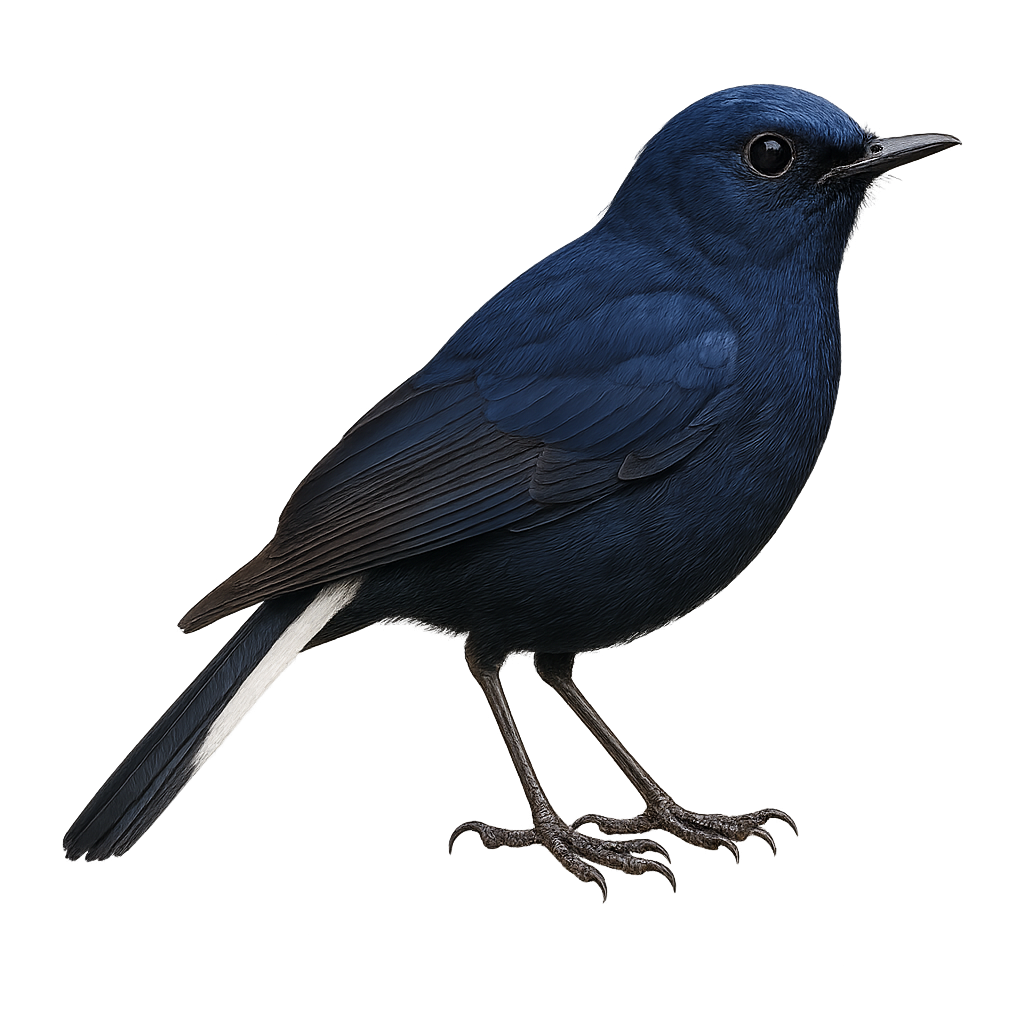
The White-tailed Robin is a captivating bird, known for its striking appearance and intriguing behavior. It features a glossy blue-black plumage with a distinctive white tail, making it easily recognizable. This bird prefers dense, humid forests, often situated at higher altitudes. It is primarily insectivorous but can also feed on small fruits. The White-tailed Robin is a rather discreet bird, often seen alone or in pairs. It is known for its melodious song that echoes through the undergrowth. Although it is relatively tolerant of human presence, it remains cautious and prefers to keep its distance.
The Red Myzomela, or Myzomela eques, is a small bird with striking bright red plumage, accented by black on its wings and tail. This nectarivore is often found in tropical rainforests, mangroves, and flower gardens, feeding primarily on nectar but also on insects. Its slender, curved beak is perfectly adapted to reach the nectar of flowers. Known for its melodious song and agile movements among branches, it is generally solitary but can sometimes be seen in small groups, especially during the breeding season. Its adaptability to various habitats makes it a resilient species in the face of environmental changes.