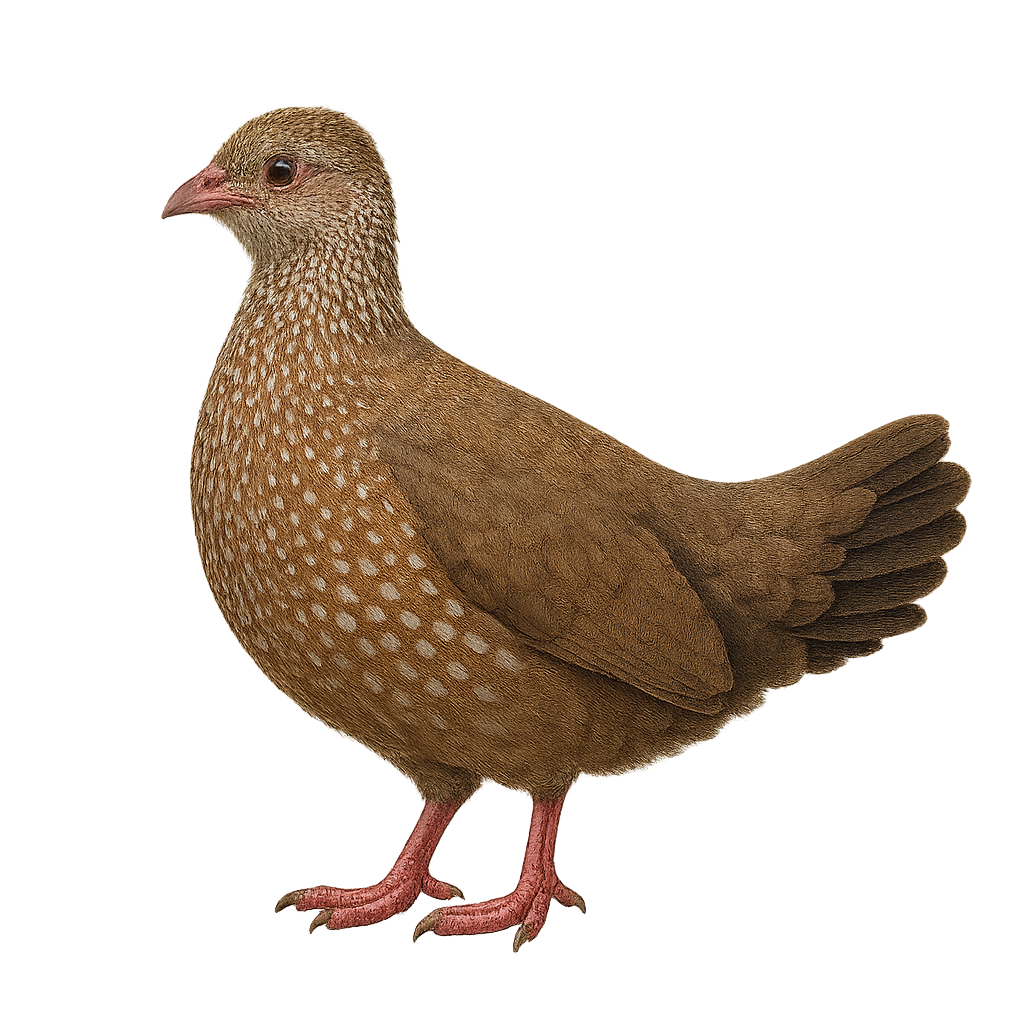
The Stone Partridge, scientifically known as Ptilopachus petrosus, is a medium-sized terrestrial bird belonging to the Odontophoridae family. It is primarily found in rocky regions and open savannas of West and Central Africa. This bird is recognizable by its speckled brown plumage, which provides effective camouflage in its natural habitat. The Stone Partridge is a social bird, often seen in small groups. It primarily feeds on seeds, insects, and small invertebrates. Although capable of flight, it prefers to run to escape predators. Its breeding season varies by region but is generally influenced by the rainy season.
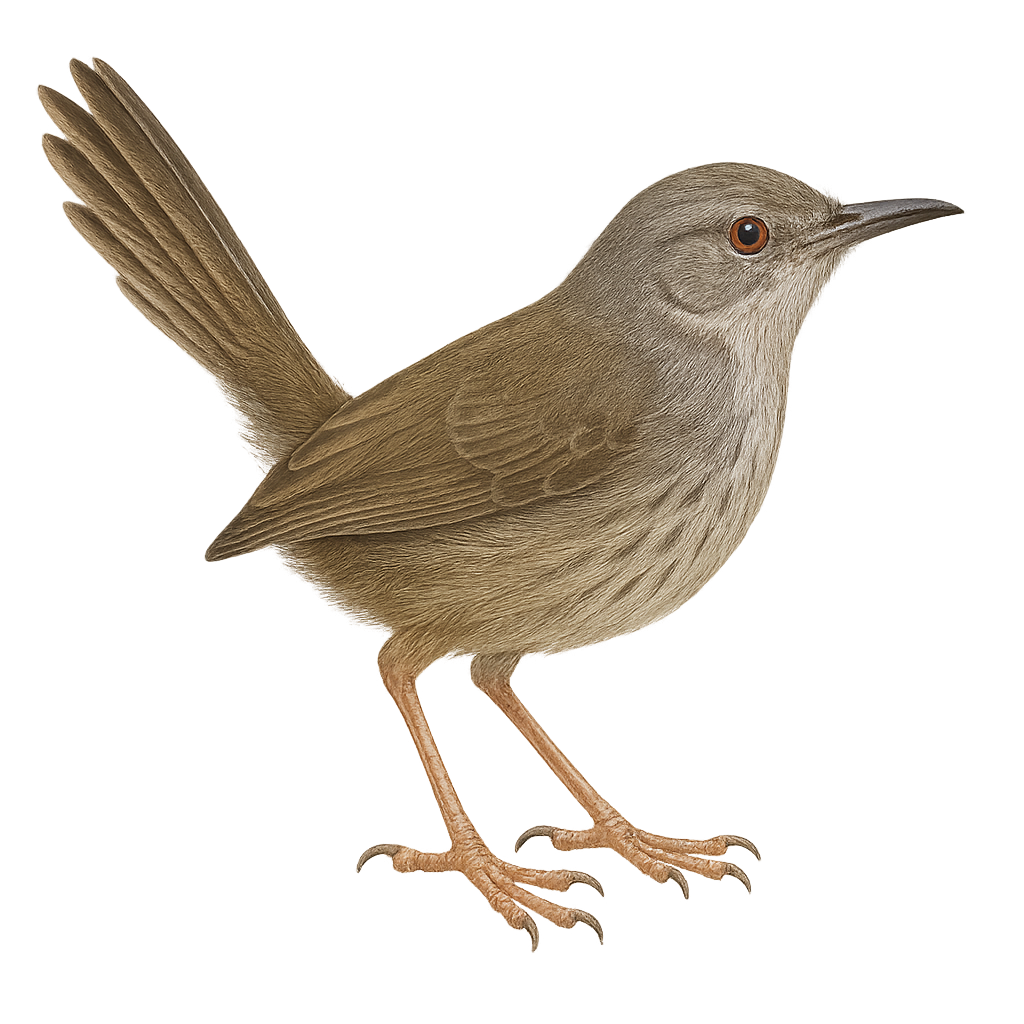
The Rufescent Prinia is a small passerine bird belonging to the Cisticolidae family. It is mainly found in the tropical and subtropical regions of Southeast Asia. Its plumage is generally brown with rufous shades on the throat, giving it its name. It measures about 13 to 14 cm in length and weighs between 6 and 10 grams. This bird is often seen in dense bushes, grasslands, and wetlands, where it primarily feeds on insects. The Rufescent Prinia is known for its melodious and repetitive song, often heard at dawn and dusk. It is a sociable bird, living in small groups and building ball-shaped nests in shrubs.
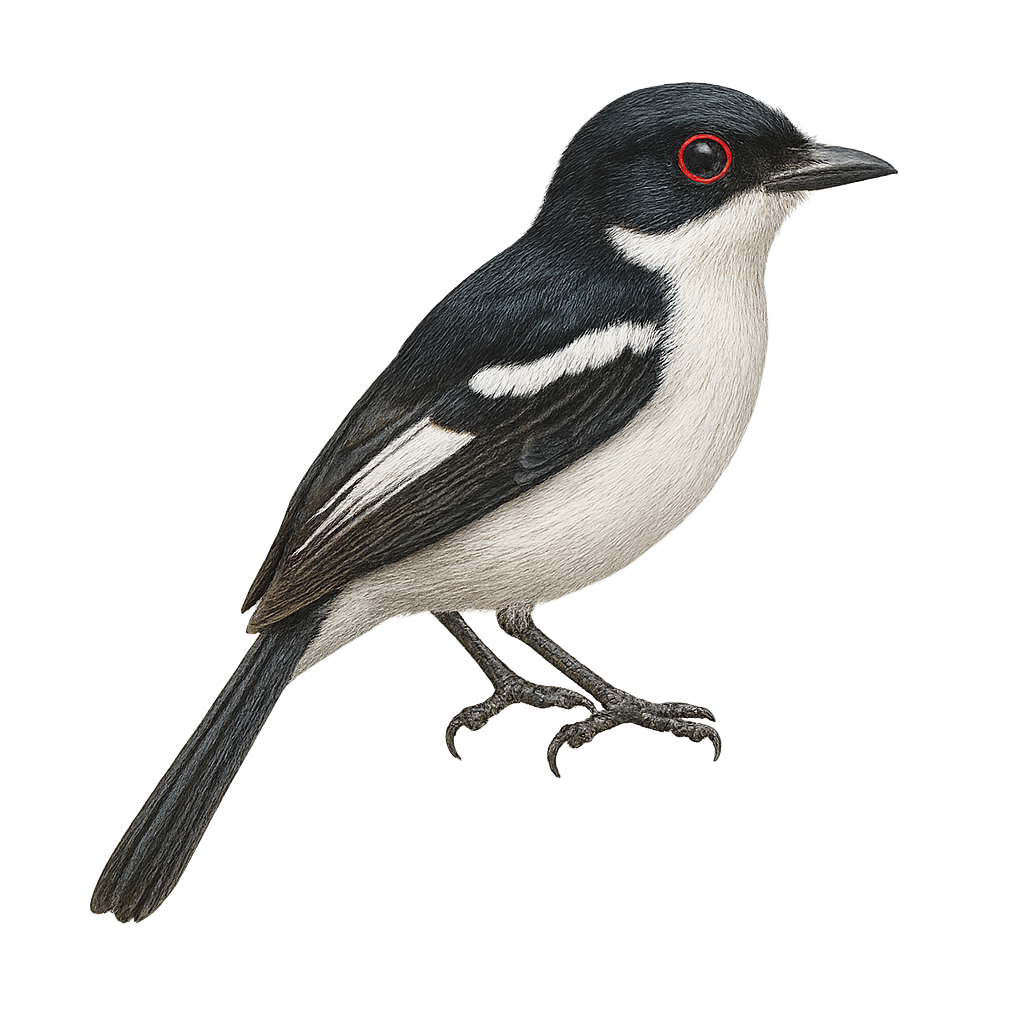
The Black-throated Wattle-eye, or Platysteira cyanea, is a small African bird with distinctive plumage. It features a black head contrasting with a white chest and gray back. Its eyes are surrounded by a reddish bare skin, adding to its unique appearance. This bird is primarily insectivorous, feeding on small insects caught in flight or on branches. It inhabits tropical forests and wooded savannas of sub-Saharan Africa, preferring dense areas where it can hide from predators. Known for its melodious songs, often heard at dawn and dusk, the Black-throated Wattle-eye is relatively common in its habitat but remains elusive and hard to spot.
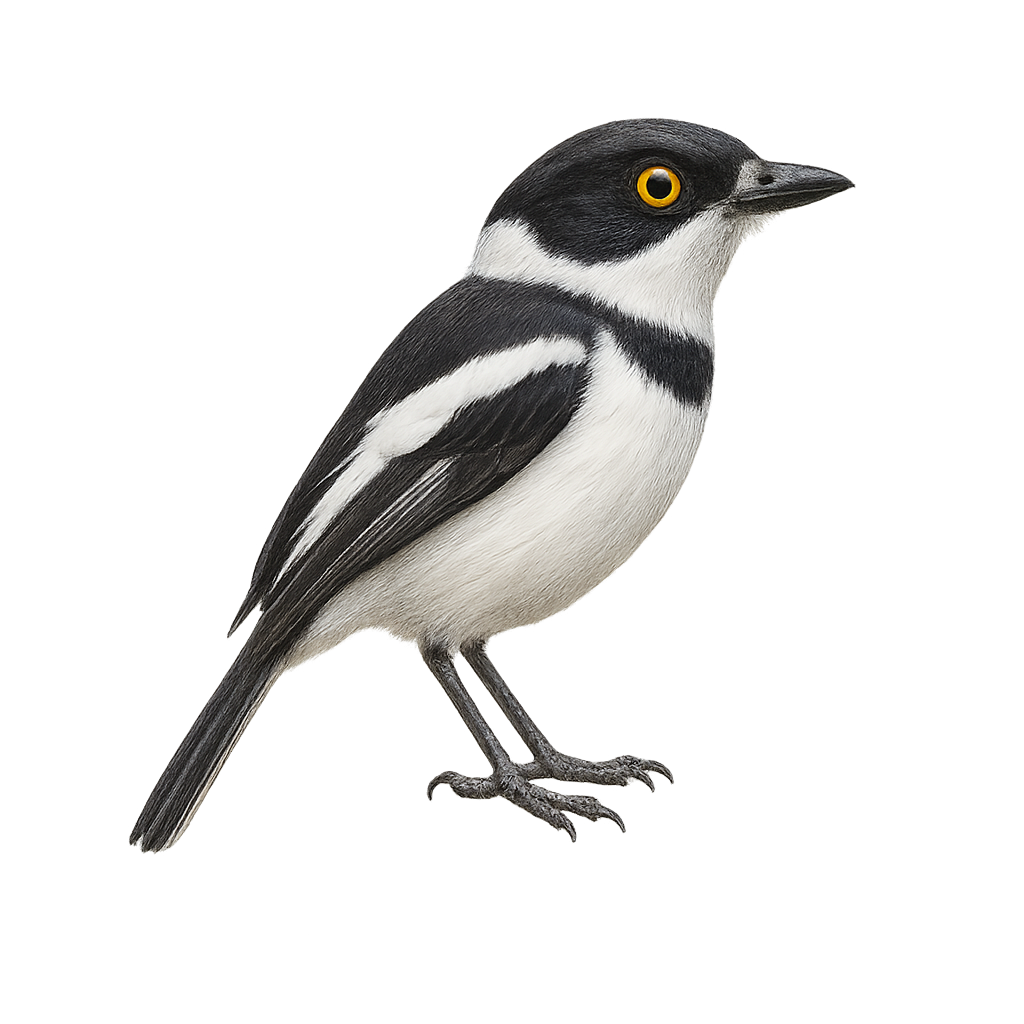
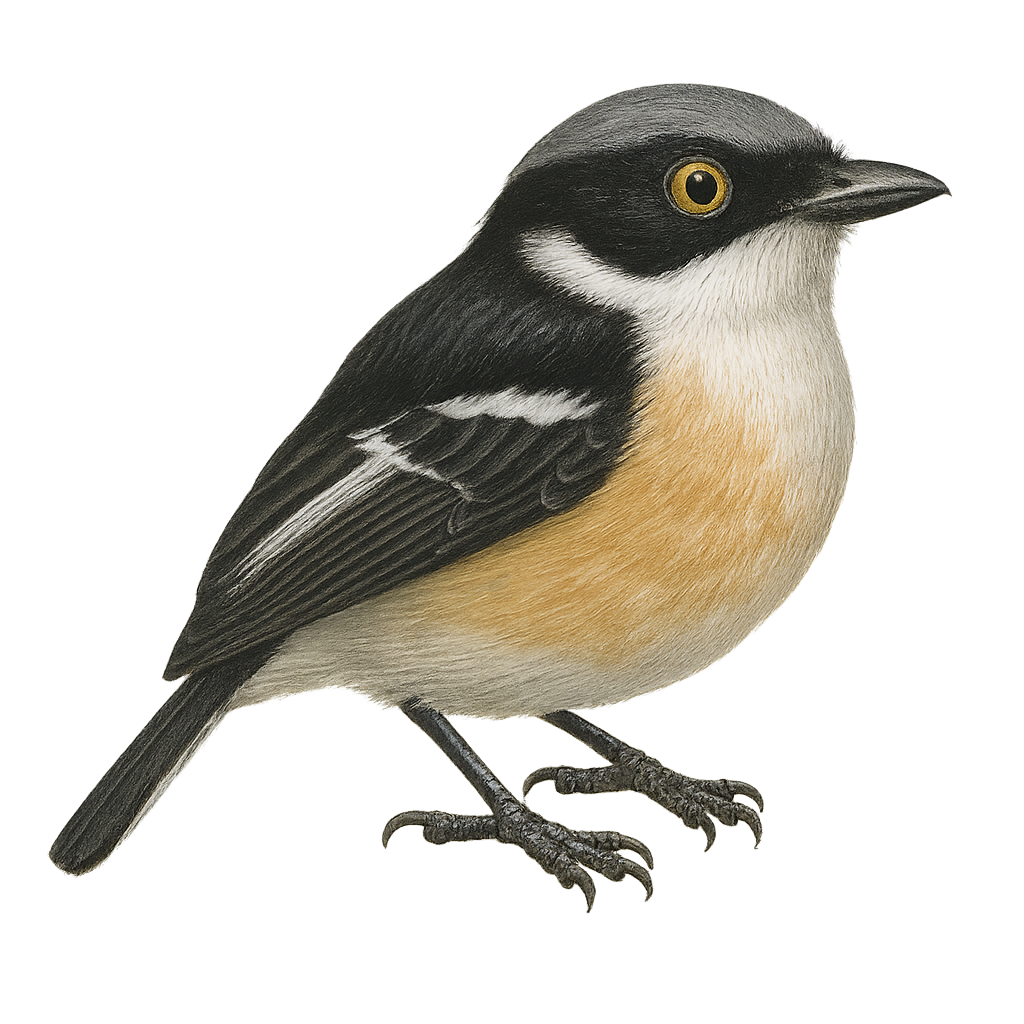
The Chinspot Batis is a small passerine bird belonging to the Platysteiridae family. It is primarily found in wooded areas and savannas of sub-Saharan Africa. This bird is characterized by its black back contrasting with its white belly and grey flanks. Males display a black breast band, while females have a browner band. They are often seen in pairs or small groups, feeding on insects caught in flight or on foliage. Their song is a soft whistle, often repeated. Although their habitat is relatively stable, they can be affected by deforestation.
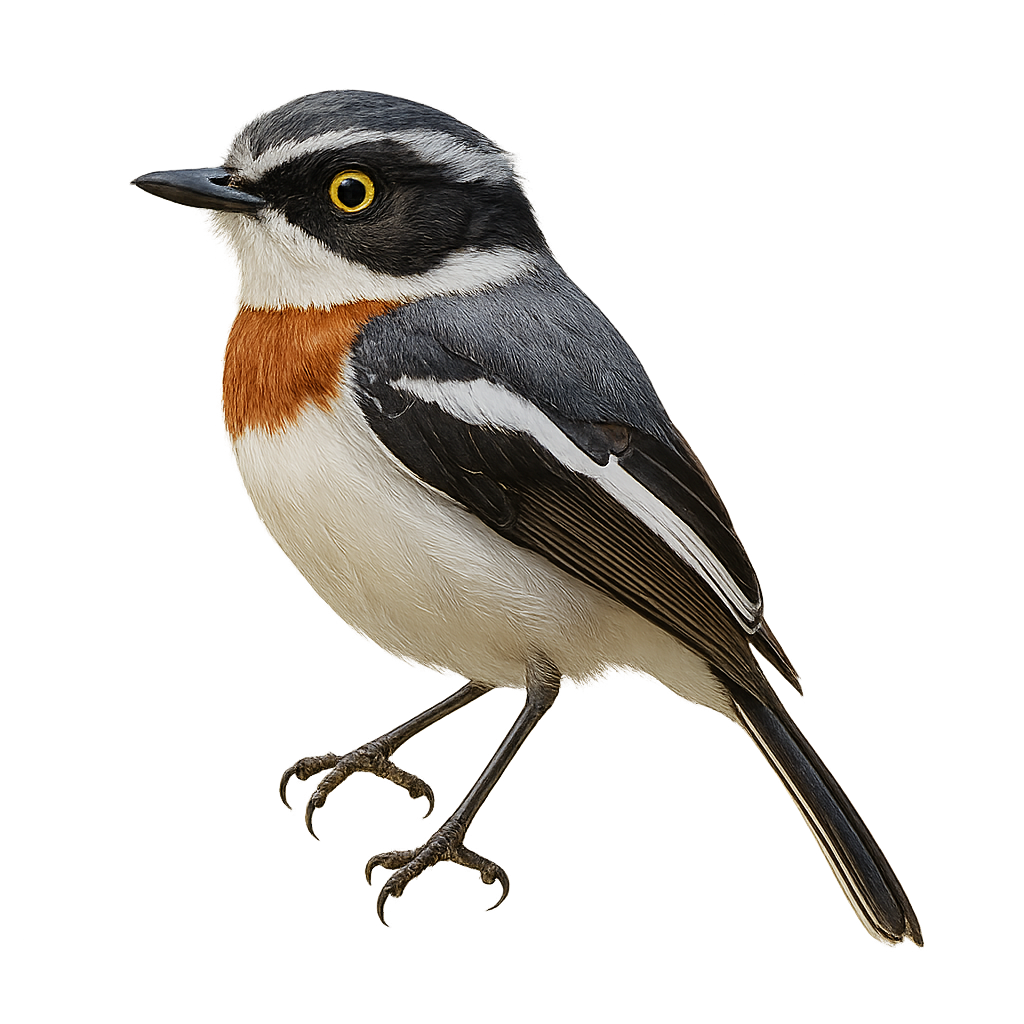
The Brother's Batis is a small passerine bird belonging to the Platysteiridae family. It is mainly found in the forests and wooded savannas of East Africa, particularly in Tanzania and Kenya. This bird is characterized by its striking black and white plumage, with a distinctive black breast band. Males and females exhibit sexual dimorphism, with females having browner tones. The Brother's Batis is an active insectivore, often seen catching insects in flight or searching for them on branches. Its song plays a crucial role in territorial and courtship behaviors.
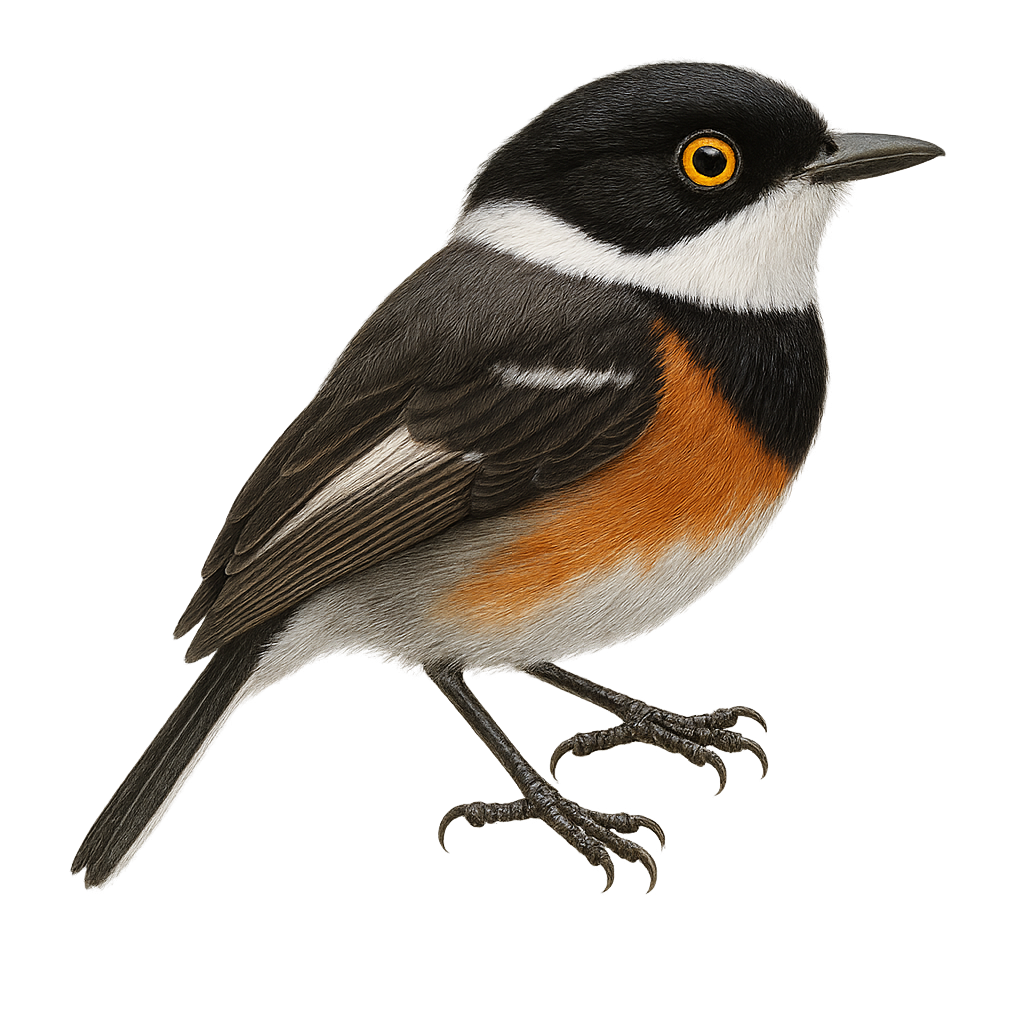
The Cape Batis is a small passerine bird native to southern Africa. It is noted for its colorful plumage, featuring a black head, white belly, and a bright orange breast band. Males and females exhibit sexual dimorphism, with females having slightly duller colors. This bird is often found in forests, thickets, and gardens, where it primarily feeds on insects. Known for its melodious songs and territorial behavior, the Cape Batis is a sedentary bird, although it may undertake minor altitudinal migrations depending on the season. Its population is stable, and it is not currently threatened.
The Chinspot Batis is a small passerine bird found mainly in sub-Saharan Africa. It is easily recognizable by its distinctive plumage, featuring a black band across the chest and a contrasting white chin. Males and females show subtle differences in coloration, with males generally having brighter colors. These birds are often seen in pairs or small groups, actively moving through bushes and trees in search of insects. They are known for their melodious and repetitive song, which plays a crucial role in territory defense and mate attraction.
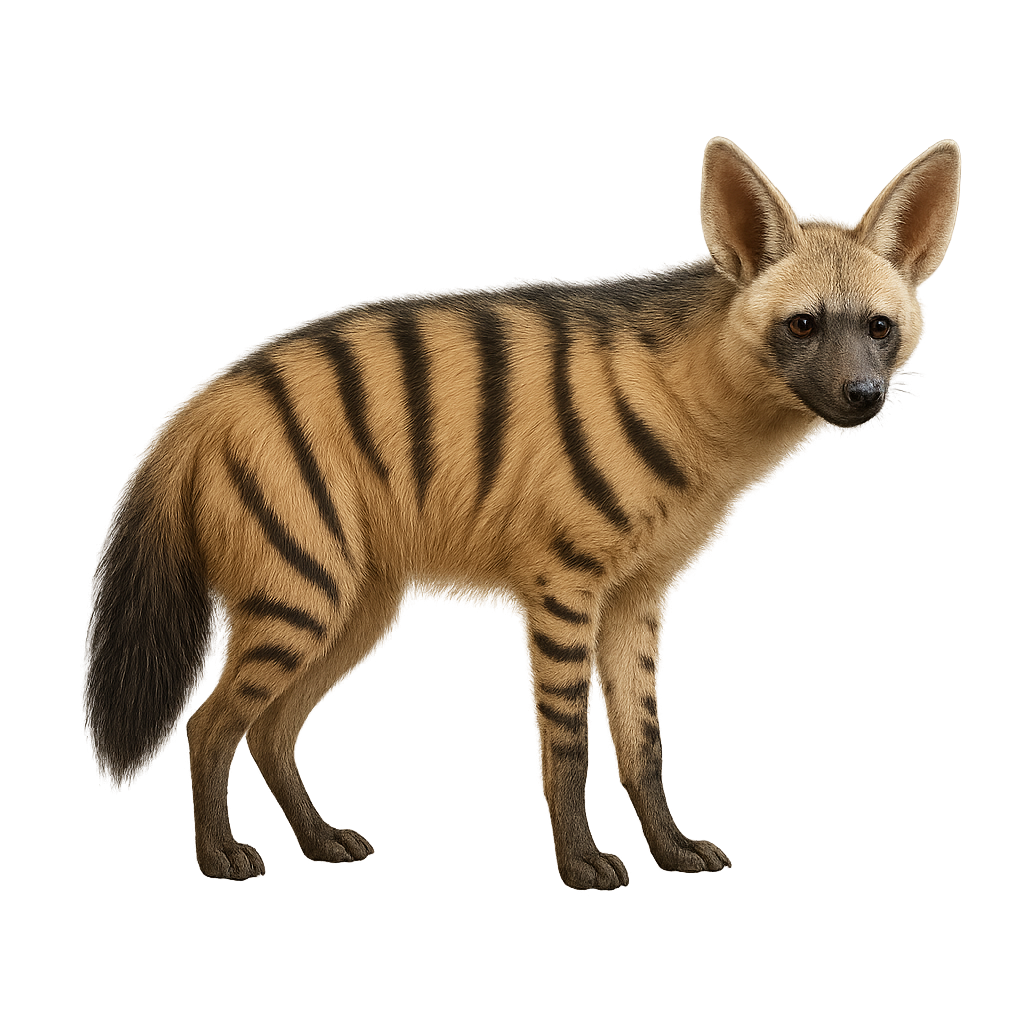
The aardwolf, or Proteles cristata, is an insectivorous mammal belonging to the Hyaenidae family, although it differs from hyenas by its diet, which mainly consists of termites. It is recognizable by its striped coat, erect mane, and slender build. Aardwolves are primarily nocturnal, allowing them to avoid the daytime heat in the arid and semi-arid regions of East and Southern Africa where they reside. They dig burrows to rest and protect themselves from predators. Although solitary, they can be observed in small family groups. Their ability to digest termites is aided by a long, sticky tongue.
The Striped hyena is a terrestrial carnivore native to North Africa and the Middle East. It is distinguished by the characteristic stripes on its back and its somewhat awkward gait. This nocturnal predator primarily feeds on carrion, small mammals, and insects. Unlike other hyenas, the Striped hyena is more solitary and less aggressive. Although relatively discreet, it is threatened by habitat destruction and human persecution.
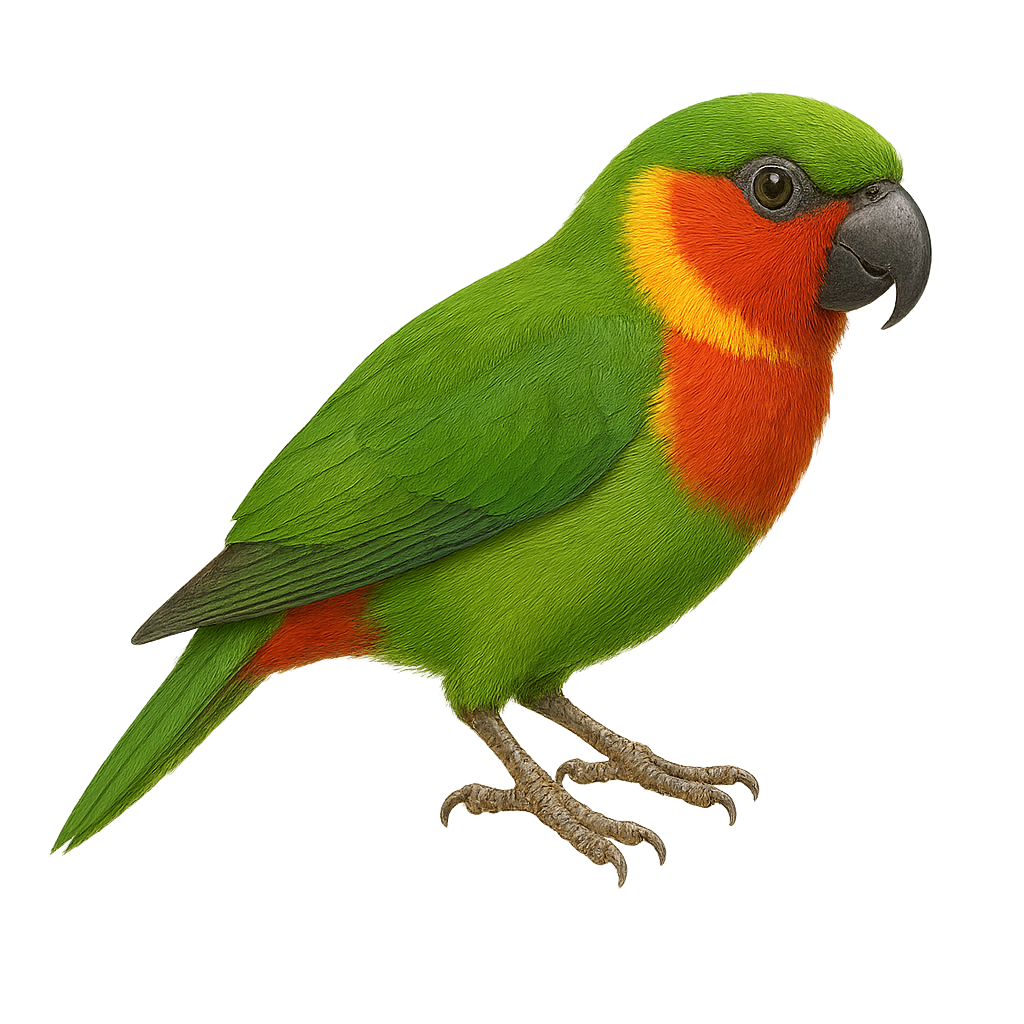
The Edwards's Fig Parrot is a medium-sized parrot species endemic to New Guinea. It is characterized by its bright green plumage, with shades of blue and red around the head and neck. This parrot primarily inhabits tropical rainforests, where it feeds on fruits, seeds, and flowers. It is often seen in small groups or pairs, moving nimbly among the branches. Although its habitat is relatively stable, it is sometimes threatened by deforestation. Its song is melodious, consisting of whistles and chirps.
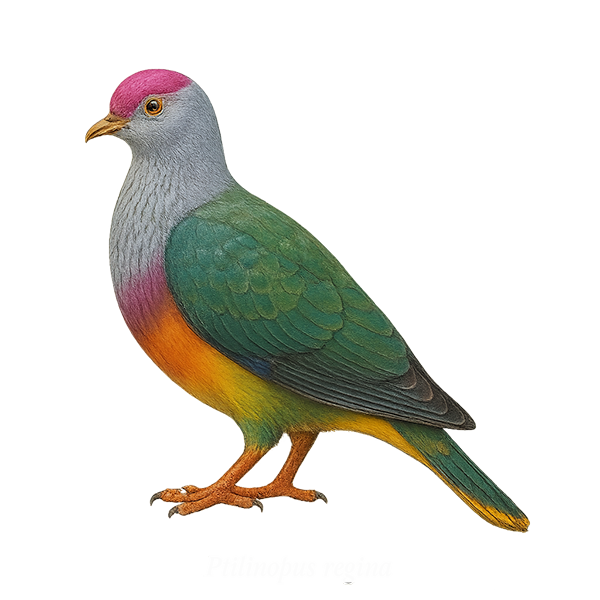
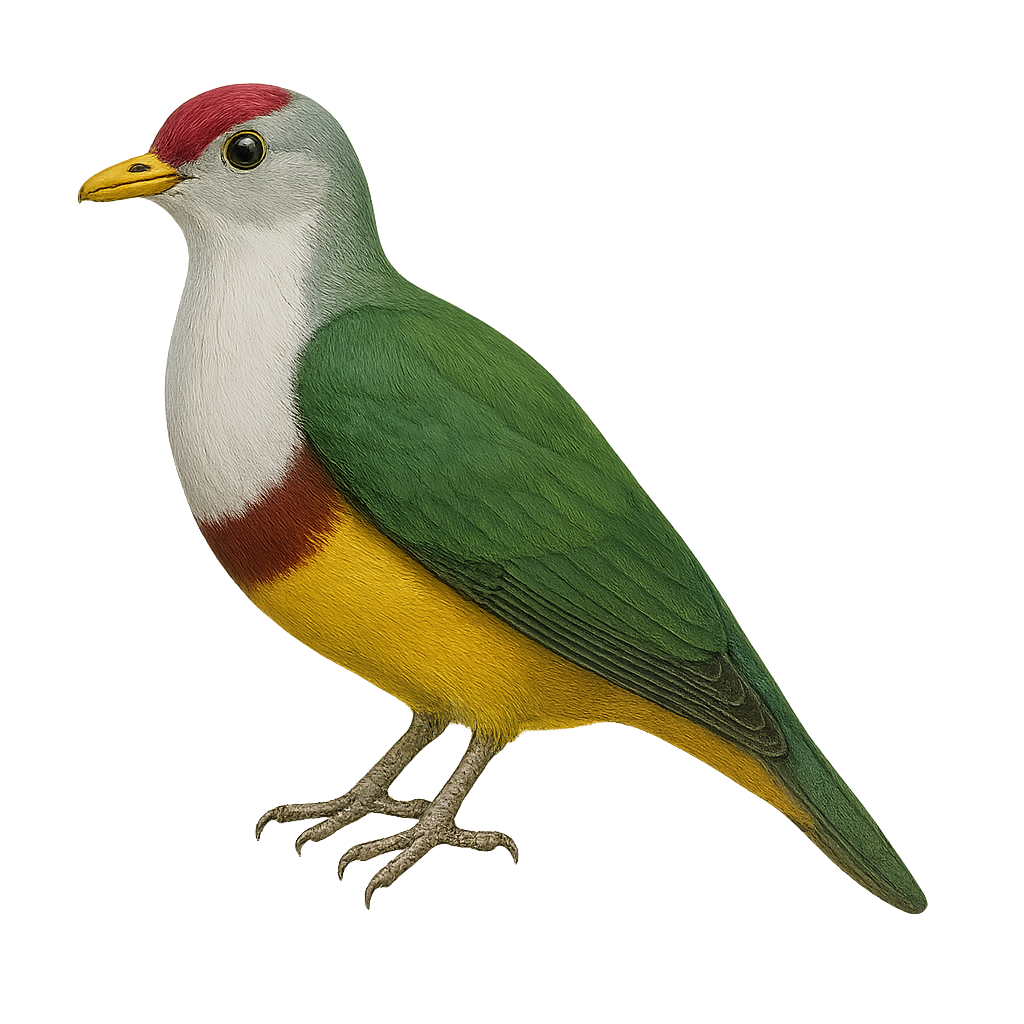
The Rose-crowned Fruit Dove is a colorful and fascinating bird native to the tropical forests of Australia and New Guinea. This medium-sized bird, measuring about 22 cm, is distinguished by its bright green plumage, vivid pink crown, and yellow belly. Males and females are similar, although males often have more vibrant colors. They primarily feed on fruits, playing a crucial role in seed dispersal. Their soft and melodious call resonates through the dense canopy. Although generally discreet, they can be observed in small groups, especially during the breeding season.
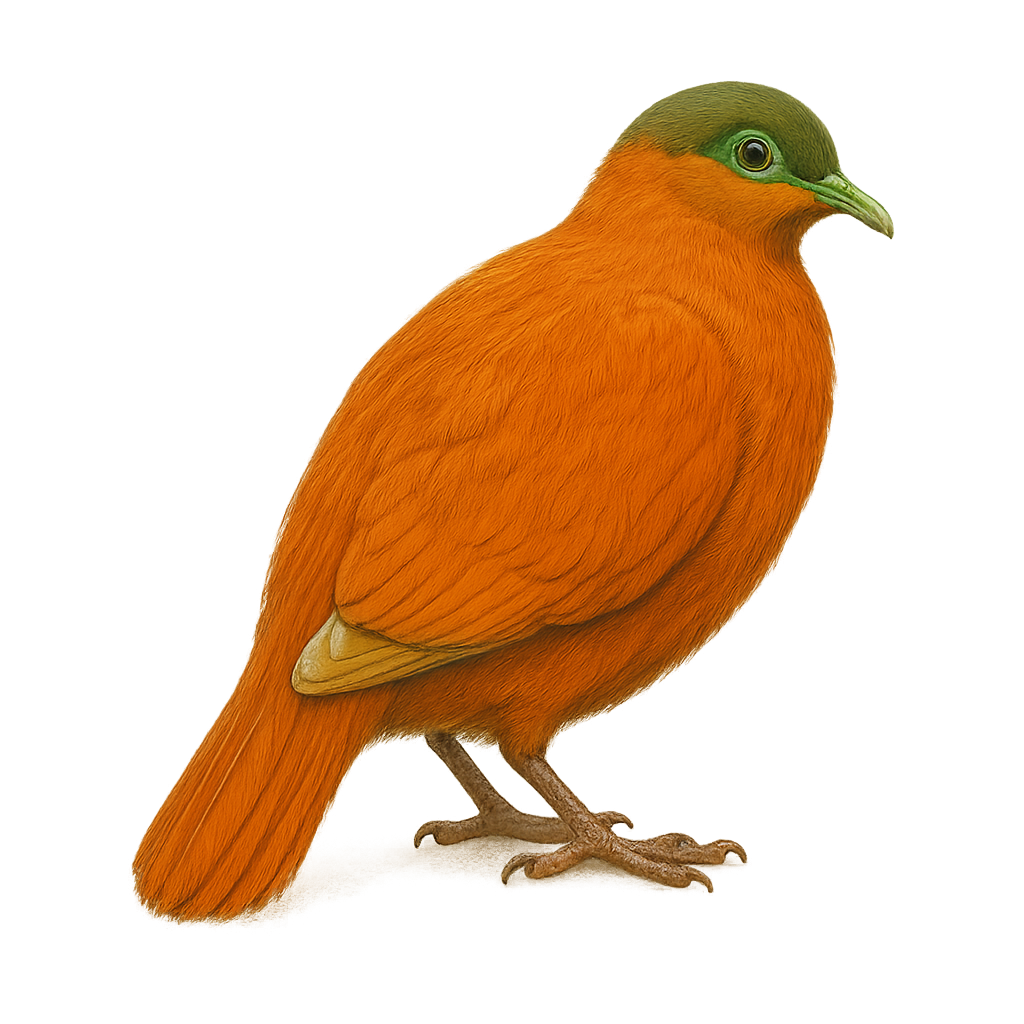
The Orange-bellied Fruit Dove, or Ptilinopus iozonus, is a colorful and fascinating bird primarily found in the rainforests of New Guinea and surrounding islands. This medium-sized pigeon, measuring about 24 cm in length, is easily recognizable by its vibrant plumage. Its bright orange belly contrasts with the vivid green of its wings and back, while its head displays shades of gray and violet. It primarily feeds on fruits, playing a crucial role in seed dispersal. Although often seen alone or in small groups, its discreet behavior sometimes makes it difficult to spot. Its ability to blend into dense foliage is impressive, making it a challenge for birdwatchers and photographers.
The Peale's Fruit Dove is a medium-sized bird, measuring about 20 cm in length. It features a vibrant plumage with a green head and neck, a bright yellow belly, and wings with shades of green and blue. Males and females are similar, although males may have slightly brighter colors. This bird is endemic to the South Pacific islands, particularly in Samoa and Tonga. It prefers dense tropical forests where it primarily feeds on fruits. Its call is soft and melodious, often heard at dawn and dusk. Although generally solitary, it can be seen in small groups during the breeding season.
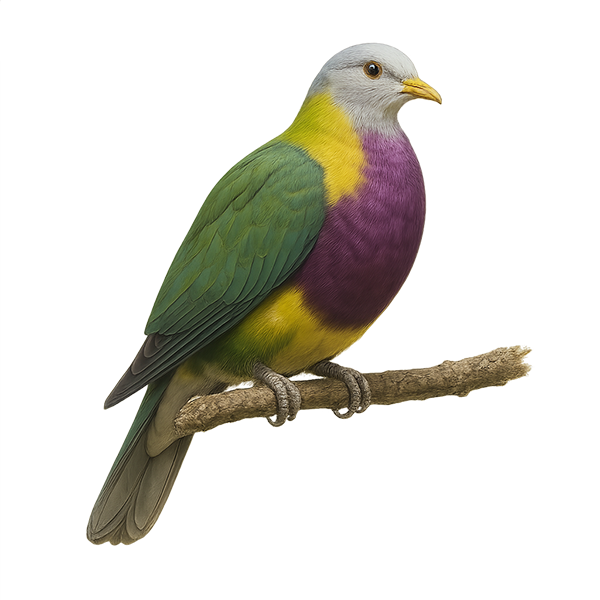
The Wompoo Fruit Dove is a medium-sized bird with vibrant and varied plumage. Its body is primarily green, with a purple head and chest, and a yellow belly. This fruit-eating pigeon is mainly arboreal, feeding on fruits in the rainforests of Australia and New Guinea. It is often heard before seen, thanks to its distinctive, deep call. Though discreet, it plays a crucial role in seed dispersal, aiding in forest regeneration. Its presence is an indicator of the health of its natural habitat.
The Beautiful Fruit Dove, or Ptilinopus pulchellus, is a bird from the Columbidae family, known for its striking and colorful plumage. It displays a vibrant mix of green, yellow, and red hues, making it particularly attractive. This bird is primarily arboreal and feeds on fruits, playing a crucial role in seed dispersal in its natural habitat. It is endemic to the tropical forests of New Guinea, where it prefers dense and humid areas. Although its conservation status is currently "least concern," deforestation and habitat loss pose potential threats to its population.
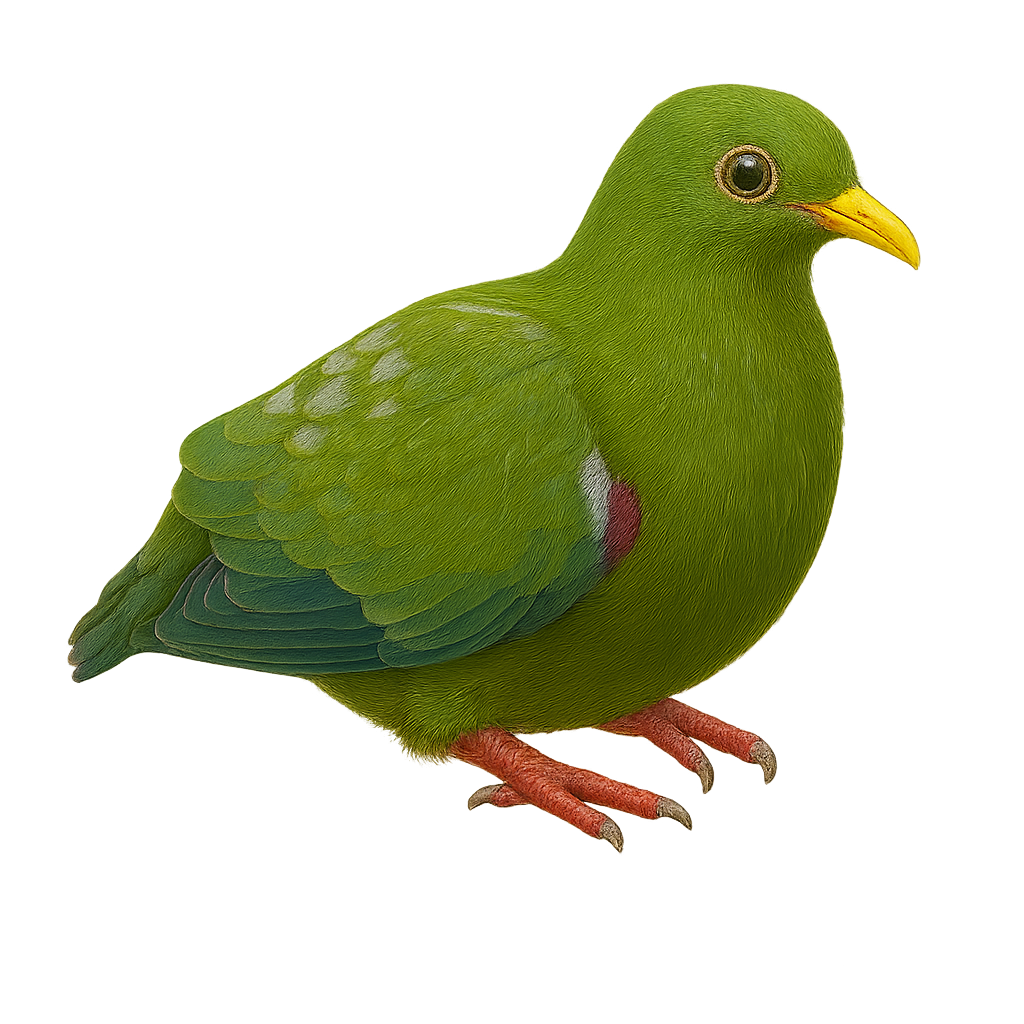
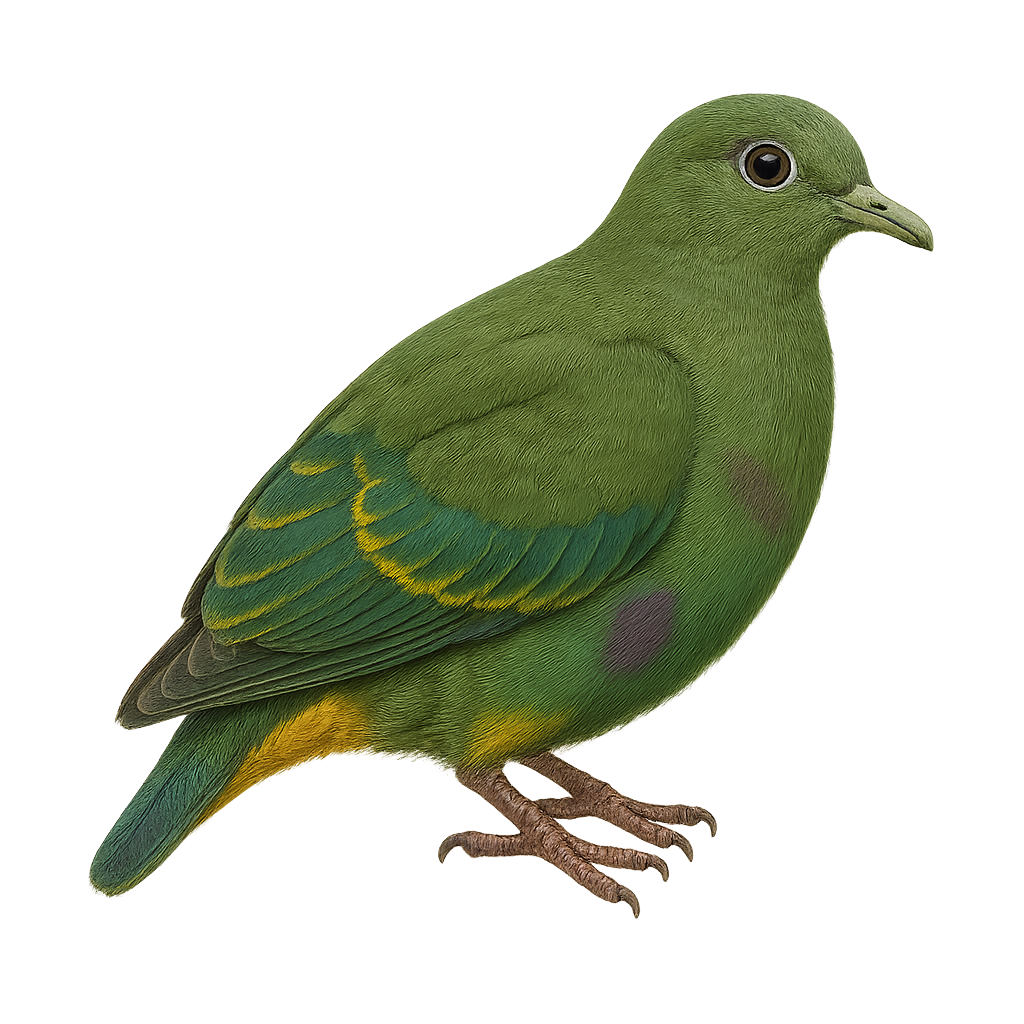
The Dwarf Fruit Dove, or Ptilinopus nainus, is a small, colorful bird belonging to the Columbidae family. It is primarily found in the lowland tropical rainforests of New Guinea and some surrounding islands. This fruit dove is recognizable by its bright green plumage, often speckled with yellow and red hues, allowing it to blend effectively among the foliage. It primarily feeds on fruits, playing a crucial role in seed dispersal. Although discreet, the Dwarf Fruit Dove is a sociable bird, often seen in small groups. Its small size and shy behavior make it a challenge for birdwatchers to spot.
The Golden Dove, or Ptilinopus victor, is a bird endemic to the tropical forests of certain Pacific islands. It is recognizable by its striking plumage, with a golden hue on the nape contrasting with the rest of its body, usually metallic green. This medium-sized pigeon measures about 30 cm in length. It primarily feeds on fruits, seeds, and occasionally insects. Its natural habitat is threatened by deforestation and the introduction of invasive species. It is often seen in pairs or small groups, and its soft, melodious voice is a distinctive sign of its presence in the dense canopy.
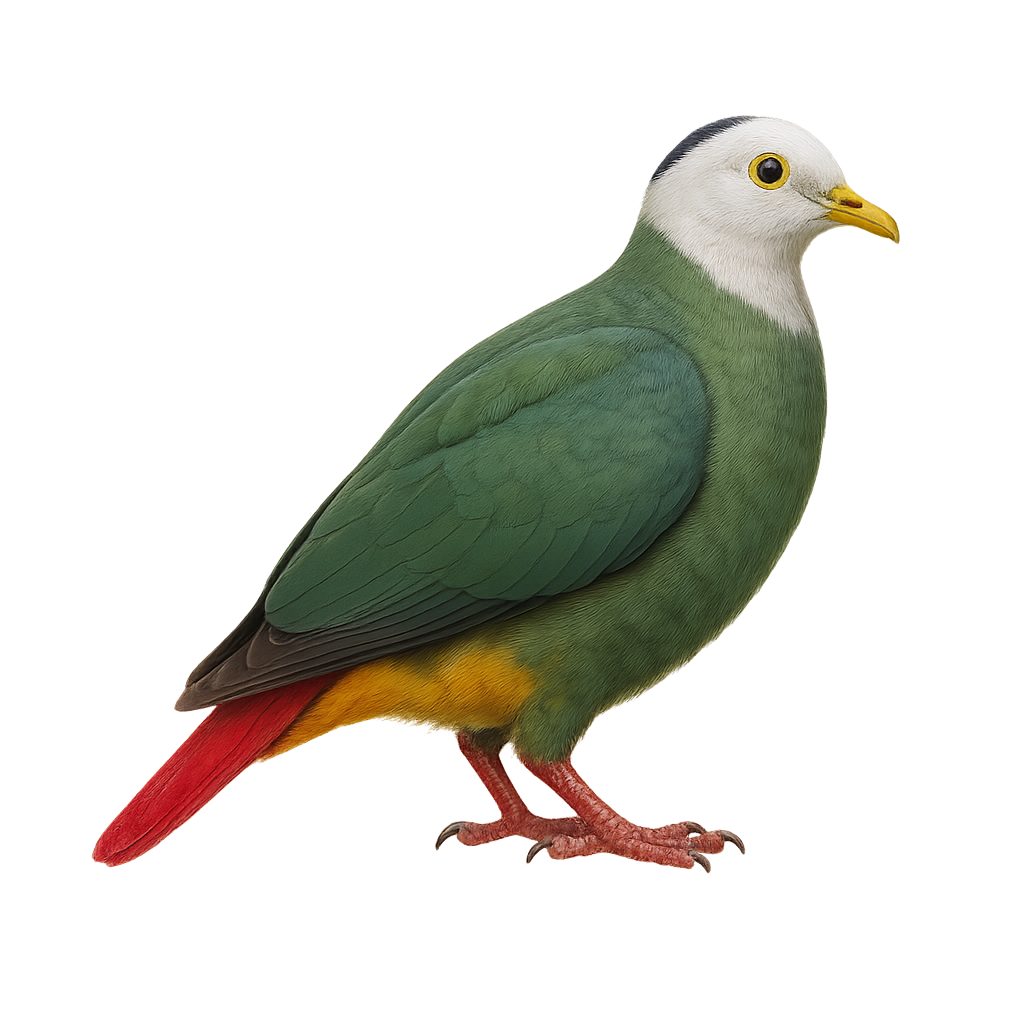
The Black-naped Fruit Dove is a medium-sized bird, measuring about 24 cm in length. It is notable for its colorful plumage, with a black head contrasting against its bright green body. The wings show shades of yellow and blue, while the underside is paler. This bird is primarily frugivorous, feeding on various fruits and berries. It is often seen in small groups in humid tropical forests, where it plays a crucial role in seed dispersal. Although generally discreet, its soft and melodious call can be heard through the canopy. The Black-naped Fruit Dove is a resilient bird, capable of adapting to different habitats, but remains vulnerable to deforestation.
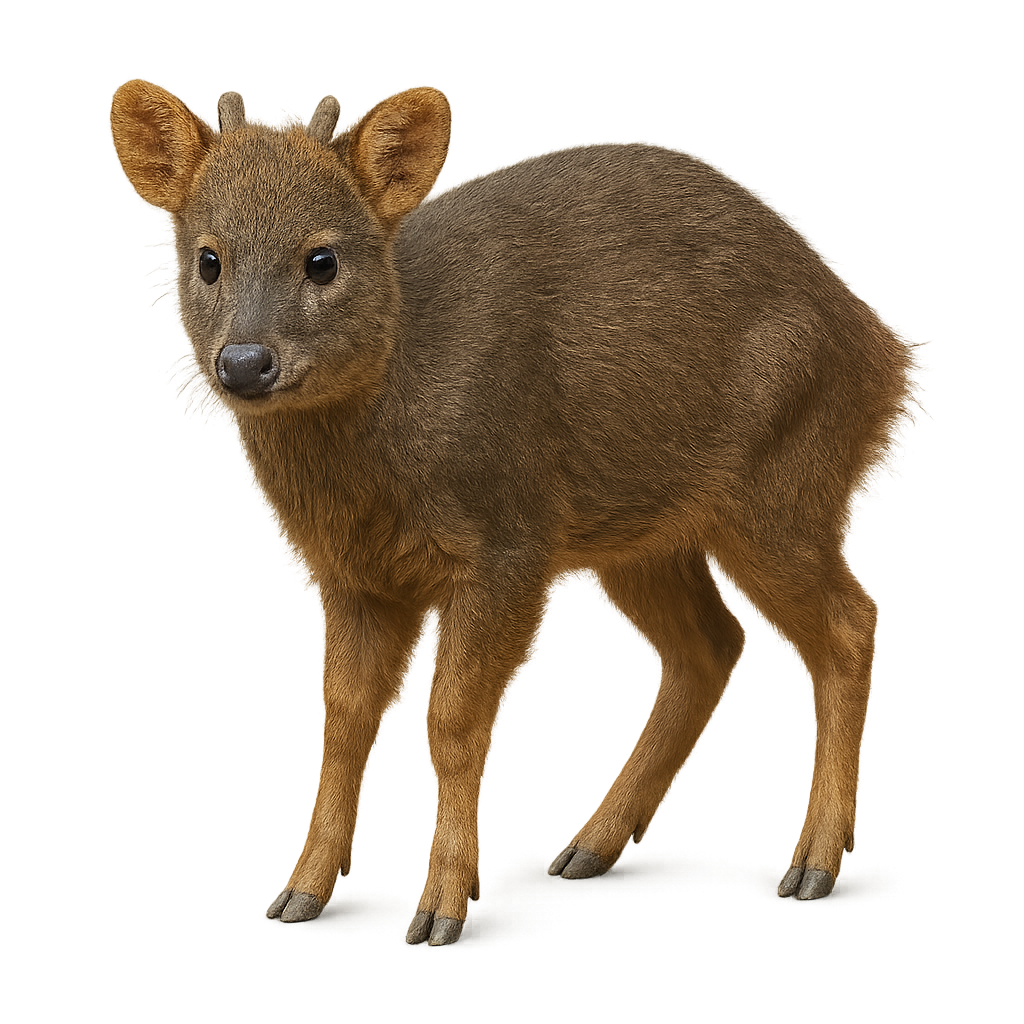
The southern pudu is the world's smallest deer, measuring 35–45 cm at the shoulder and weighing 7–10 kg, with dense reddish-brown fur. A secretive and crepuscular species of temperate South American forests, it feeds mainly on leaves, fungi and fallen fruits. During the rutting period, males mark a small territory by rubbing against shrubs and emitting soft calls.
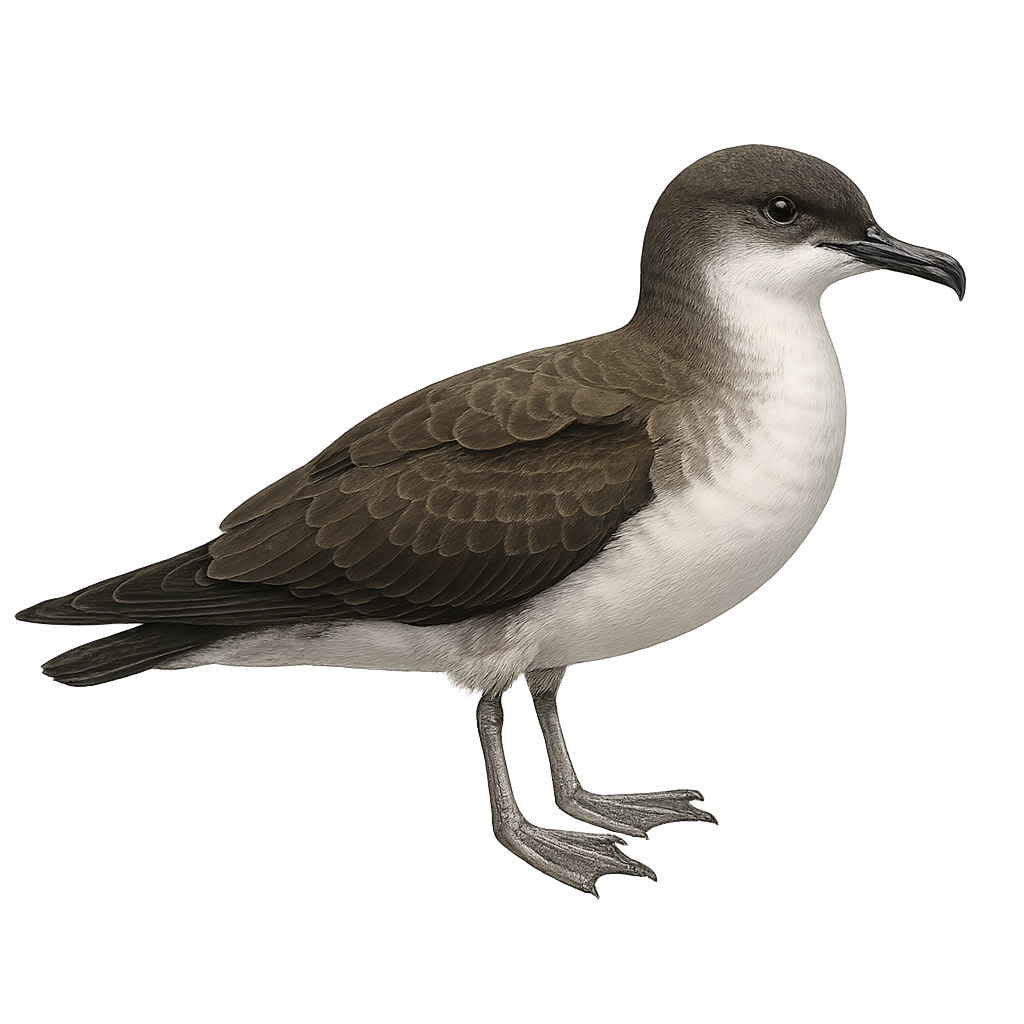
The Buller's Shearwater, or Ardenna bulleri, is an elegant and graceful seabird primarily observed in the Pacific Ocean. It is distinguished by its silvery-gray plumage on the back and white on the belly, with long, slender wings that allow it to glide effortlessly over the waves. This migratory bird travels great distances between its breeding grounds in New Zealand and its feeding areas in the North Pacific. It nests in colonies on isolated islands, digging burrows in the ground to lay its eggs. The Buller's Shearwater feeds mainly on fish and squid, which it captures by skillfully diving into the water. Although its conservation status is concerning due to threats to its nesting habitats, conservation efforts are underway to protect this fascinating bird.
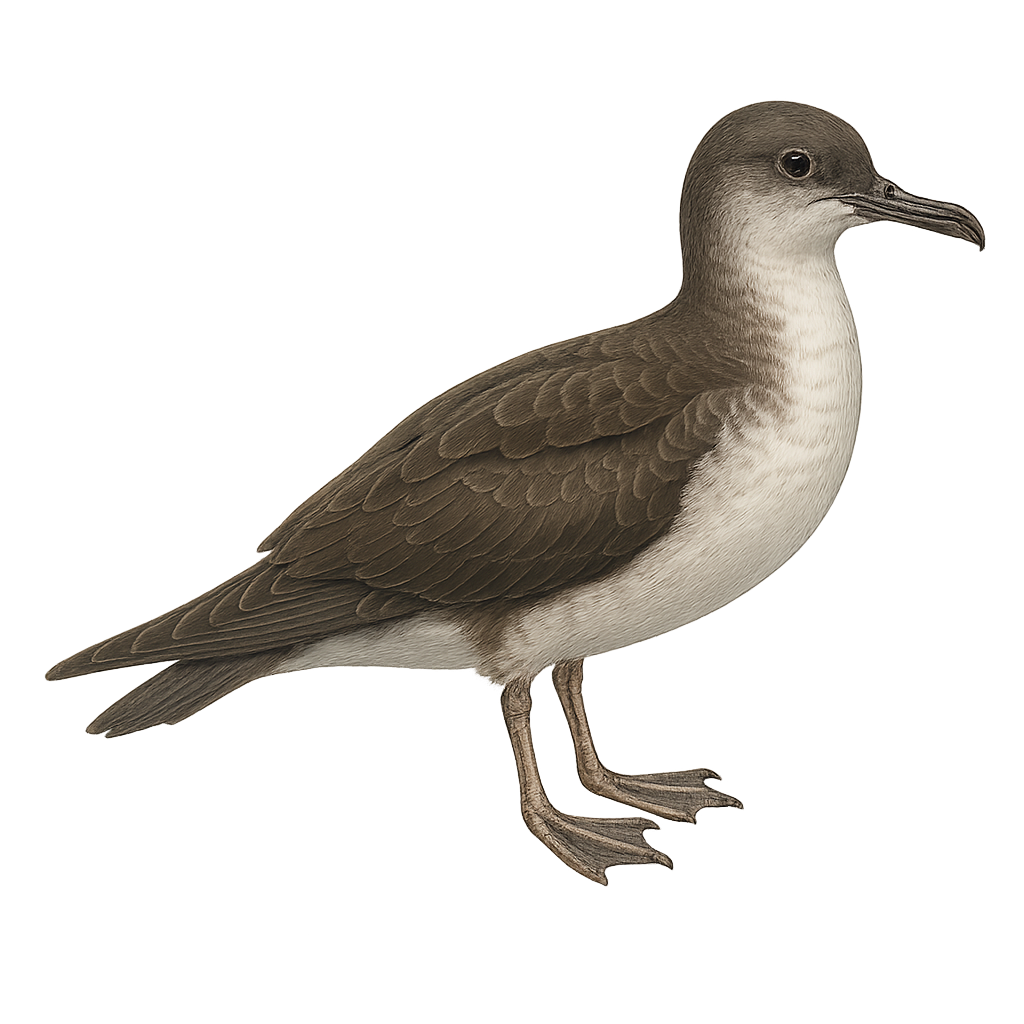
The Manx Shearwater, Puffinus puffinus, is a medium-sized seabird, measuring about 30 to 38 cm in length with a wingspan of 76 to 89 cm. Its plumage is predominantly black above and white below, allowing it to blend into its marine environment. Known for its long migrations, this bird travels thousands of kilometers between its breeding sites in Europe and wintering grounds in South America. It nests in burrows on isolated islands, often in dense colonies. The Manx Shearwater feeds mainly on fish and squid, diving underwater to catch its prey. Although relatively common, it is vulnerable to introduced predators at its nesting sites.
The Balearic Shearwater, Puffinus mauretanicus, is a seabird endemic to the Balearic Islands. It is characterized by its dark brown plumage on top and lighter underneath, with long, narrow wings adapted for gliding over waves. Measuring about 30 to 40 cm in length with a wingspan of 75 to 90 cm, it is perfectly adapted to life at sea. This bird primarily feeds on fish and cephalopods, which it captures by diving underwater. Unfortunately, the Balearic Shearwater is critically endangered due to predation by introduced species, marine pollution, and overfishing, which reduces its food resources.
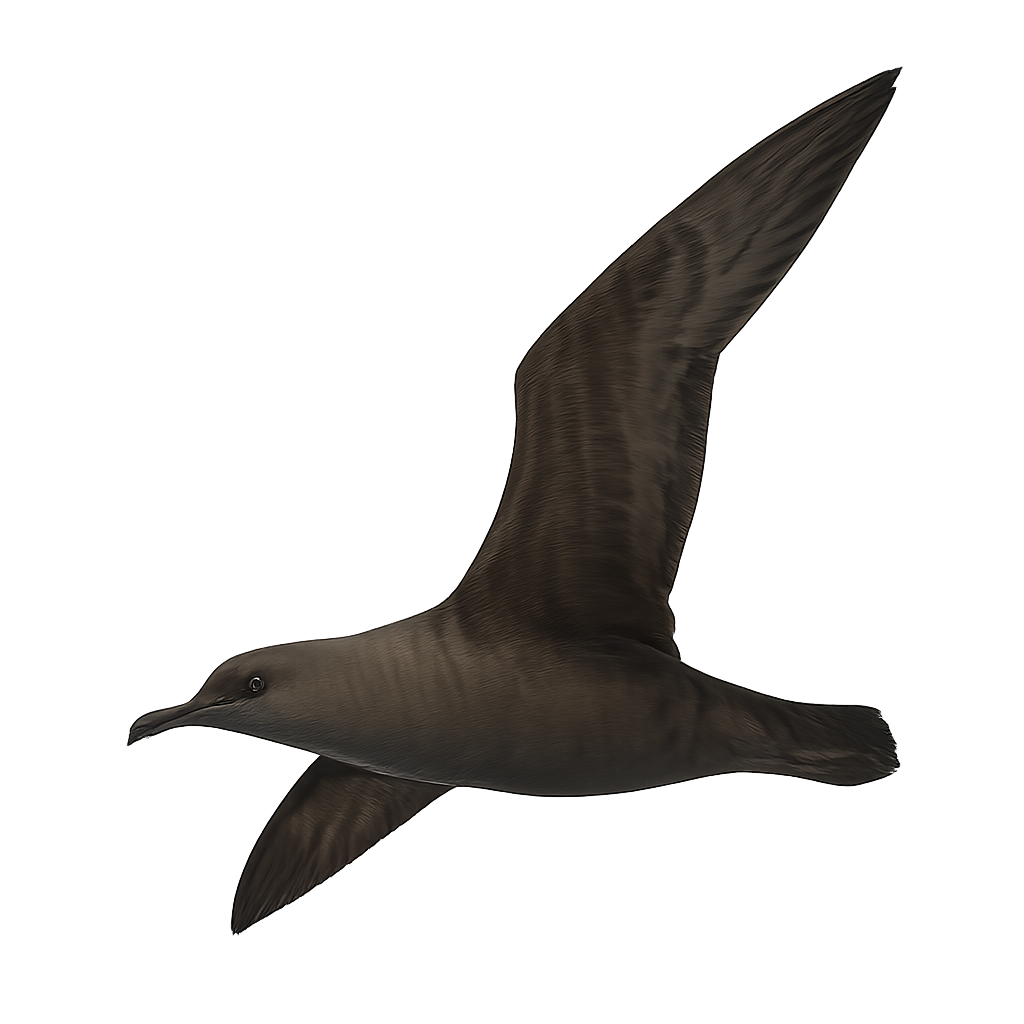
The Sooty Shearwater is a medium-sized seabird known for its dark brown plumage and long, slender wings. It is often seen gliding close to the ocean waves, skillfully using air currents to travel great distances. This tireless migrator covers thousands of kilometers between its breeding sites in the southern hemisphere and feeding areas in the northern hemisphere. It nests mainly on remote islands, digging burrows in the ground to lay a single egg. The Sooty Shearwater feeds primarily on fish and squid, diving underwater to catch its prey. Although its population is still large, it is threatened by industrial fishing and climate change.
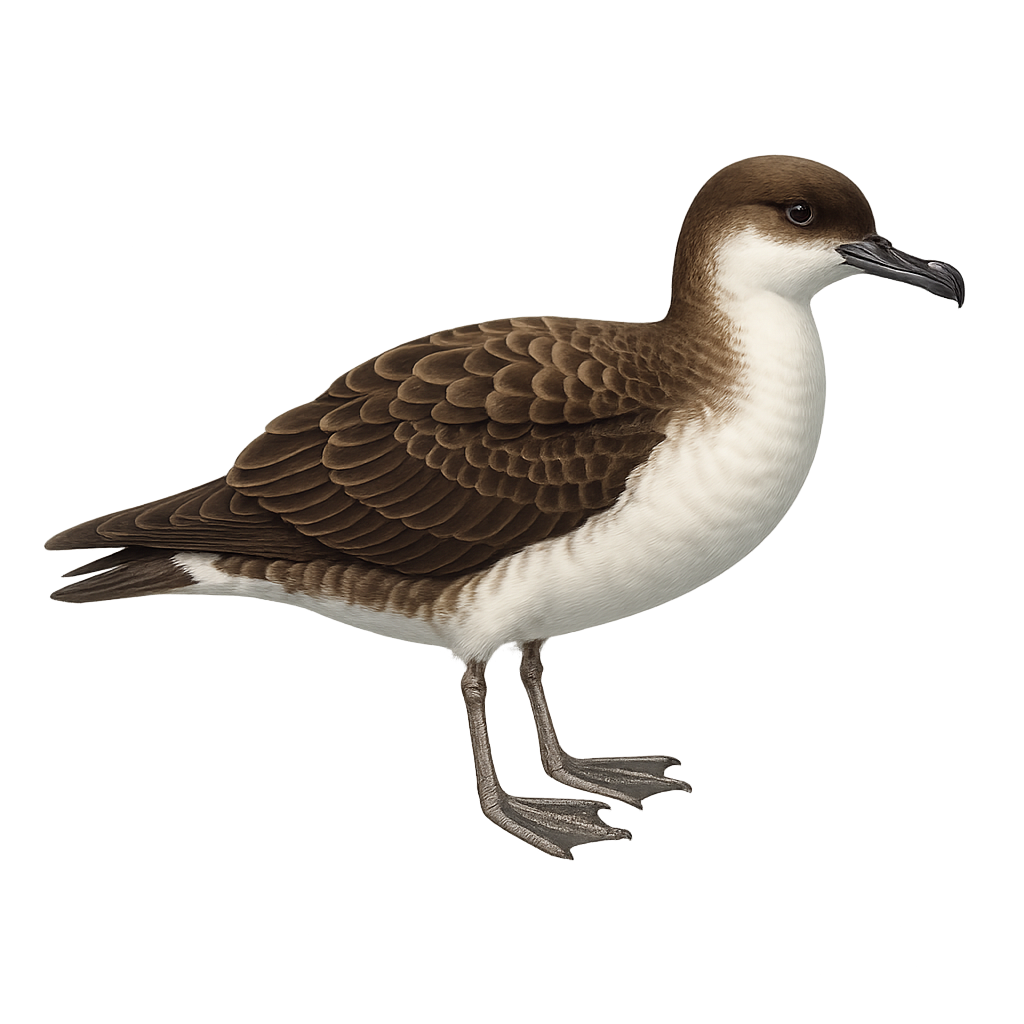
The Great Shearwater, or Ardenna gravis, is a medium-sized seabird belonging to the Procellariidae family. It is mainly observed in the North Atlantic, where it migrates long distances between its breeding grounds in the southern hemisphere and feeding areas in the northern hemisphere. This bird is recognizable by its brown and white plumage, with a dark head and sturdy beak. It primarily feeds on fish and squid, which it captures by skillfully diving into the water. The Great Shearwater is an excellent glider, using air currents to travel great distances with minimal effort. Its population is considered stable, although it is sensitive to environmental changes and marine pollution.
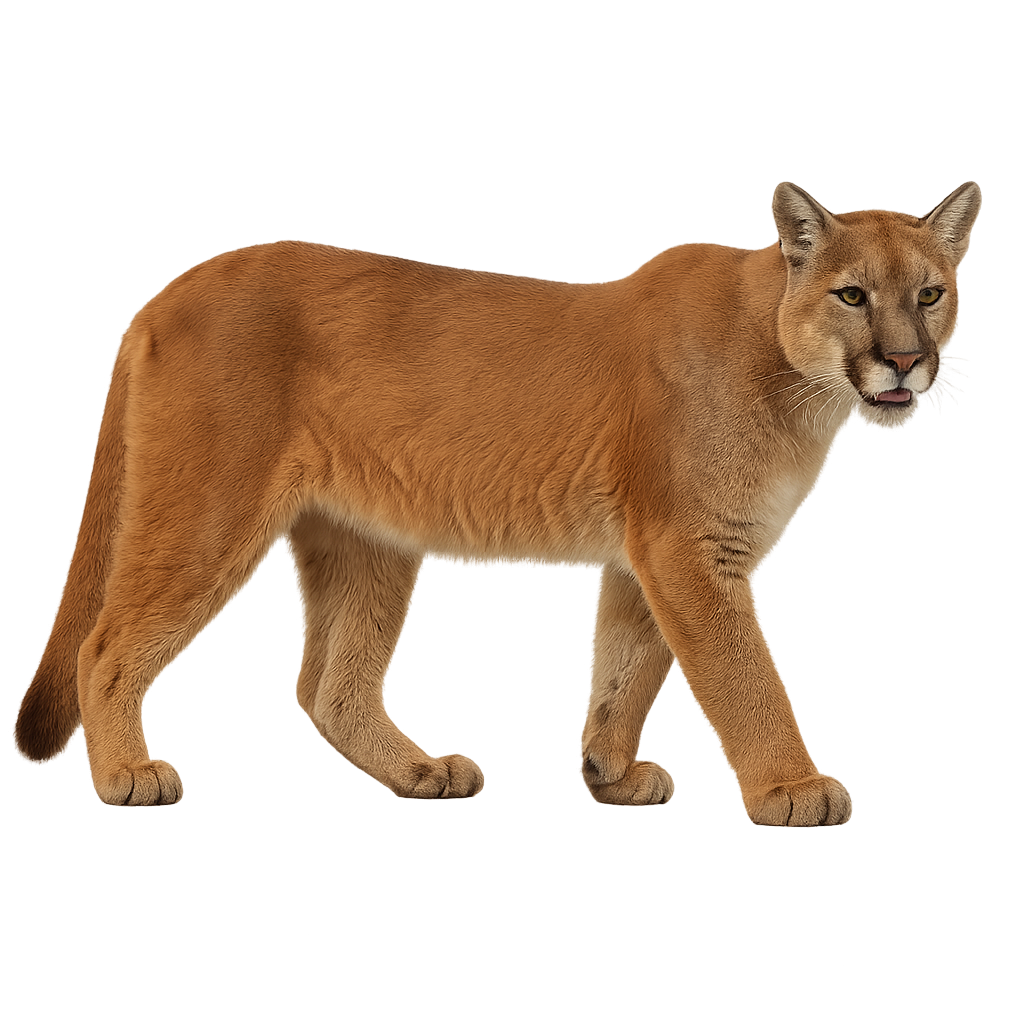
The Puma is a large feline found primarily in the Americas, from Canada to the southern tip of South America. It measures between 1.1 and 1.8 meters in length, with a tail measuring 60 to 80 cm, and weighs between 40 and 100 kg, depending on the sex and subspecies. Its coat is typically sandy, gray, or brown, with a lighter underside. The Puma is a solitary predator, primarily hunting deer, small mammals, and birds. It is also capable of traveling great distances and adapting to different types of habitats, ranging from mountainous forests to desert areas. While its population remains relatively stable in certain regions, it can be threatened by habitat loss, fragmentation of its territories, and hunting.
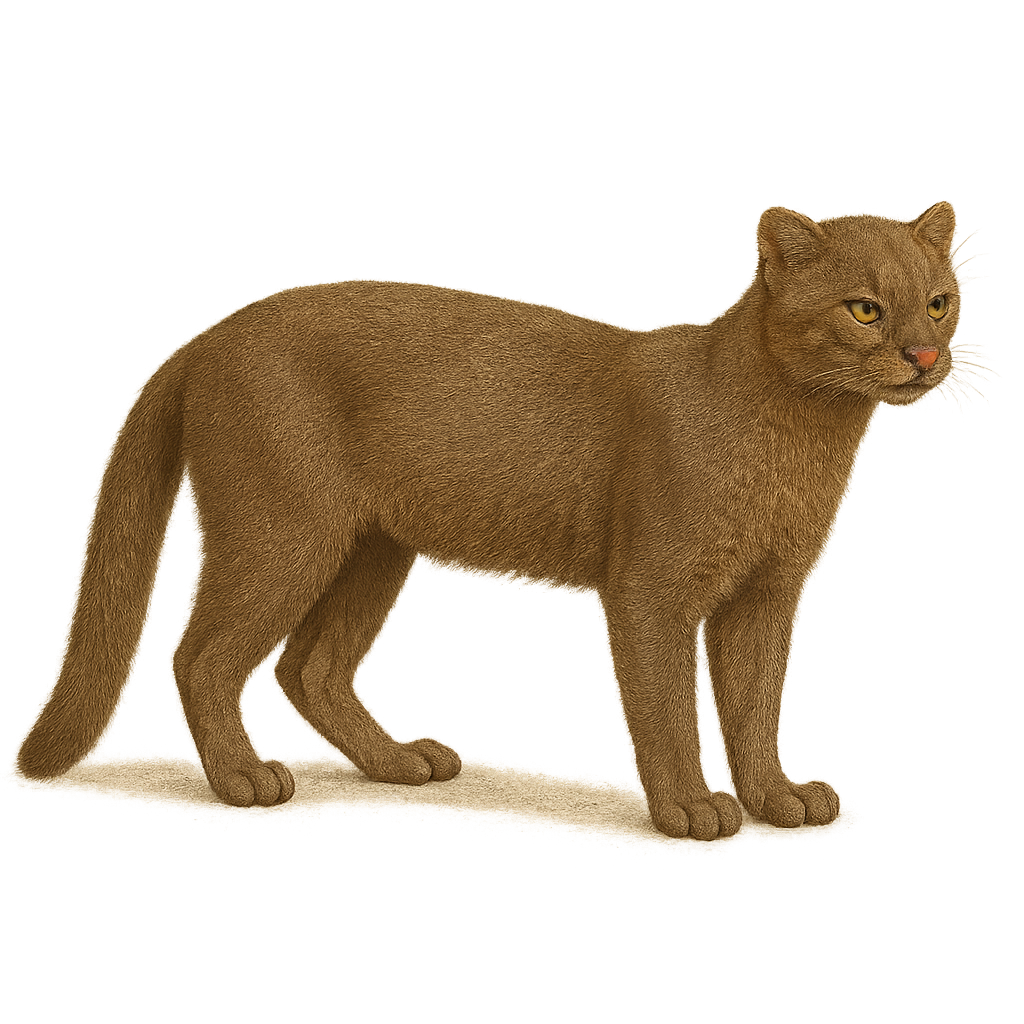
The Puma yagouaroundi, commonly known as the Puma jaguarundi, is a medium-sized feline native to the Americas. It is characterized by its elongated body, short legs, and long tail. Its coat is uniform, ranging from gray to reddish-brown, allowing it to blend into its surroundings. This feline is primarily solitary and territorial, marking its territory with glandular secretions. It is an opportunistic hunter, feeding on small mammals, birds, and reptiles. Although mainly terrestrial, it is also a good climber and swimmer. Its adaptability to various habitats, from tropical forests to savannas, makes it a resilient predator.
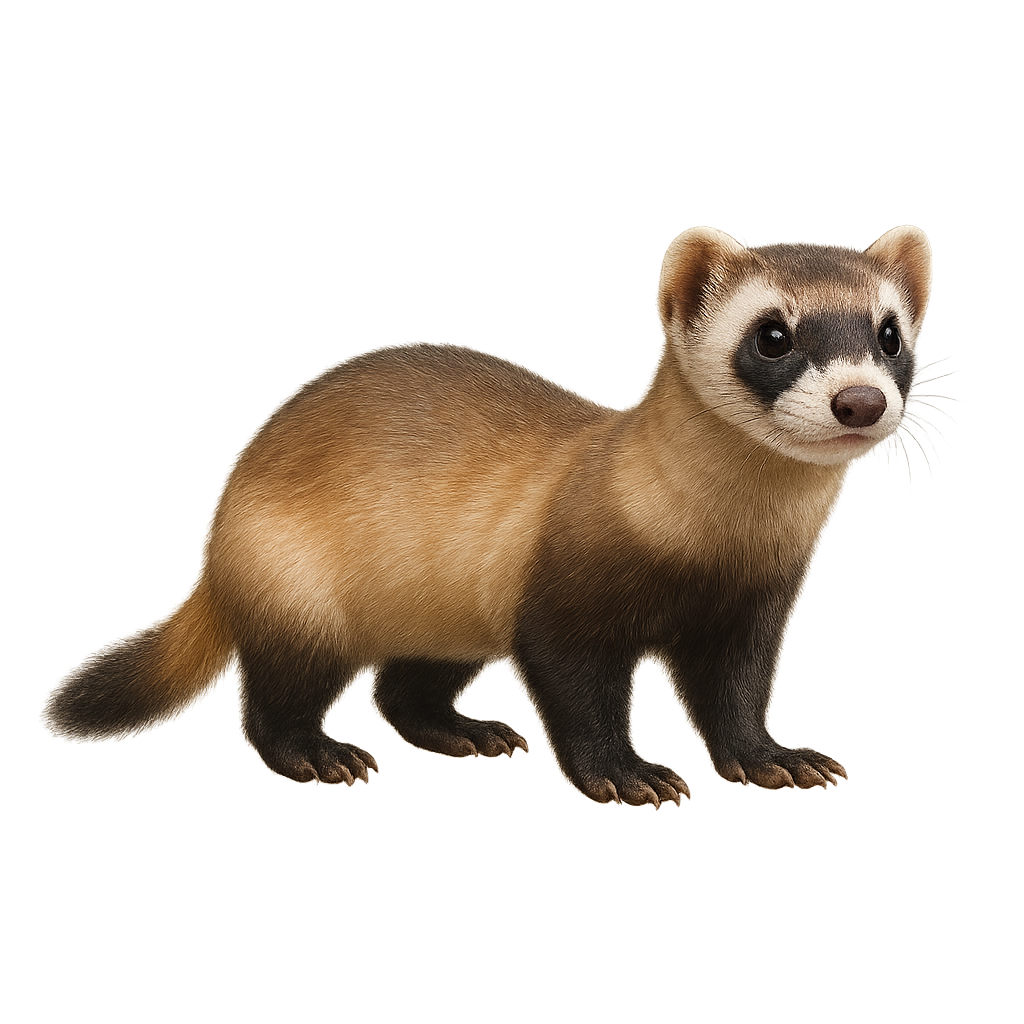
The black-footed ferret, or Mustela nigripes, is a rare and iconic small carnivore of the North American prairies. It is distinguished by its light beige fur, black feet, and facial mask, as well as its slender body and bushy tail. This mustelid is a specialized predator, primarily feeding on prairie dogs. Unfortunately, it is critically endangered due to habitat loss and disease. Conservation efforts, including captive breeding and reintroduction into the wild, are crucial for its survival. The black-footed ferret is a symbol of prairie biodiversity and the importance of ecosystem conservation.
The European Polecat is a small carnivore found primarily in Europe, inhabiting a variety of environments such as forests, meadows, and agricultural areas. It measures about 45 to 60 cm in length, with a tail of 20 to 30 cm, and weighs between 0.8 and 1.5 kg. Its fur is generally light brown or gray, with lighter underparts and a distinctive black mark on its face, surrounding its eyes. The European Polecat is a nocturnal and opportunistic predator, primarily feeding on small mammals, birds, eggs, as well as fruits and insects. While it is often perceived as a pest by farmers, it plays an important role in regulating populations of small animals. Its population is generally stable, but it can be threatened by habitat loss and road collisions.
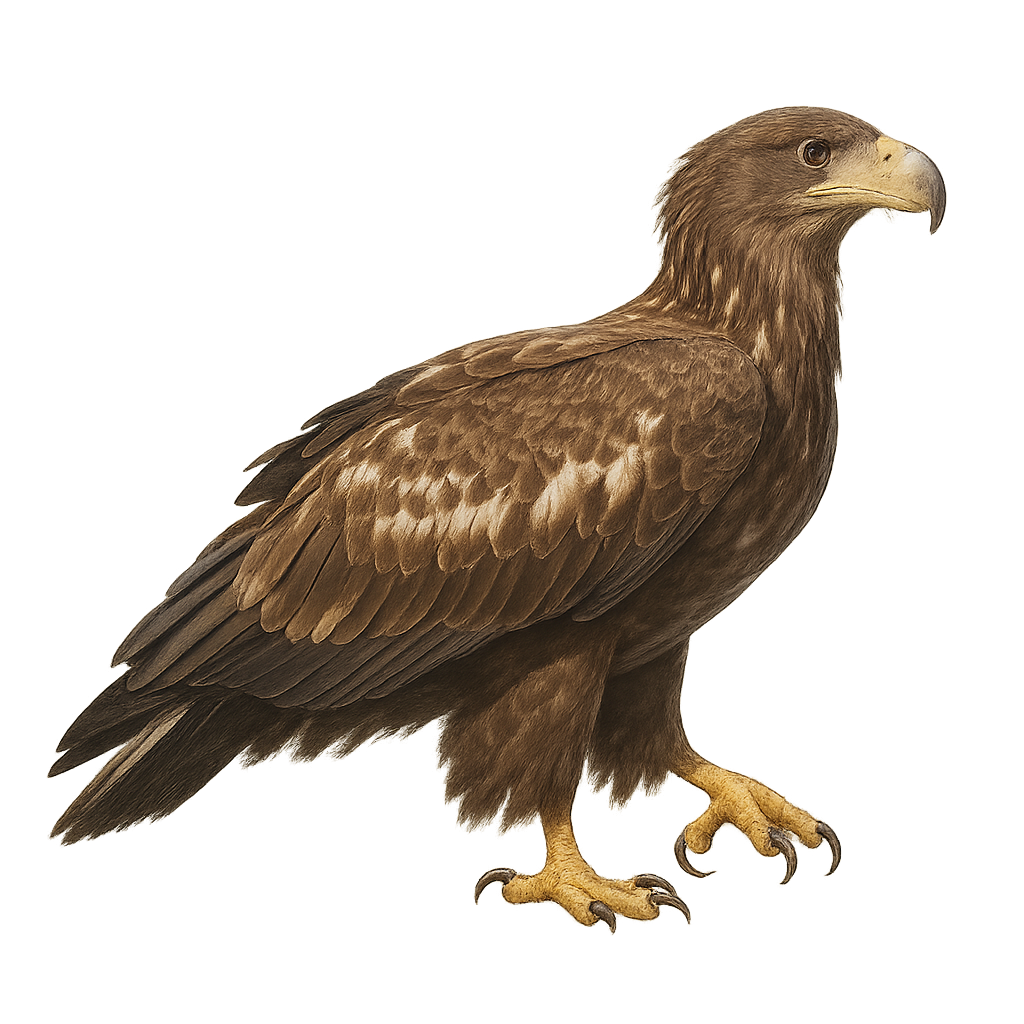
The White-tailed Eagle is a large raptor primarily found in Eastern Europe, Northern Asia, and some regions of Central Asia. It measures about 70 to 90 cm in length, with a wingspan of 1.8 to 2.3 meters, and weighs between 3 and 6 kg. Its plumage is primarily brown with a distinctive white head and tail. The White-tailed Eagle is an excellent fisherman, primarily feeding on fish, but it also hunts birds, small mammals, and scavenges carrion. It primarily inhabits areas near bodies of water such as lakes, rivers, and estuaries. While its population has been growing in some areas due to conservation efforts, this species remains vulnerable to habitat loss, water pollution, and human disturbances.
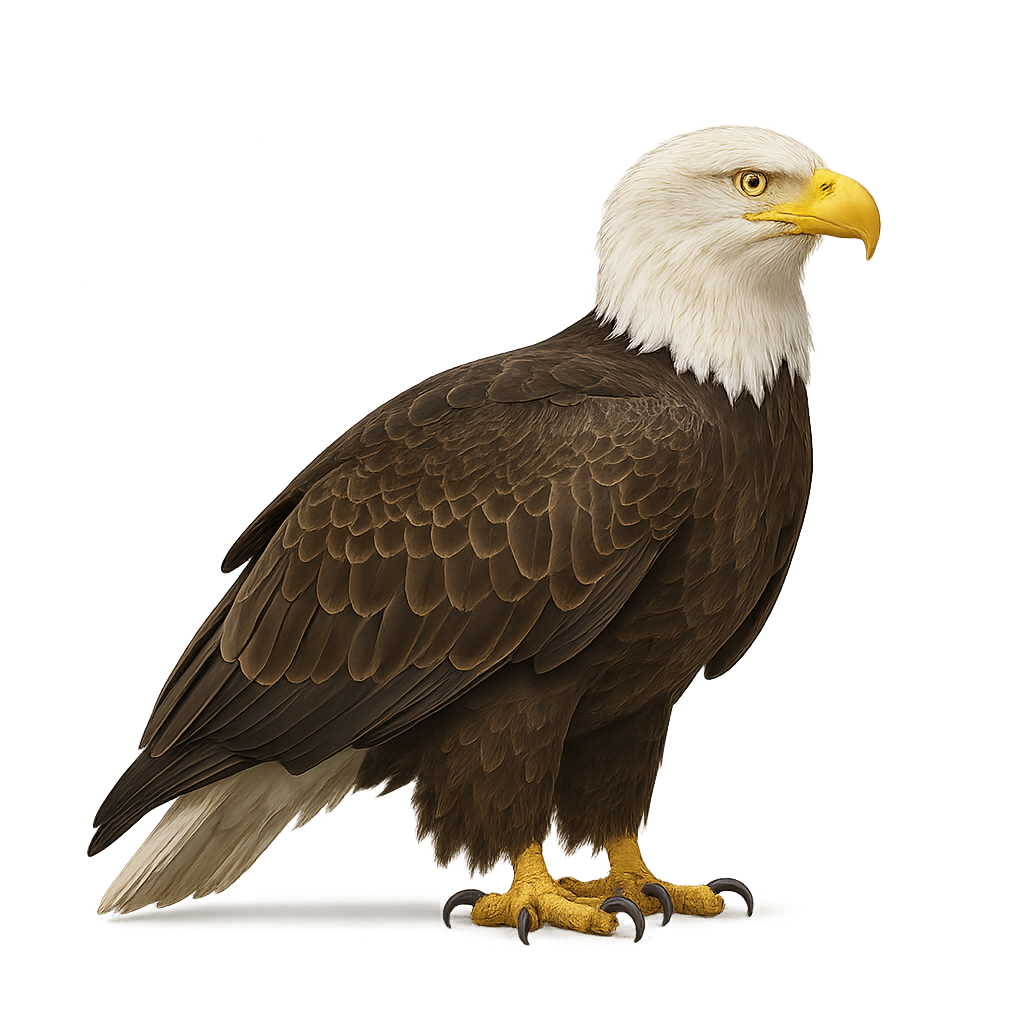
The Bald Eagle is a large raptor primarily found in North America, near bodies of water such as lakes, rivers, and coastal areas. It measures about 70 to 90 cm in length, with a wingspan of 1.8 to 2.3 meters, and weighs between 3 and 6 kg. Its plumage is primarily dark brown with characteristic white head and tail. The Bald Eagle is an excellent hunter, primarily feeding on fish, small mammals, and birds, which it captures by diving or snatching its prey with powerful talons. Although its population once faced a significant decline and was threatened, particularly due to pollution and hunting, the Bald Eagle is now a protected species, and its population has greatly recovered.