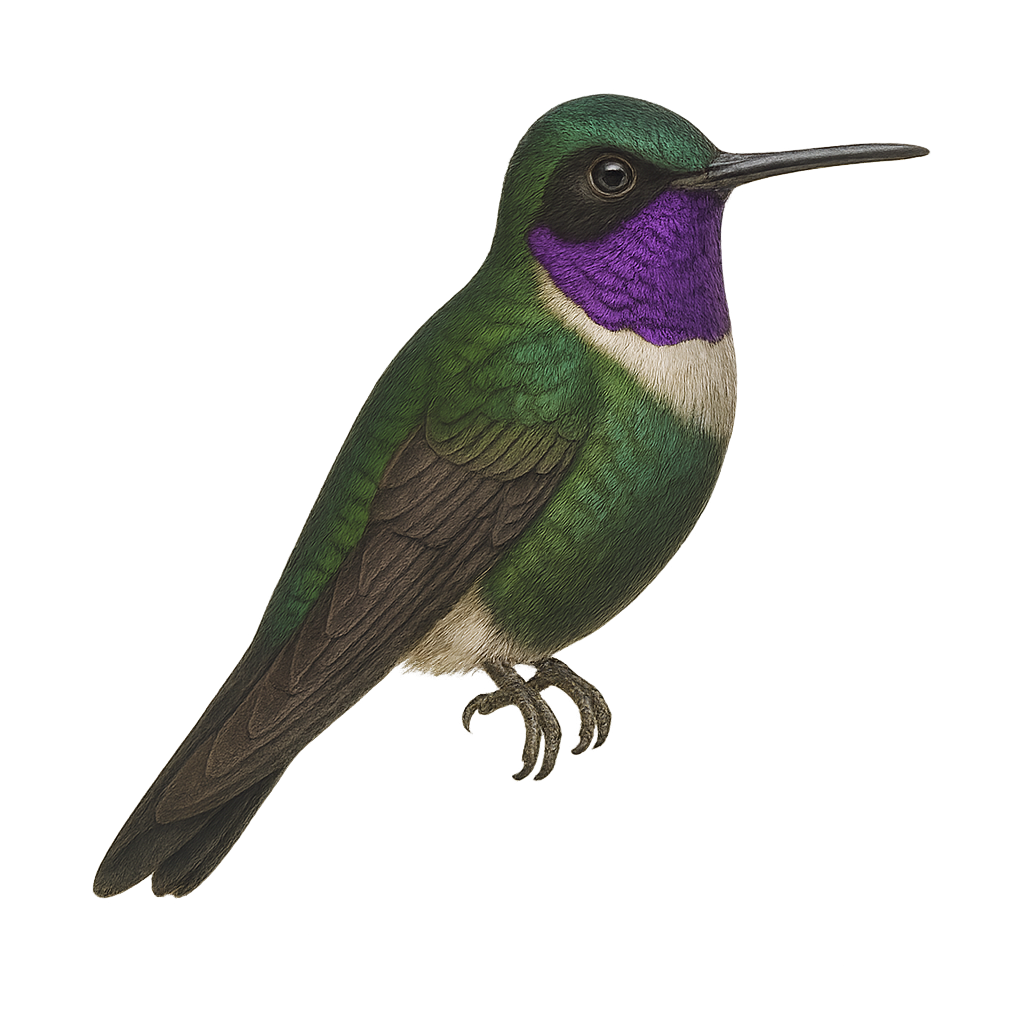
The Mountain Bee-eater, Merops oreobates, is a colorful and fascinating bird belonging to the Meropidae family. It is primarily found in the mountainous regions of East Africa, where it inhabits montane forests and wooded areas. Its vibrant plumage, featuring shades of green, blue, and yellow, makes it easily recognizable. This bird primarily feeds on insects, especially bees and wasps, which it catches in flight with remarkable agility. The Mountain Bee-eater is a sociable bird, often seen in small groups. It nests in burrows dug into banks or sandy slopes. Although its conservation status is currently stable, deforestation and habitat loss could threaten its populations in the future.
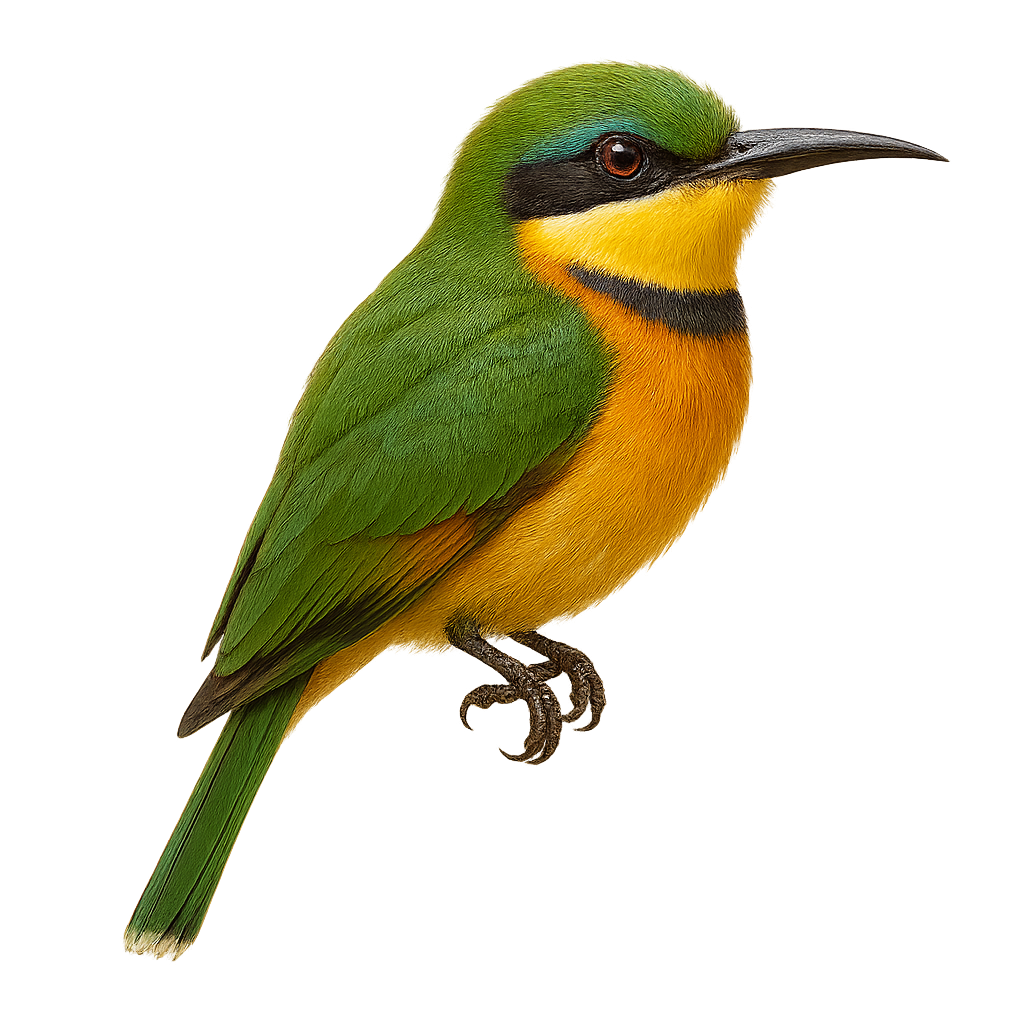
The Little Bee-eater, Merops pusillus, is a vibrant and fascinating bird, easily recognizable by its bright green plumage, yellow throat, and distinctive black eye stripe. Measuring about 15 to 17 cm in length, it is one of the smallest members of its family. It primarily inhabits savannas, open woodlands, and riverine areas in sub-Saharan Africa. The Little Bee-eater is an agile predator, feeding mainly on flying insects, especially bees and wasps, which it catches in flight. It is often seen in small groups, perched on low branches, from where it launches to catch its prey. Although relatively tolerant of human presence, it remains cautious and prefers to keep its distance.
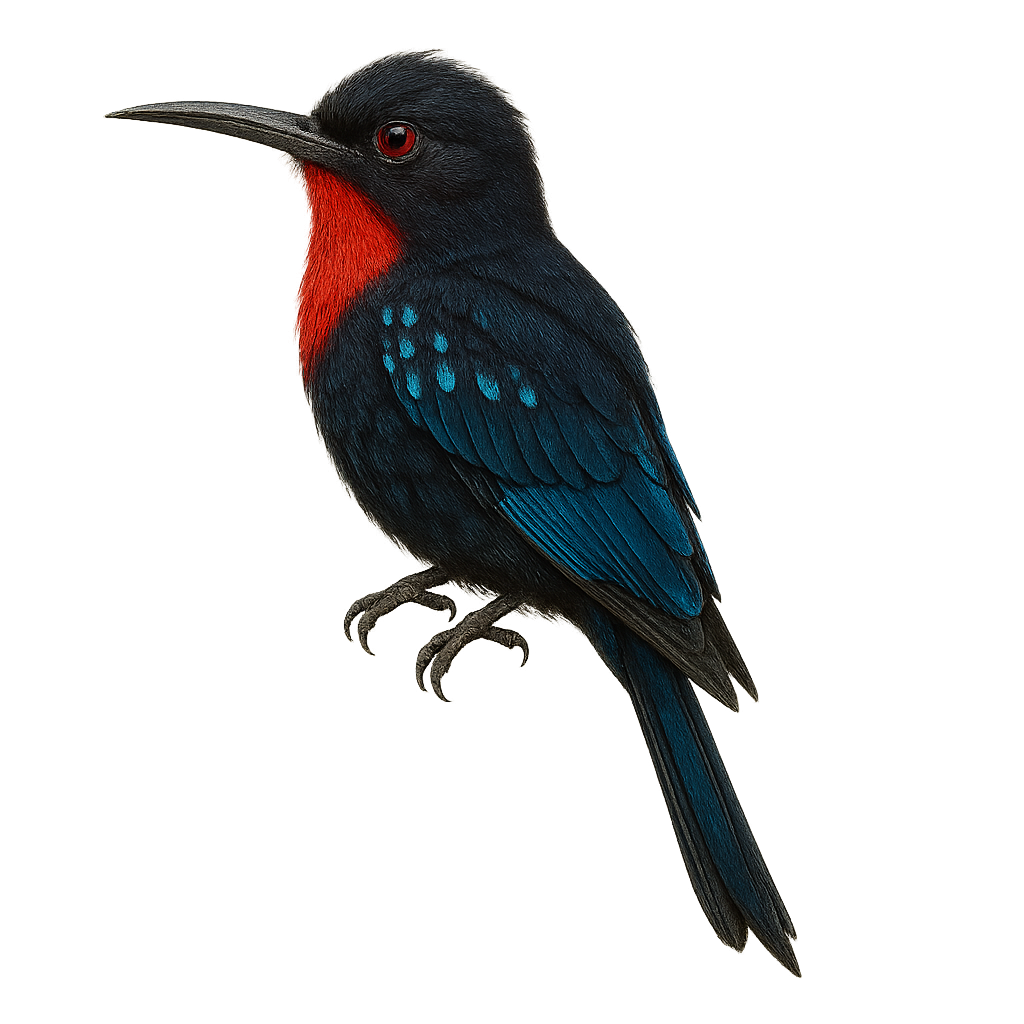
The Black-headed Bee-eater, Merops gularis, is a fascinating bird belonging to the Meropidae family. This bee-eater is distinguished by its black head contrasting with its bright red throat and vibrant green plumage. It is primarily found in the humid tropical forests of West Africa, where it feeds mainly on flying insects, particularly bees and wasps. Its flight is agile and swift, allowing it to catch prey mid-air. Although its habitat is relatively stable, deforestation poses a threat to its population. The Black-headed Bee-eater is a sociable bird, often seen in small groups, and is known for its melodious and varied vocalizations.
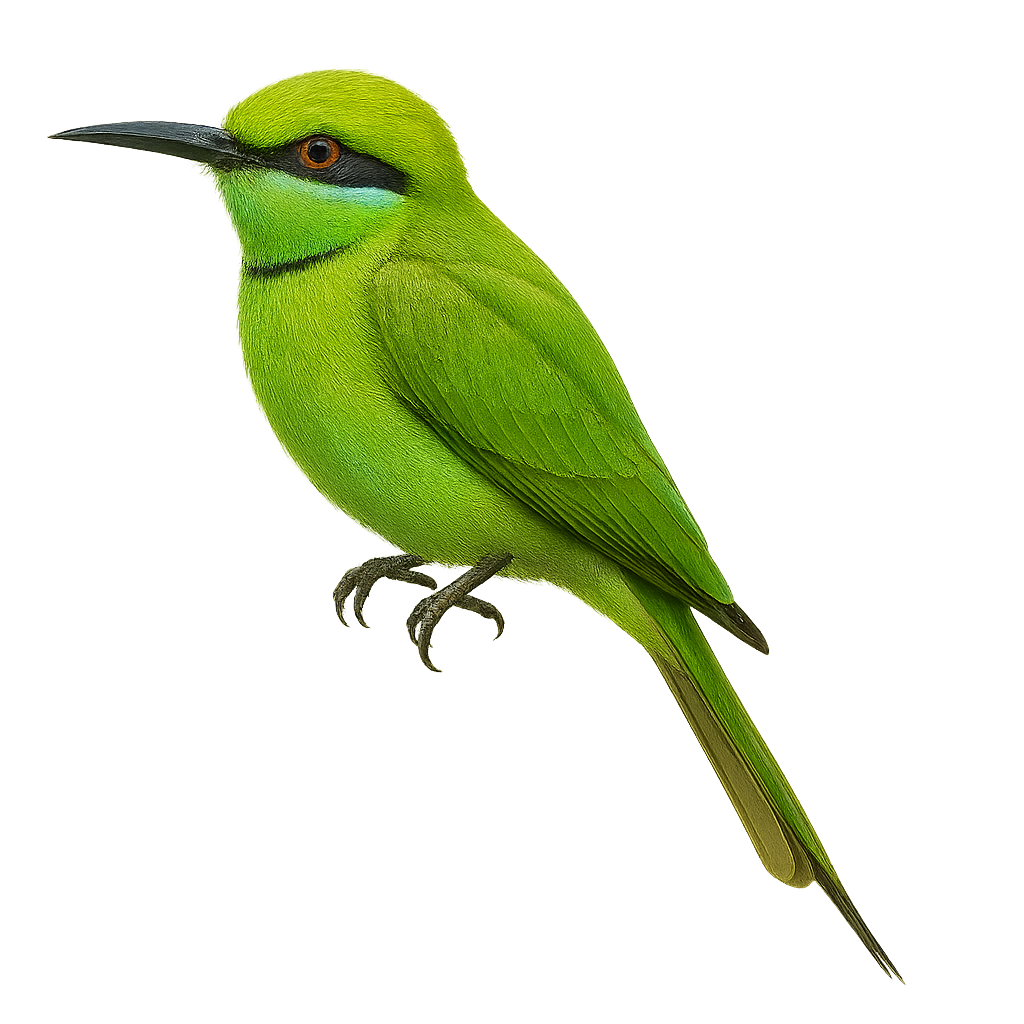
The Persian Green Bee-eater, Merops viridissimus, is a colorful and graceful bird, primarily green with shades of blue and yellow. Known for its long central tail feathers and curved beak, it is adept at catching insects mid-flight. This bee-eater inhabits mainly arid and semi-arid regions, favoring open areas with sparse trees. Often seen in small groups, it perches on exposed branches. Its flight is agile and swift, allowing it to catch prey in mid-air. The Persian Green Bee-eater is also noted for its melodious calls, often heard during its flights.
The Hartebeest is a medium-sized antelope, easily recognizable by its large lyre-shaped horns and distinctive coat. It stands about 1.1 to 1.3 meters tall at the shoulder, with a weight ranging from 90 to 150 kg. Its coat is generally reddish-brown, with characteristic white markings on the belly, legs, and around the eyes, and a darker coat on the back. The Hartebeest primarily inhabits savannas, grasslands, and grassy areas in East and Southern Africa, notably in Kenya, Tanzania, South Africa, and Namibia. Herbivorous, it primarily feeds on grasses, leaves, and young shoots. It lives in social groups, usually composed of females and young, while adult males often live alone or in small groups. While the Hartebeest is not currently endangered, it faces threats such as habitat loss, hunting, and disease.
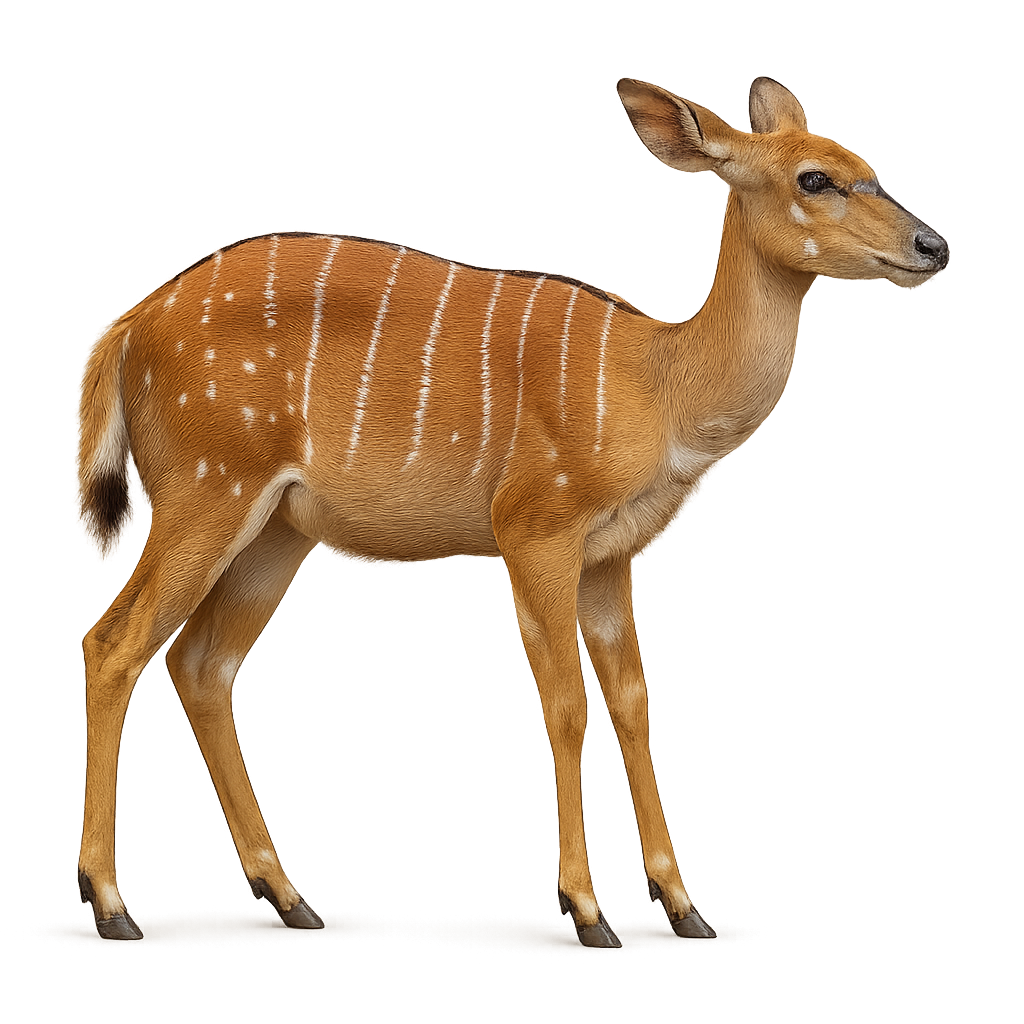
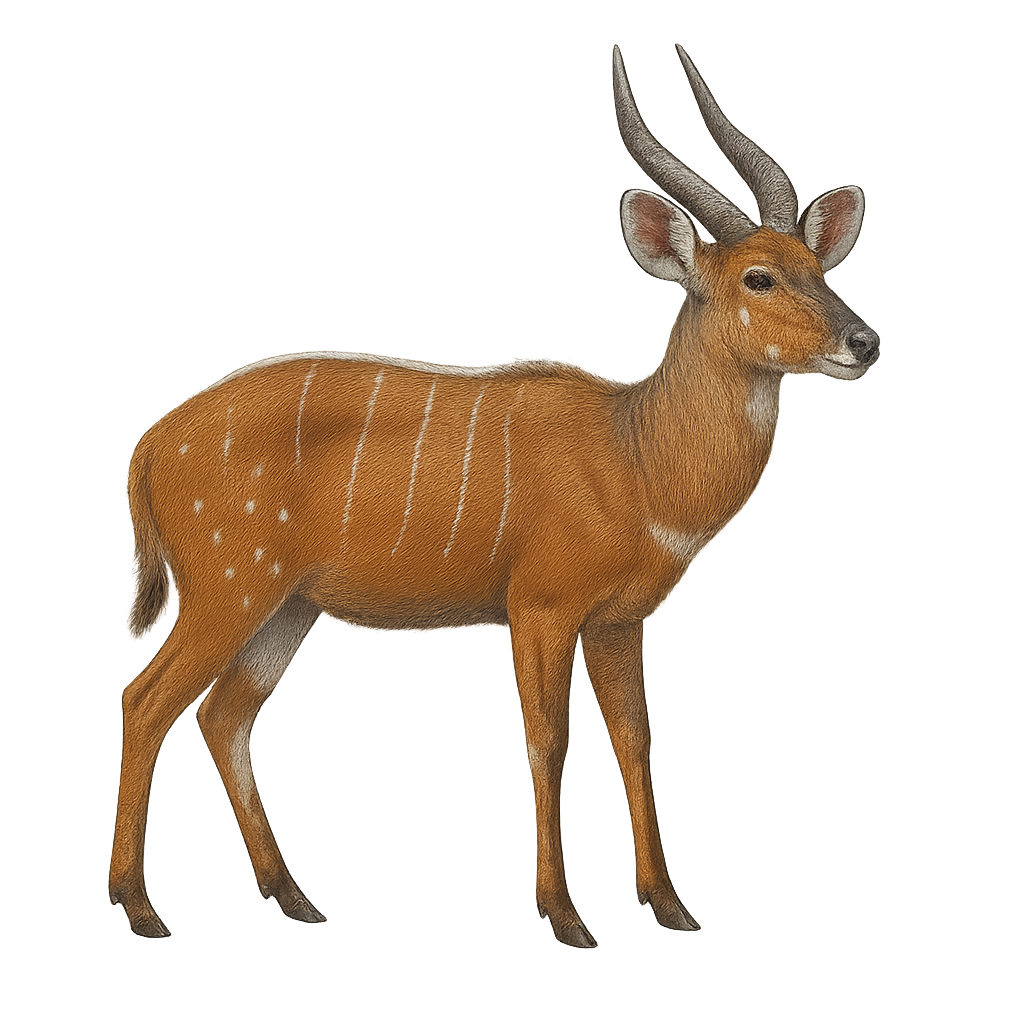
The bushbuck, or Tragelaphus scriptus, is a small African antelope known for its brown coat adorned with white stripes and spots. Males have spiral horns, while females do not. This mammal is primarily nocturnal and crepuscular, favoring dense forests and bushy areas where it can hide from predators. It is solitary, although females may be seen with their young. The bushbuck is an herbivore, feeding on leaves, fruits, and young shoots. Its ability to remain still and silent makes it a challenging animal to observe in its natural habitat.
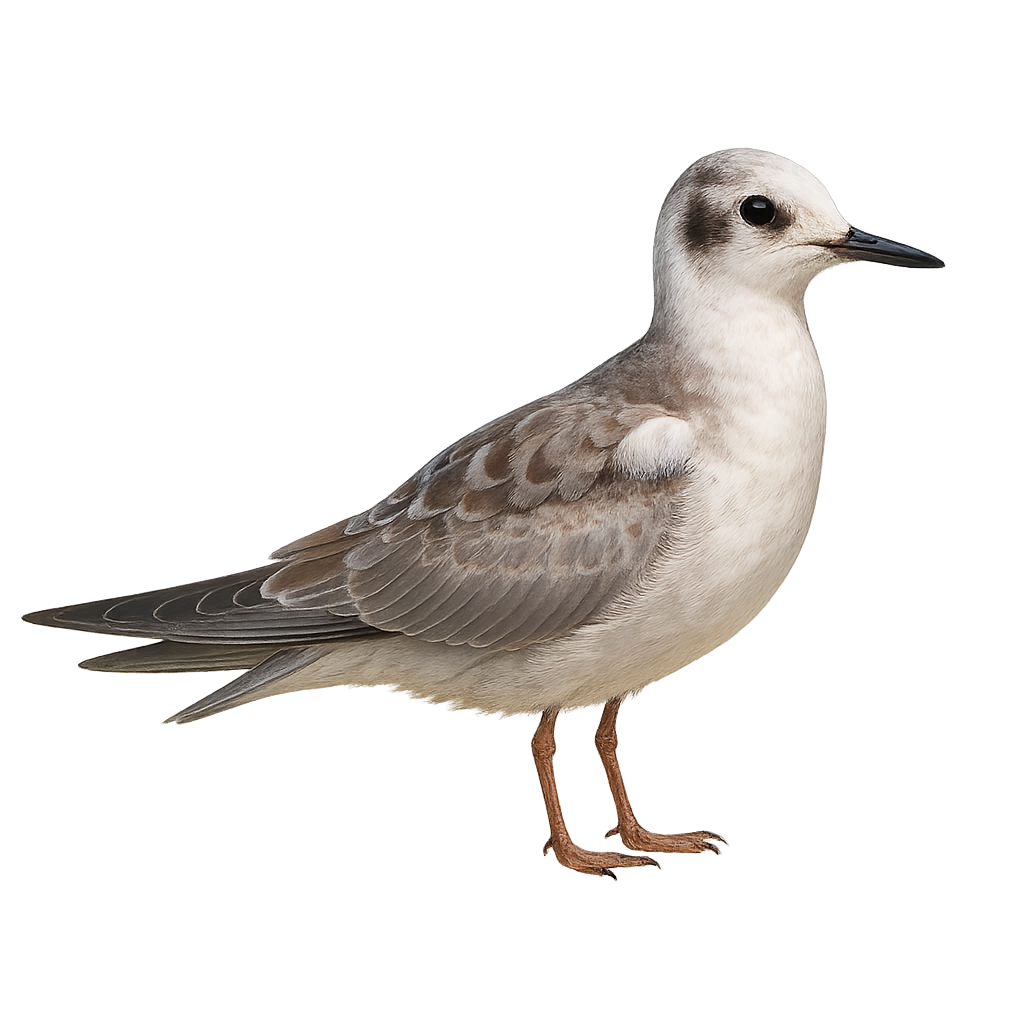
The White-winged Tern, Chlidonias leucopterus, is an elegant bird from the Laridae family, recognizable by its white wings contrasting with its black body during the breeding season. It primarily inhabits wetlands, marshes, and lakes, where it feeds on insects and small fish. This migratory bird is found in Eastern Europe and Asia during the breeding season, before migrating to Africa and South Asia for the winter. Its population is generally stable, although threats such as habitat destruction and pollution can affect it locally. The White-winged Tern is a fascinating bird to observe, especially during its aerial acrobatics over water bodies.
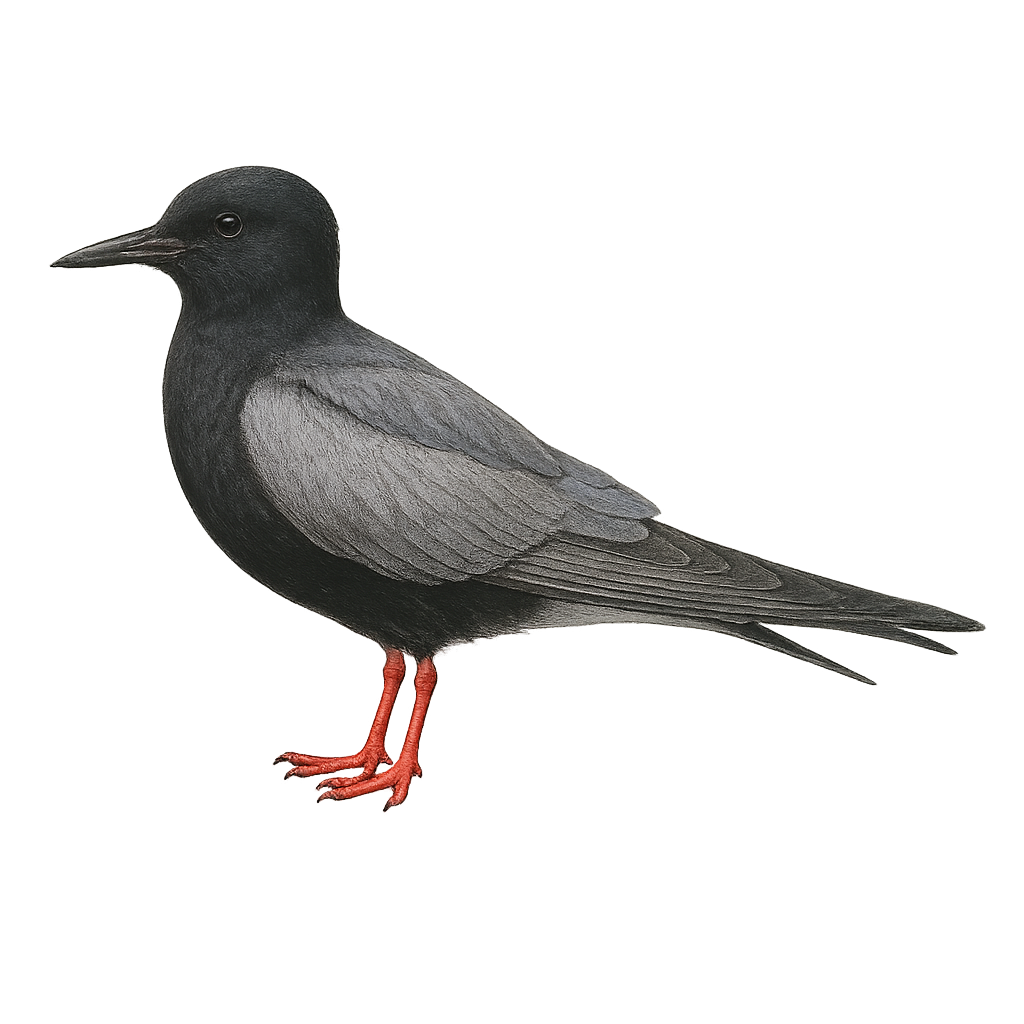
The black tern is a small tern of 23–26 cm with contrasting black and white breeding plumage and a slender body. It inhabits freshwater wetlands, marshes and shallow lakes, feeding on insects and small fish caught in flight by pattering over the water surface. During breeding, it nests on floating vegetation, lays 2–4 eggs and defends its territory with swift aerial displays and sharp calls.
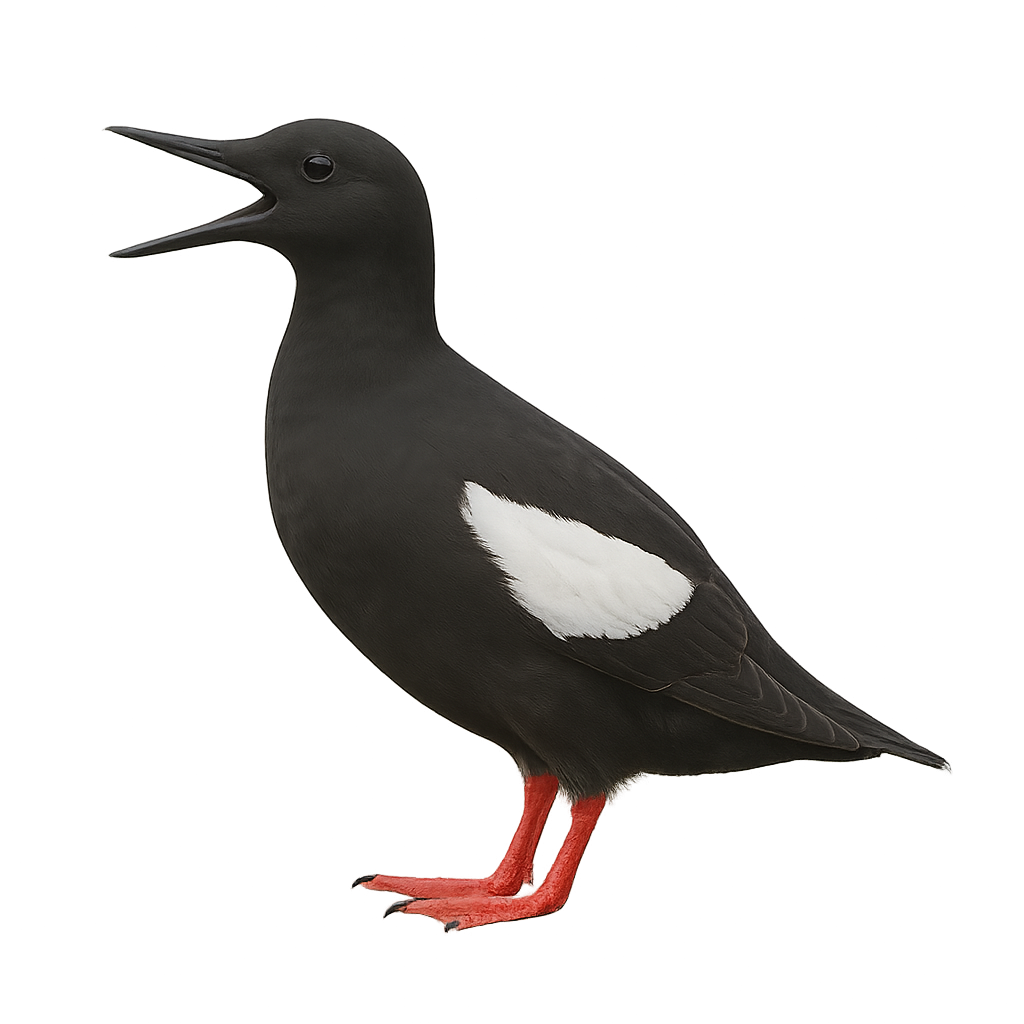
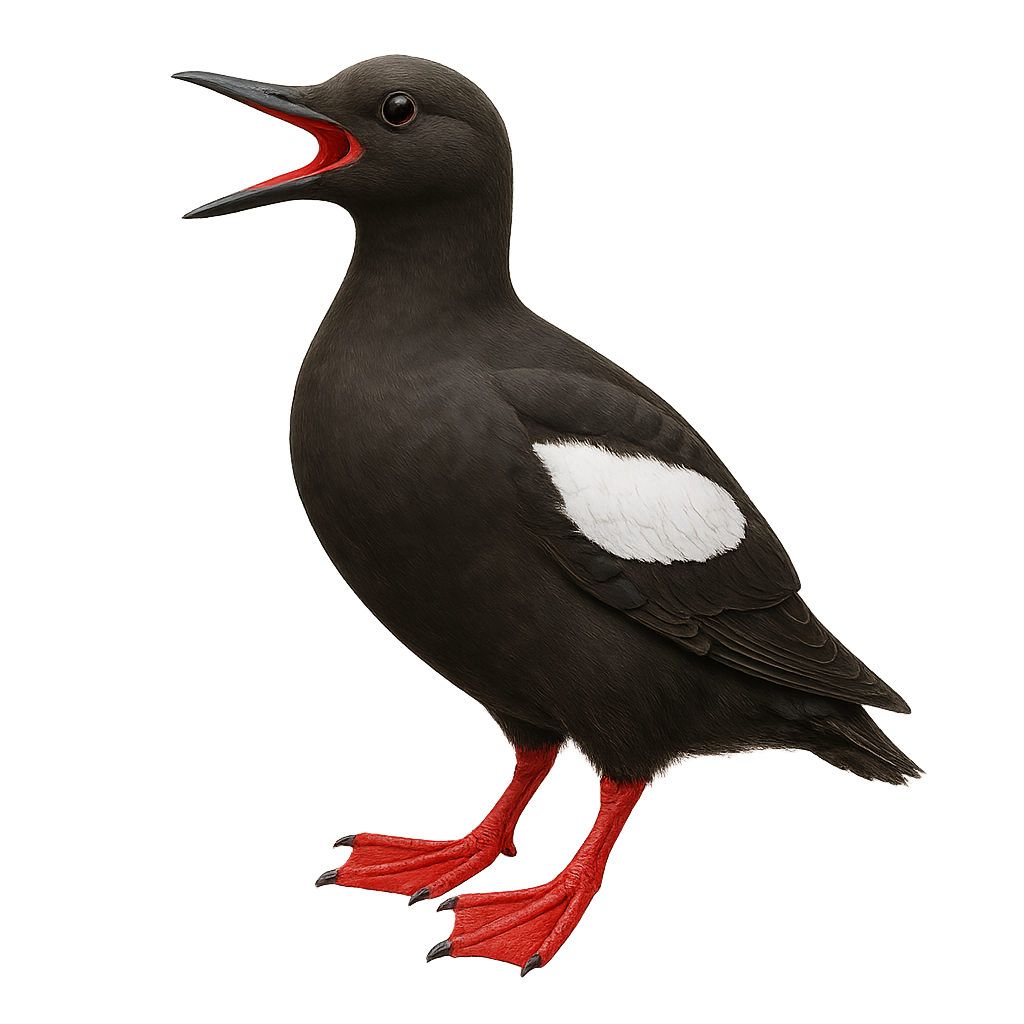
The Black Guillemot is a medium-sized seabird, measuring between 32 and 38 cm in length with a wingspan of 49 to 58 cm. In breeding plumage, it has a black body with a large white wing patch, bright red feet, and a red interior to its bill. In winter, its plumage becomes paler, with a light grey back and head and white underparts. It inhabits rocky coasts of the North Atlantic and Arctic, nesting in crevices of cliffs or under rocks. Its diet mainly consists of fish, crustaceans, and mollusks, which it captures by diving up to 50 meters deep. Although listed as Least Concern by the IUCN, it is sensitive to marine pollution and predation by introduced species.
The Pigeon Guillemot, Cepphus columba, is a medium-sized seabird belonging to the Alcidae family. It is primarily black with distinctive white wing patches and red legs. Its slender, pointed bill is adapted for catching small fish and marine invertebrates. Found mainly along the rocky coasts of the North Pacific, from Alaska to California, it is known for its impressive diving abilities, reaching significant depths to hunt its prey. During the breeding season, it nests in rocky crevices, often in scattered colonies. The Pigeon Guillemot is a resilient bird, well-adapted to its marine environment, but remains sensitive to human disturbances and environmental changes.
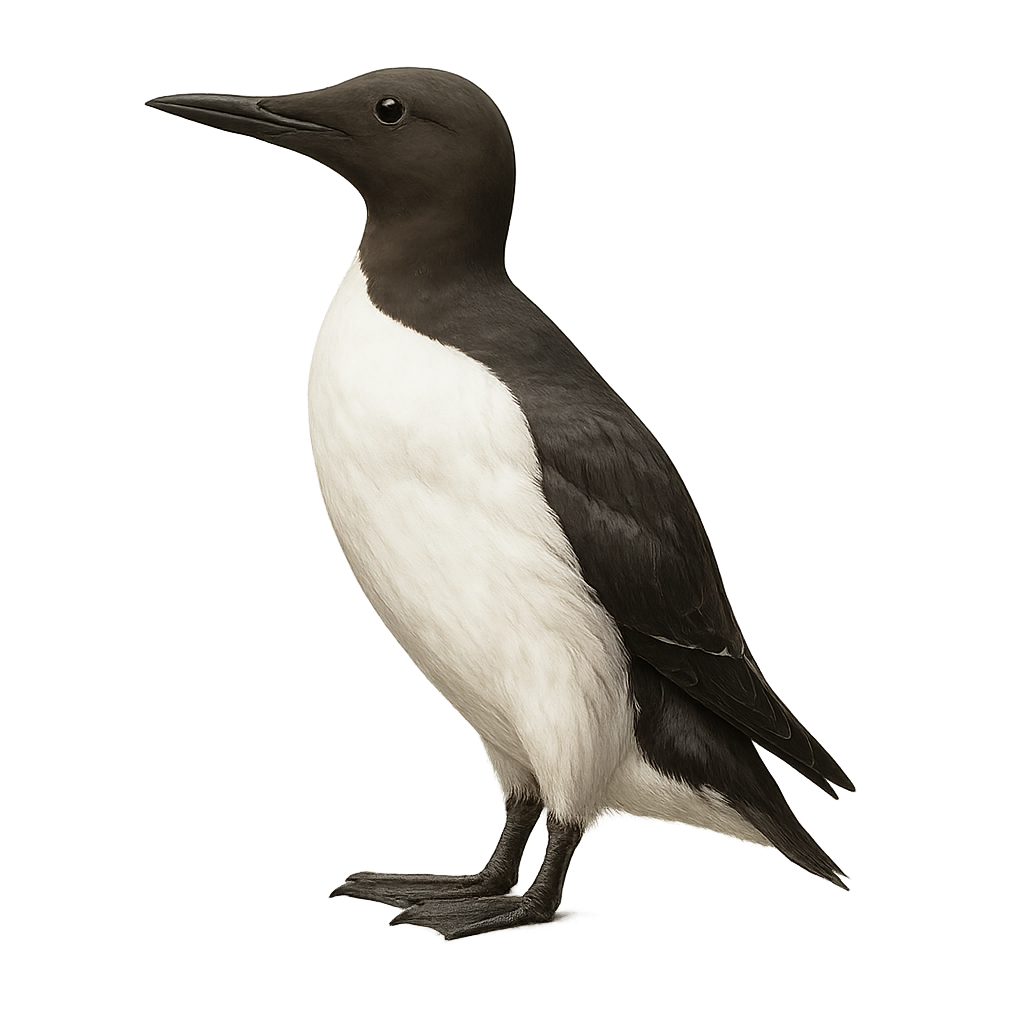
The Thick-billed Murre, or Uria lomvia, is a robust seabird found in the cold waters of the Arctic and subarctic regions. It is identifiable by its distinctive black and white plumage, with a black back and white belly, as well as its thick, short bill. This bird is an excellent diver, capable of reaching impressive depths to catch fish and crustaceans, which make up the bulk of its diet. Breeding colonies are typically located on steep cliffs, where the birds nest in large groups to protect themselves from predators. Although currently listed as Least Concern by the IUCN, the Thick-billed Murre is vulnerable to climate change and marine pollution, which threaten its natural habitat.
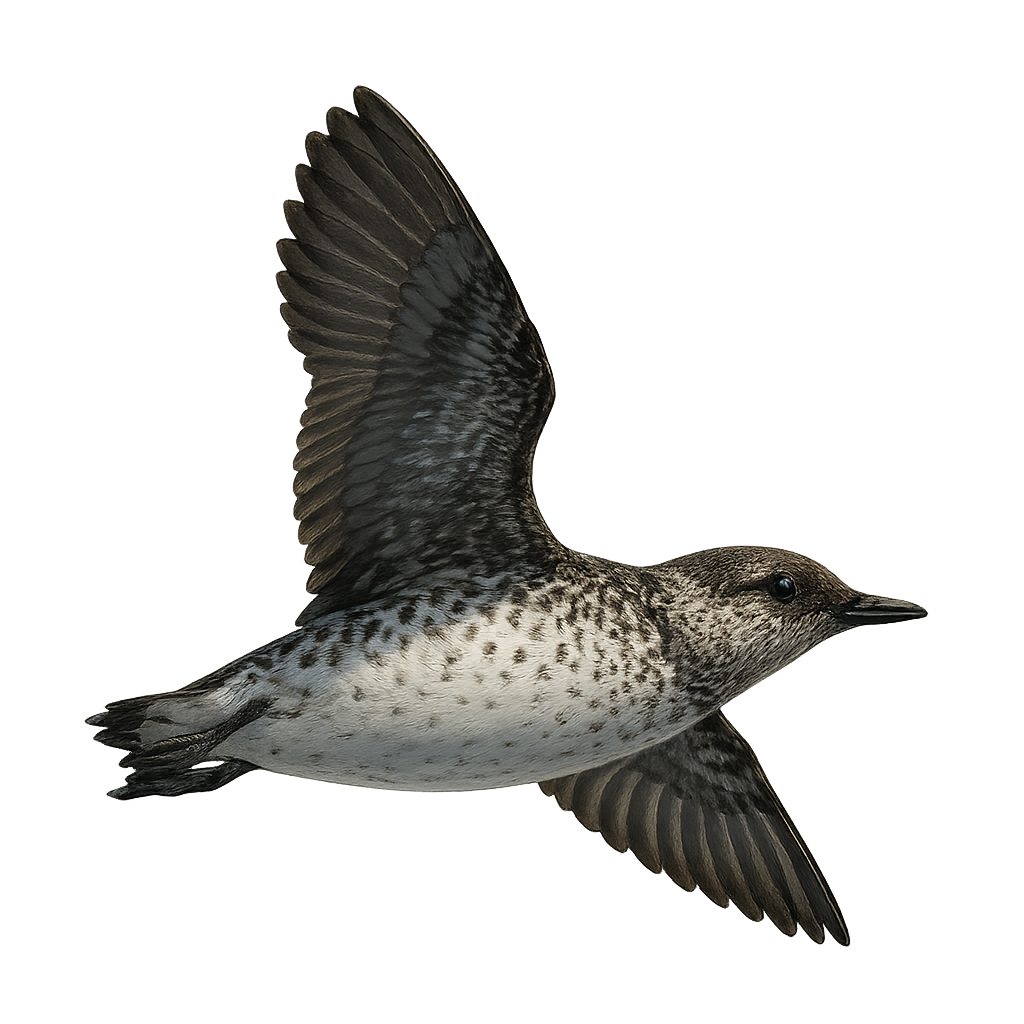
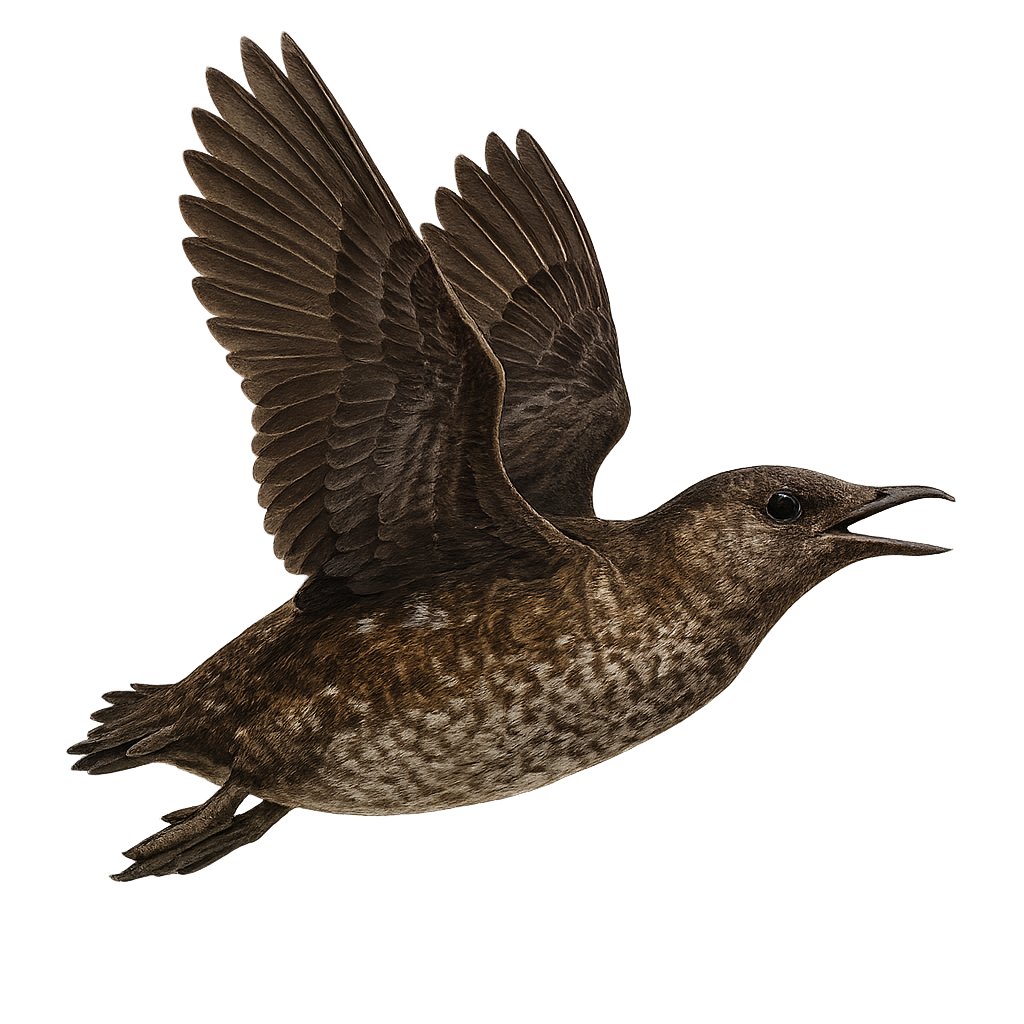
The Kittlitz's Murrelet, or Brachyramphus brevirostris, is a discreet seabird belonging to the Alcidae family. It is primarily found in the cold waters of Alaska and the Russian Far East. This bird is distinguished by its marbled brown breeding plumage and white belly, while its winter plumage is more subdued with grayish tones. Its compact size and short bill are well-suited to its marine lifestyle. It primarily feeds on small fish and marine invertebrates. The Kittlitz's Murrelet is known for its ability to nest far from the coast, often on rocky slopes or cliffs, making it difficult to observe. Its population is vulnerable due to climate change and marine pollution.
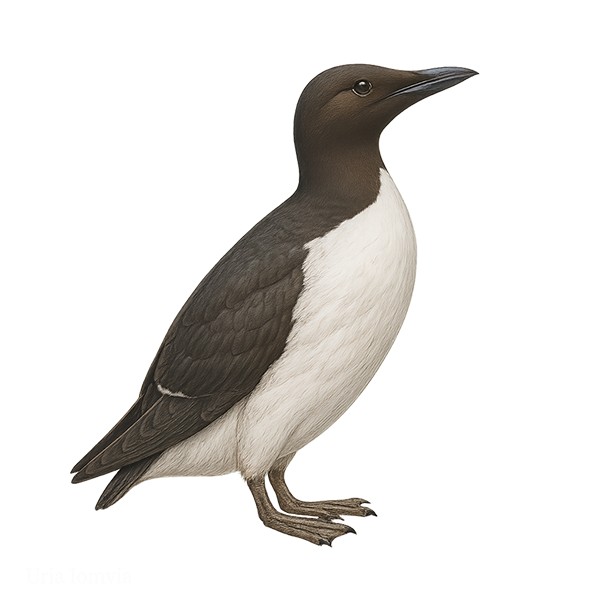
The Common Guillemot is a seabird characterized by its black and white plumage, and its streamlined body which allows it to swim with agility. It measures about 40 to 45 cm in length and weighs between 500 and 700 g. Its head is black with sharp white eyes, and its wings are short and pointed, suited for diving. The Common Guillemot primarily lives on coastal cliffs, where it nests in very dense colonies, often on inaccessible sites. It is found mainly in Northern Europe, particularly in Scandinavia, the United Kingdom, and Iceland, but also along the coasts of the North Atlantic. The Common Guillemot is an excellent diver, primarily feeding on fish, particularly small herring and capelin, which it catches by diving underwater in search of prey. While the species is not endangered, it is vulnerable to marine pollution, climate change, and disruption of its breeding sites.
The Marbled Murrelet, Brachyramphus marmoratus, is a discreet and fascinating seabird belonging to the Alcidae family. It is primarily observed along the North Pacific coasts, from Alaska to California. This small bird, measuring about 25 cm in length, is recognizable by its marbled brown and white plumage, which allows it to blend effectively into its environment. Unlike most other alcids, the Marbled Murrelet nests in old-growth forests, often several kilometers from the sea, where it lays a single egg on a tree branch. It primarily feeds on small fish and marine invertebrates, which it skillfully captures by diving underwater. Unfortunately, this species is threatened by the loss of its forest habitat and human disturbances.
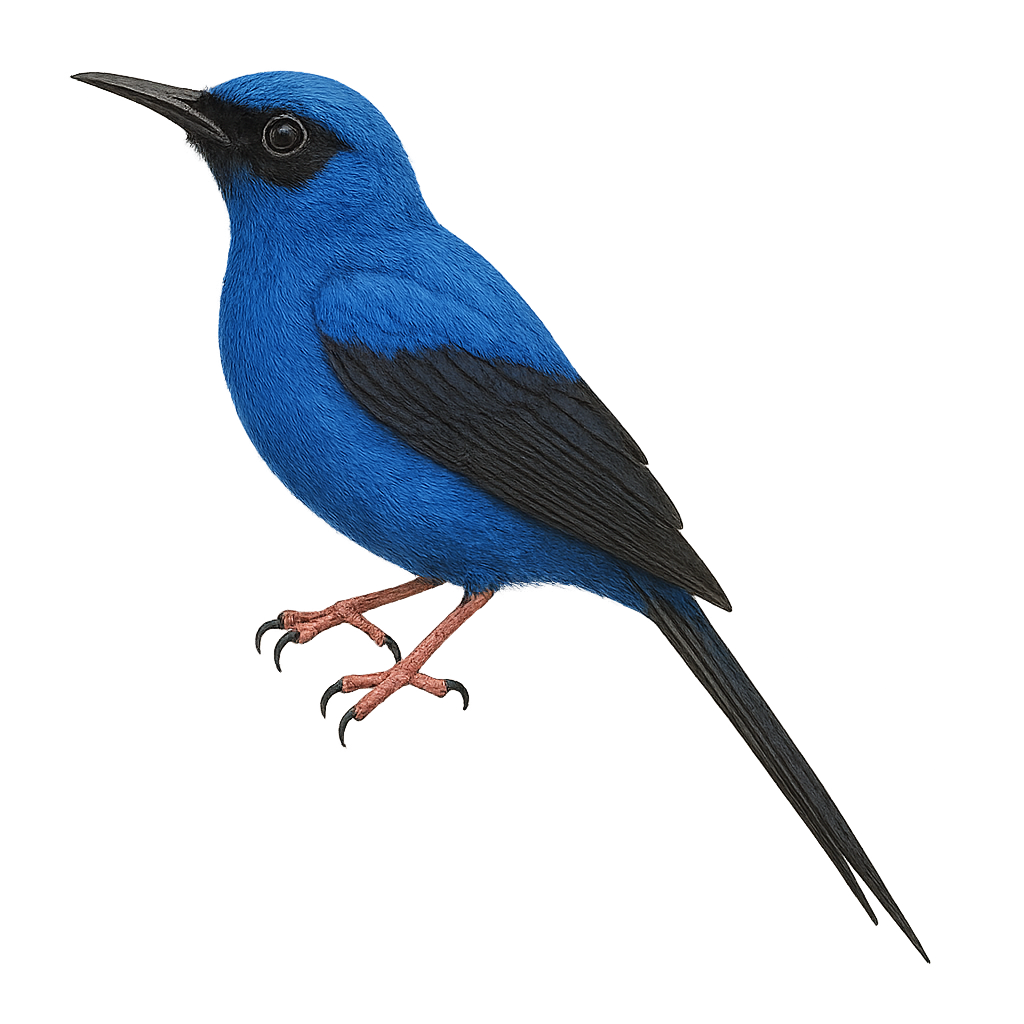
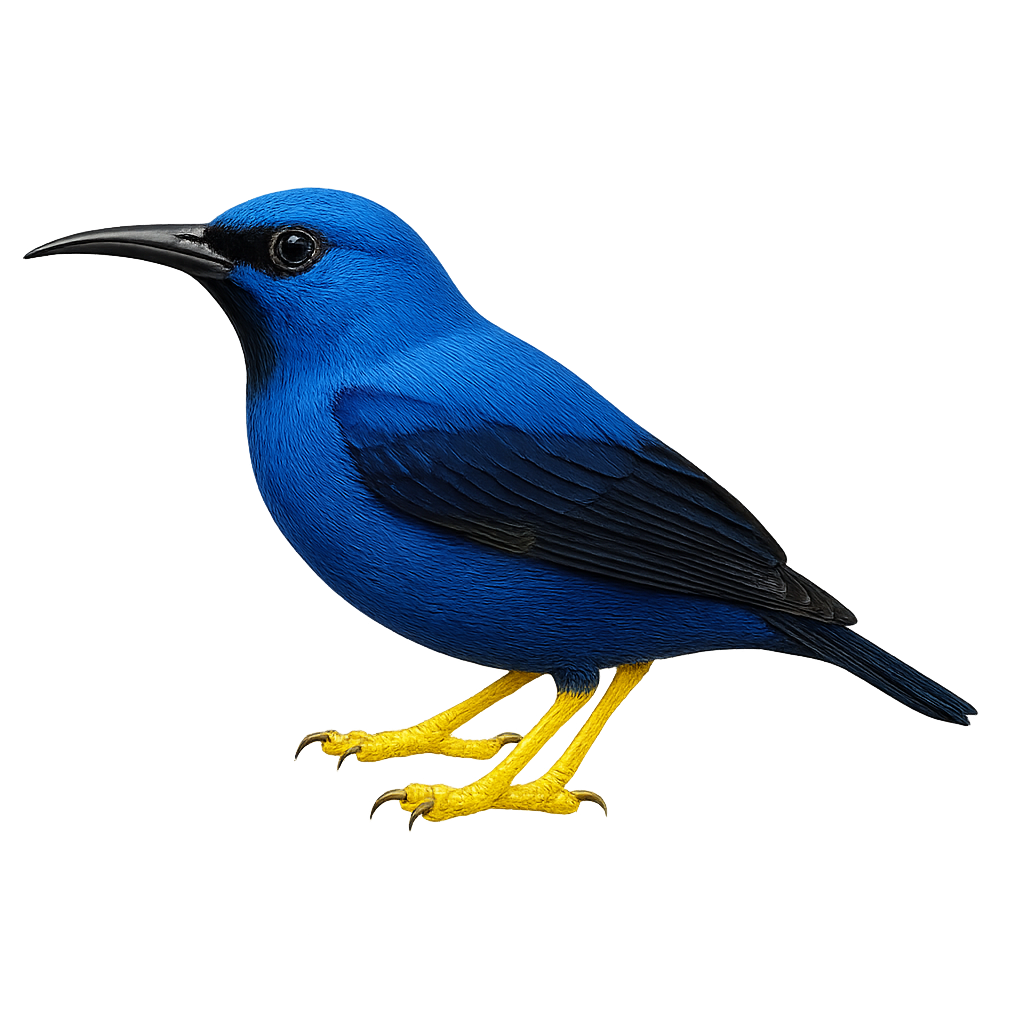
The Shining Honeycreeper, Cyanerpes nitidus, is a small, vibrant tropical bird, primarily electric blue with black wings and tail. Males display a striking plumage, while females are generally duller, with green and yellow hues. This bird is commonly found in the humid tropical forests of South America, particularly in Brazil, Colombia, and Venezuela. It primarily feeds on nectar but also consumes insects and fruits. Its slender, curved beak is perfectly adapted for extracting nectar from flowers. The Shining Honeycreeper is an active and social bird, often seen in small groups or pairs.
The Cyanerpes lucidus, or Shining Honeycreeper, is a small tropical bird with vibrant colors, primarily blue with black wings and a slender, curved beak. This nectarivore primarily feeds on nectar but also consumes fruits and insects. It is found in the humid forests and forest edges of Central America, from southern Mexico to Panama. Males display a striking blue plumage, while females are more subdued in green. Their behavior is generally active and social, often seen in small groups. They play a crucial role in pollinating tropical plants.
The Purple Honeycreeper is a small tropical bird with vibrant plumage, primarily blue with shades of violet, and black wings. Males have a curved black bill, while females display a more subdued green plumage. This bird inhabits the humid forests of Central and South America, feeding mainly on nectar, fruits, and insects. Its behavior is generally active and sociable, often seen in small groups. It plays a crucial role in the pollination of tropical plants. Although not currently threatened, deforestation poses a potential risk to its natural habitat.
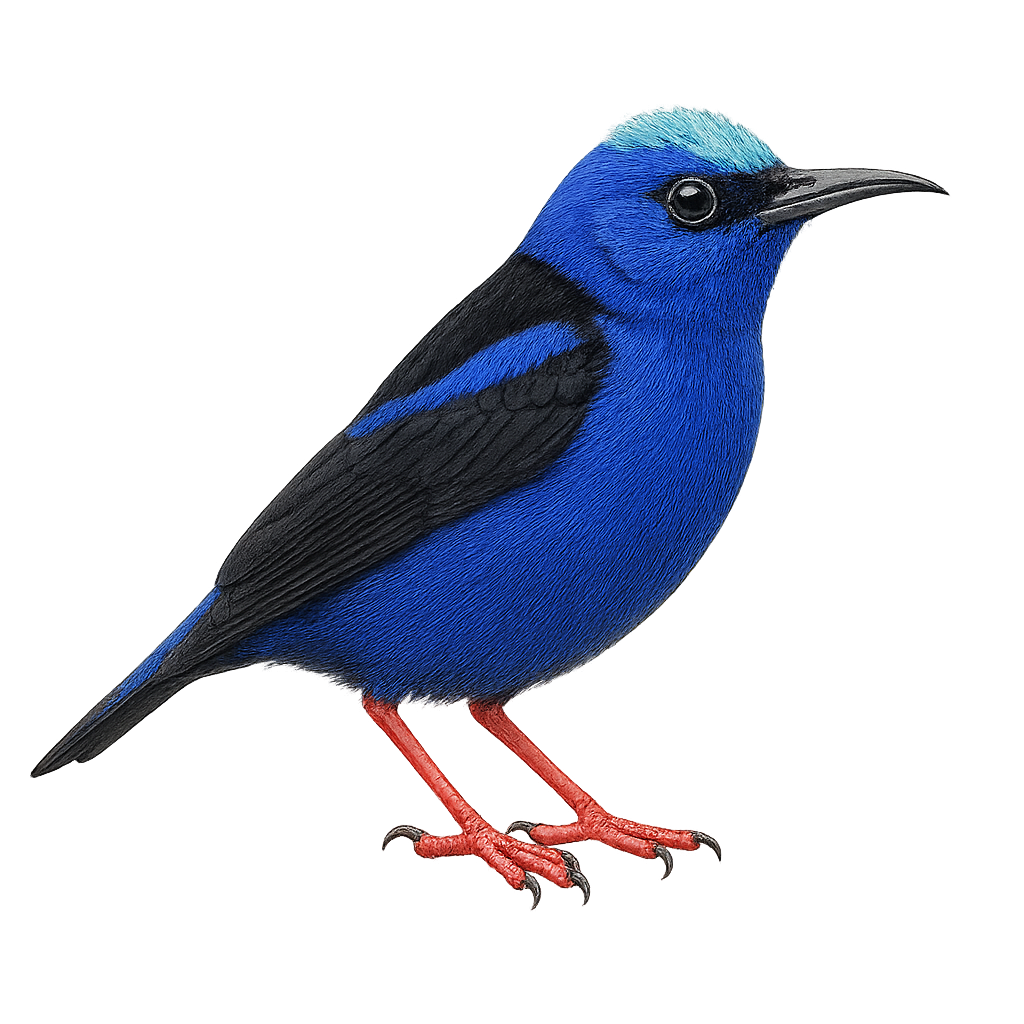
The Red-legged Honeycreeper, Cyanerpes cyaneus, is a small, vibrantly colored tropical bird, primarily electric blue with black wings and red legs. It is commonly found in the humid forests and wooded areas of Central and South America. This nectarivore feeds mainly on nectar but also consumes fruits and insects. Males display a striking plumage, while females are generally olive green with bluish hues. The Red-legged Honeycreeper is a social bird, often seen in small groups, and is known for its aerial acrobatics when feeding. Its breeding season varies by region but is generally active year-round in tropical areas.
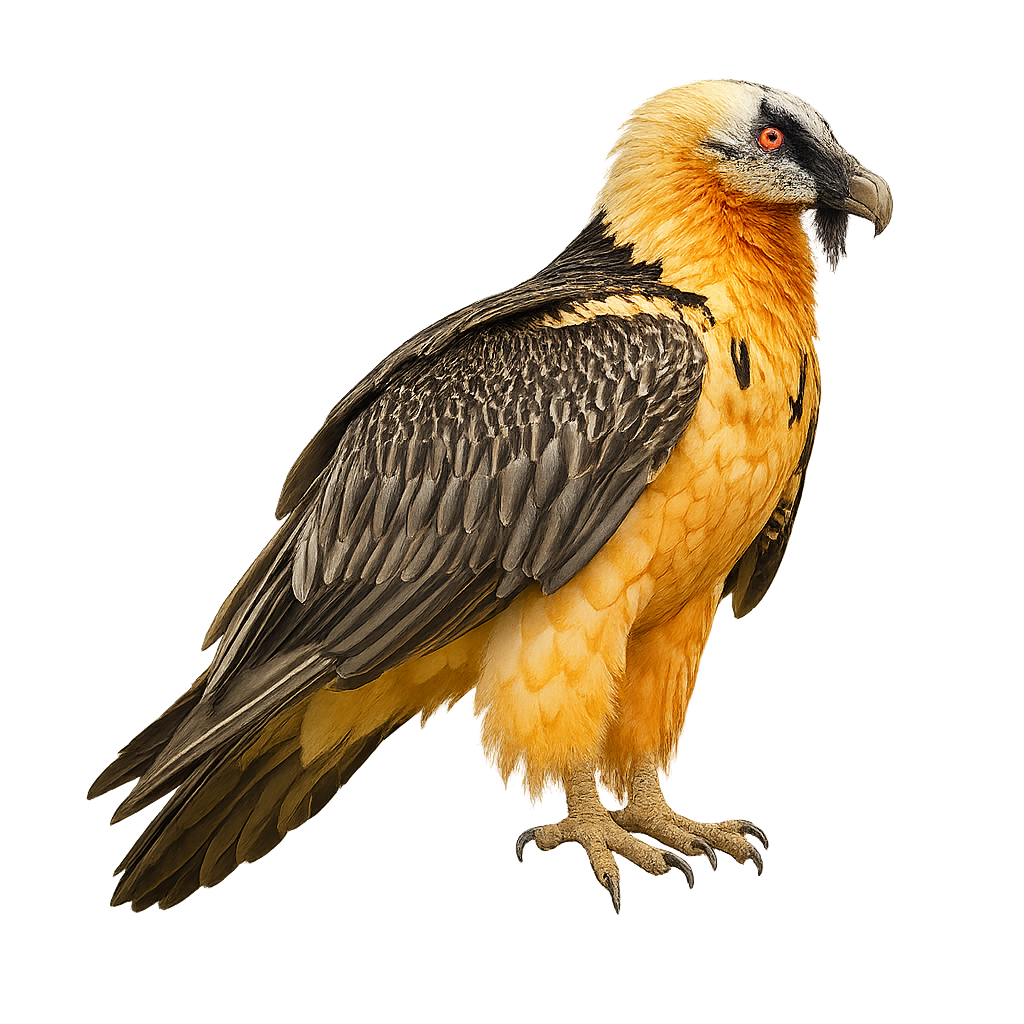
The Bearded Vulture is a large vulture, easily recognizable by its distinctive head, large wings, and brown and white plumage. It measures about 1.1 to 1.3 meters in length, with a wingspan of 2.6 to 2.8 meters, and weighs between 4.5 and 7.5 kg. Its head is covered with dark feathers, while its wings and back are mainly brown, with lighter feathers on its belly. The Bearded Vulture is unique among vultures for its feeding behavior, as it primarily feeds on bones. It is capable of breaking the hardest bones by dropping them from great heights to shatter them, allowing it to access the bone marrow. It primarily inhabits mountains, notably the Alps, the Pyrenees, and the Himalayas, where it also feeds on carcasses of dead animals, such as chamois or mouflons. Although the species was once endangered, conservation efforts have helped restore its population in certain areas. However, the Bearded Vulture remains vulnerable to human disturbance, habitat loss, and the decline of its natural prey.
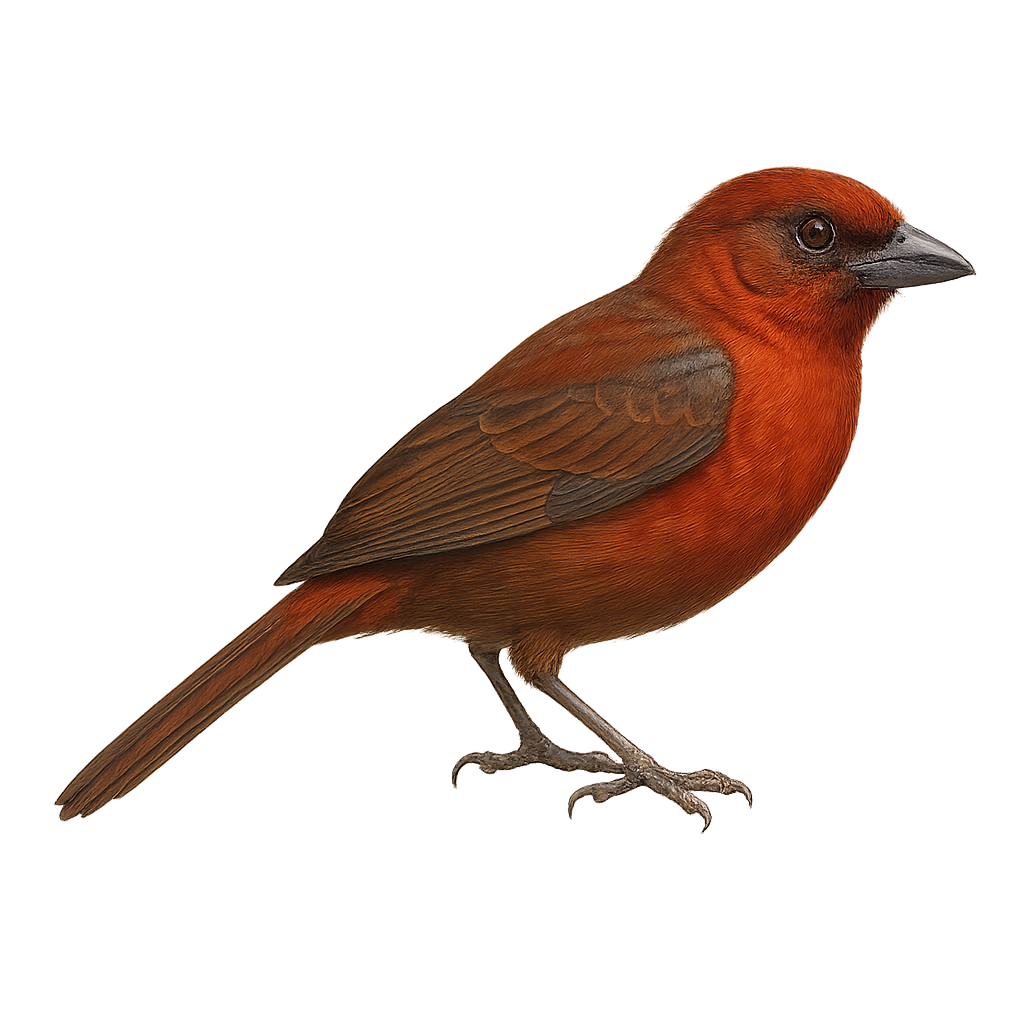
The Red-throated Ant-tanager is a medium-sized bird, primarily recognized for its bright red throat in males, while females display more subdued tones. It is mainly found in the tropical and subtropical forests of Central America, favoring dense undergrowth. This bird is often seen in small groups, feeding on insects and fruits. Its song is a soft whistle, often heard at dawn. Although relatively common in its natural habitat, it remains discreet and difficult to spot due to its plumage that blends into the forest environment. Its ability to adapt to various forest habitats makes it a resilient species in the face of deforestation.
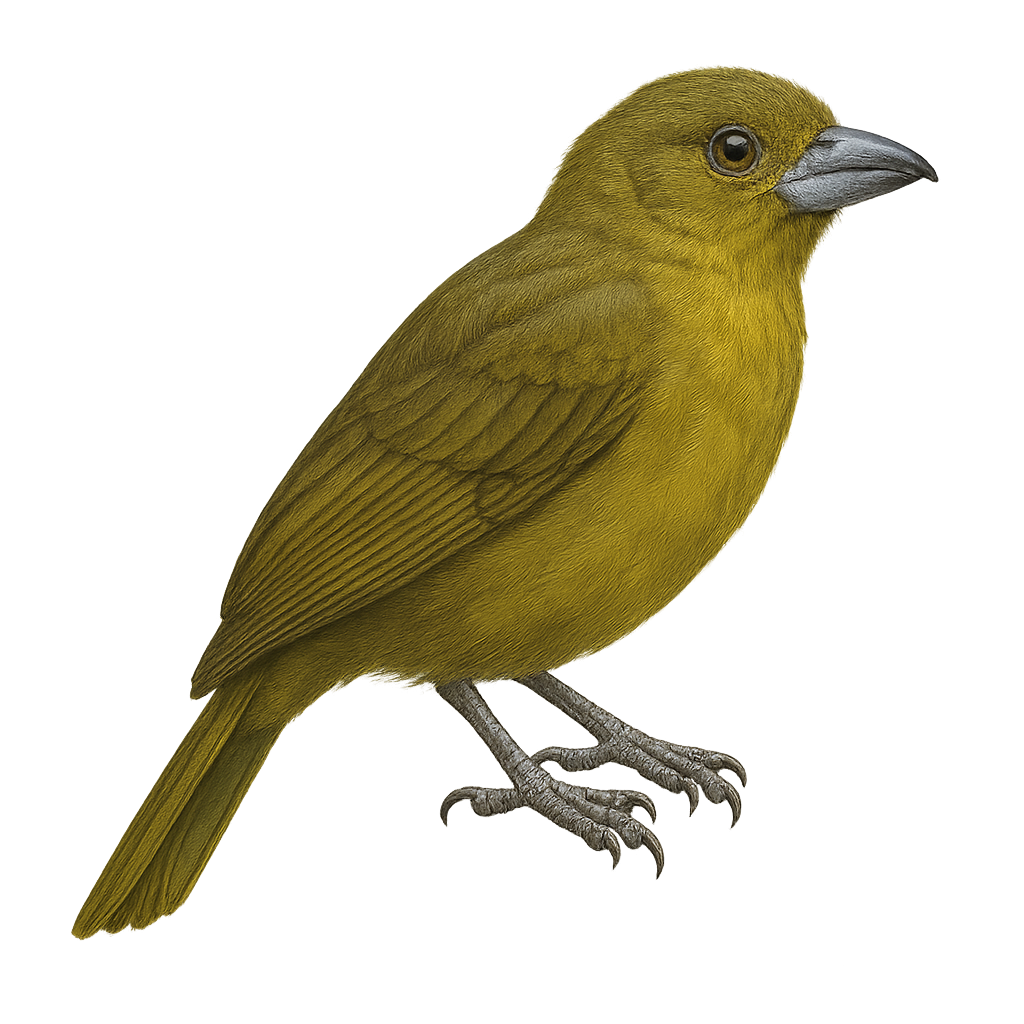
The Carmiol's Tanager is a medium-sized bird, measuring about 18 cm in length. It features primarily olive-green plumage, with darker shades on the wings and tail. Its head is marked by a grayish cap, and it has a robust, slightly hooked beak suited for its varied diet. This bird primarily feeds on fruits, insects, and small invertebrates. It is mainly found in the humid forests and wooded areas of Central America, particularly in Costa Rica and Panama. The Carmiol's Tanager is often seen in small groups, actively moving through the canopy in search of food. Although not considered threatened, deforestation poses a potential threat to its natural habitat.
The hamadryas baboon, also known as the sacred baboon, is a primate species distinguished by its silver fur and the impressive mane of the males. Native to the Horn of Africa and parts of the Arabian Peninsula, it lives in complex social groups. Dominant males lead harems consisting of several females and their offspring. These baboons are diurnal and spend most of their time foraging for food, primarily fruits, seeds, and insects. Their natural habitat includes savannas, arid steppes, and rocky areas. Although they can survive in harsh environments, their population is threatened by habitat loss and hunting.
The Common Eider is a medium-sized seabird, easily recognizable by its distinctive plumage and diving behavior. It measures about 40 cm in length, with a wingspan of 65 to 75 cm, and weighs between 500 and 900 g. Its plumage is primarily black and white, with a black head, a wide white band around the neck, and white spots on the wings. The male, during the breeding season, has a bright orange beak and a distinctive white line running from the beak to the back of the head. The Common Eider primarily inhabits the cold waters of the North Atlantic, notably around the coasts of Iceland, Greenland, Canada, and Northern Europe. It is an excellent diver, feeding mainly on small fish, crustaceans, and marine invertebrates, which it captures underwater. The Common Eider migrates southward during the winter. Although the species is not currently endangered, it is vulnerable to marine pollution, climate change, and disturbance of its breeding sites.
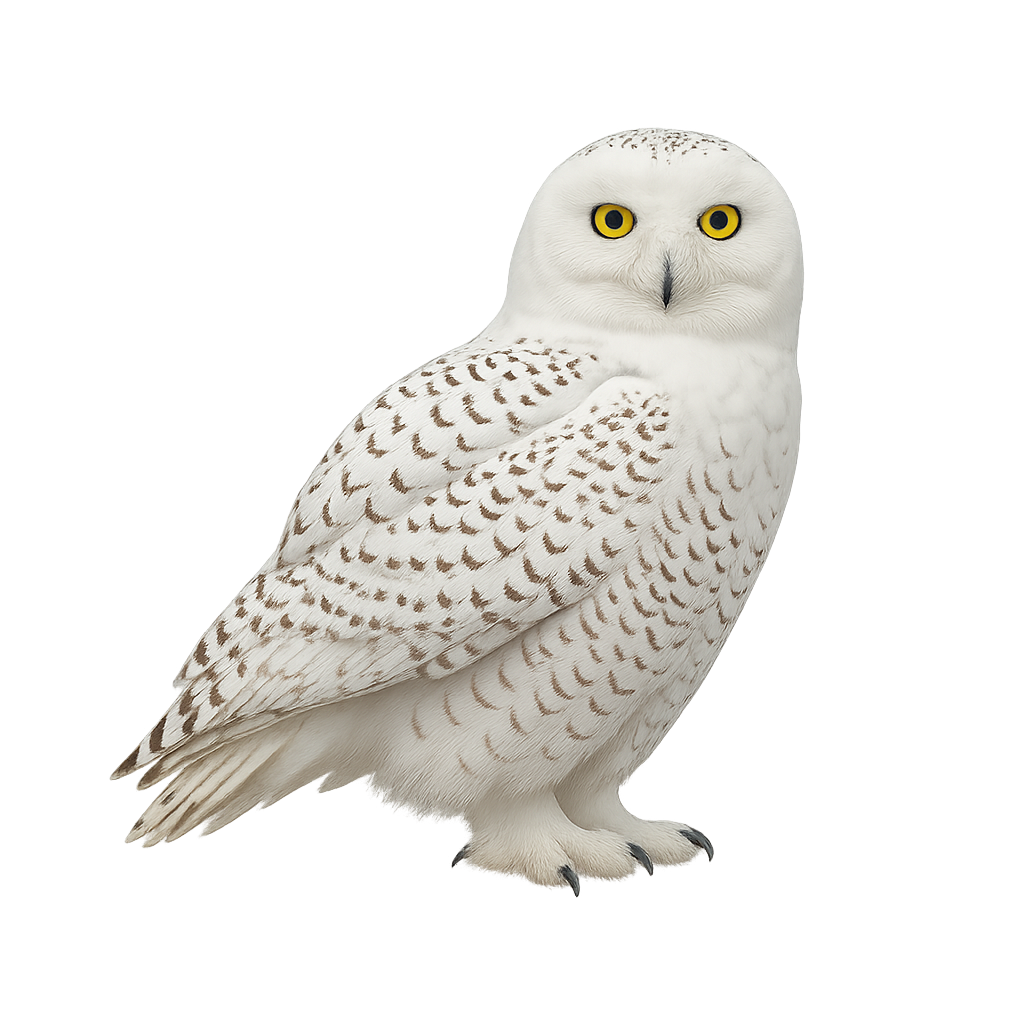
The Snowy Owl is a large nocturnal raptor, easily recognizable by its pure white plumage, speckled with dark spots on its back and wings. It measures about 55 to 65 cm in length, with a wingspan of 1.3 to 1.5 meters, and weighs between 1.5 and 2.5 kg. Its head is round, with large, piercing yellow eyes and a short, hooked beak. The Snowy Owl primarily inhabits the Arctic regions, notably in Canada, Alaska, Scandinavia, and Russia, where it frequents tundras and snowy landscapes. It primarily feeds on small mammals, such as lemmings, but also hunts birds and occasionally fish. This raptor is an excellent hunter, capable of spotting its prey with its keen vision, even in low light conditions. Although the Snowy Owl is not currently endangered, it is sensitive to climate change and the loss of its natural habitat.
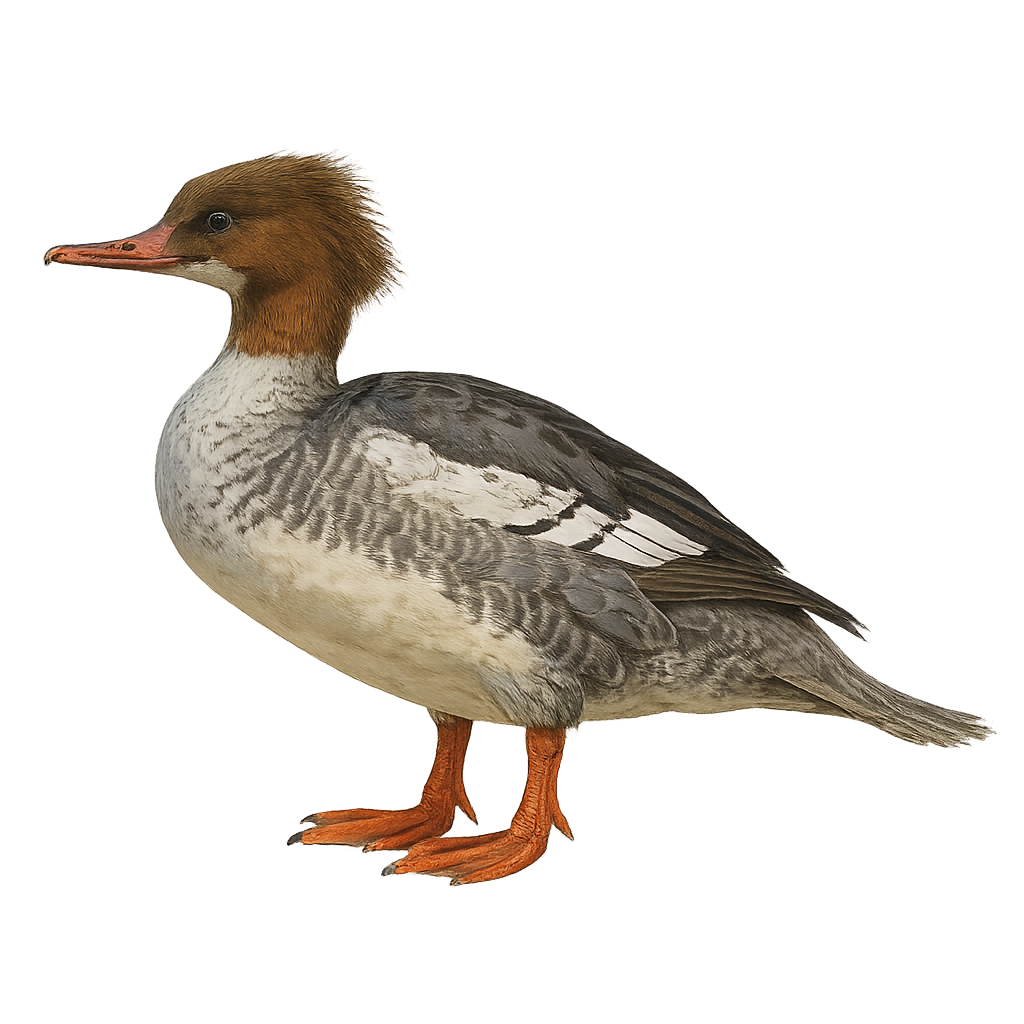
The Common Merganser is a large diving duck measuring between 58 and 71 cm in length, with a wingspan of 82 to 97 cm. The male features a dark green iridescent head, white body, and black back, while the female has a reddish-brown crested head and light gray body. This duck is characterized by its long, slender red bill with serrated edges, ideal for catching slippery fish. It inhabits clear-water rivers and lakes in forested regions of Europe, Asia, and North America. Nesting in tree cavities or cliff crevices, it lays between 6 and 17 eggs per season. Its diet mainly consists of fish, but also includes amphibians, crustaceans, and aquatic insects. Although listed as Least Concern, habitat loss can locally impact its populations.
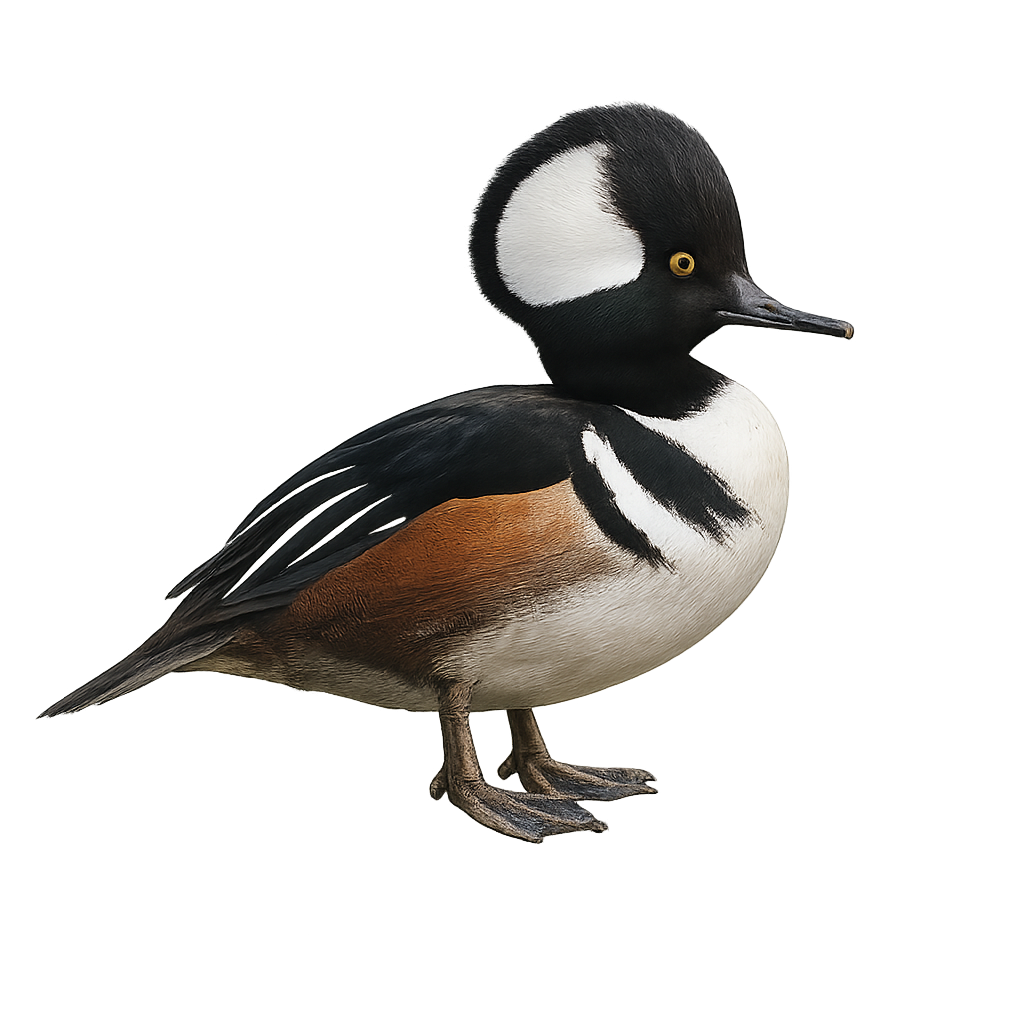
The Hooded Merganser is a medium-sized duck, easily recognizable by its distinctive crest and vibrant colors. It measures about 40 to 50 cm in length, with a wingspan of 60 to 70 cm, and weighs between 400 and 700 g. The male, during the breeding season, has a black and white head with an impressive crest of white feathers on top. Its plumage is mainly black and white, with shades of brown and green, and it has a short, wide beak adapted for feeding on fish, crustaceans, and aquatic invertebrates. The female, on the other hand, is more subtle, with light brown plumage and a less prominent crest. The Hooded Merganser primarily inhabits North America, particularly in the northeastern United States, where it frequents lakes, rivers, and wetland areas. It is an excellent diver, capable of diving underwater to capture its prey. Although the species is not in immediate danger, it is vulnerable to habitat loss and water pollution.
The Red-breasted Merganser is a slender diving duck, measuring about 52 to 58 cm in length with a wingspan of 67 to 82 cm. The male features a dark green head with a shaggy crest, a white collar, a rusty speckled chest, and a thin red bill. The female has a reddish-brown head with a more subdued crest, a grayish body, and a duller red bill. This duck inhabits coastal waters, estuaries, bays, and large lakes, favoring saline or brackish areas. It primarily feeds on small fish, but also consumes crustaceans, aquatic insects, and amphibians, captured using its serrated bill adapted for fishing. A migratory species, it nests on the ground near water, often concealed under vegetation or in rocky crevices. Although listed as Least Concern by the IUCN, the Red-breasted Merganser is sensitive to water pollution, coastal habitat destruction, and human disturbances.
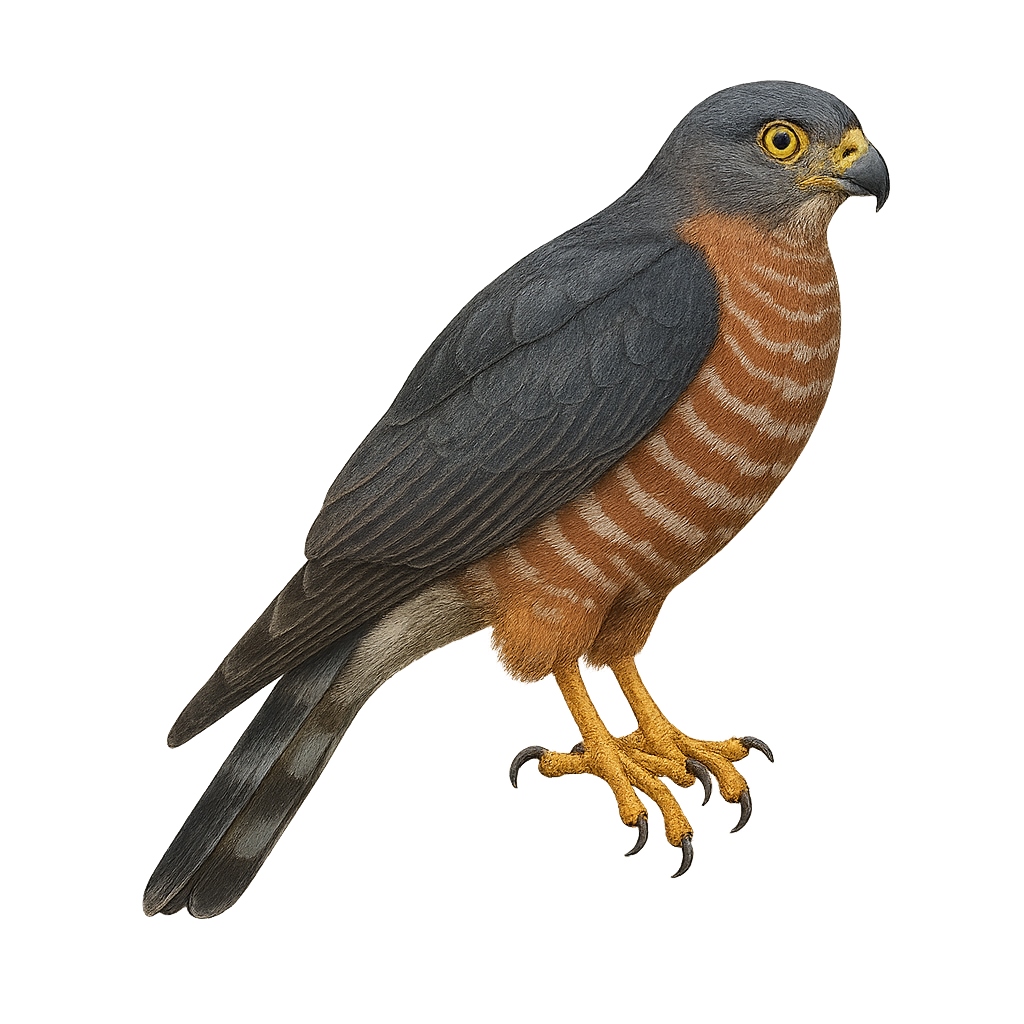
The Double-toothed Kite, or Harpagus bidentatus, is a medium-sized raptor found mainly in the tropical forests of Central and South America. It is easily recognizable by its grayish plumage and short, rounded wings, which allow it to maneuver skillfully through dense forest canopies. This bird of prey primarily feeds on reptiles, insects, and occasionally small mammals. Its name comes from the two prominent teeth on its beak, which help it grasp and tear its prey. The Double-toothed Kite is often observed following groups of capuchin monkeys, taking advantage of the commotion they cause to catch frightened prey.
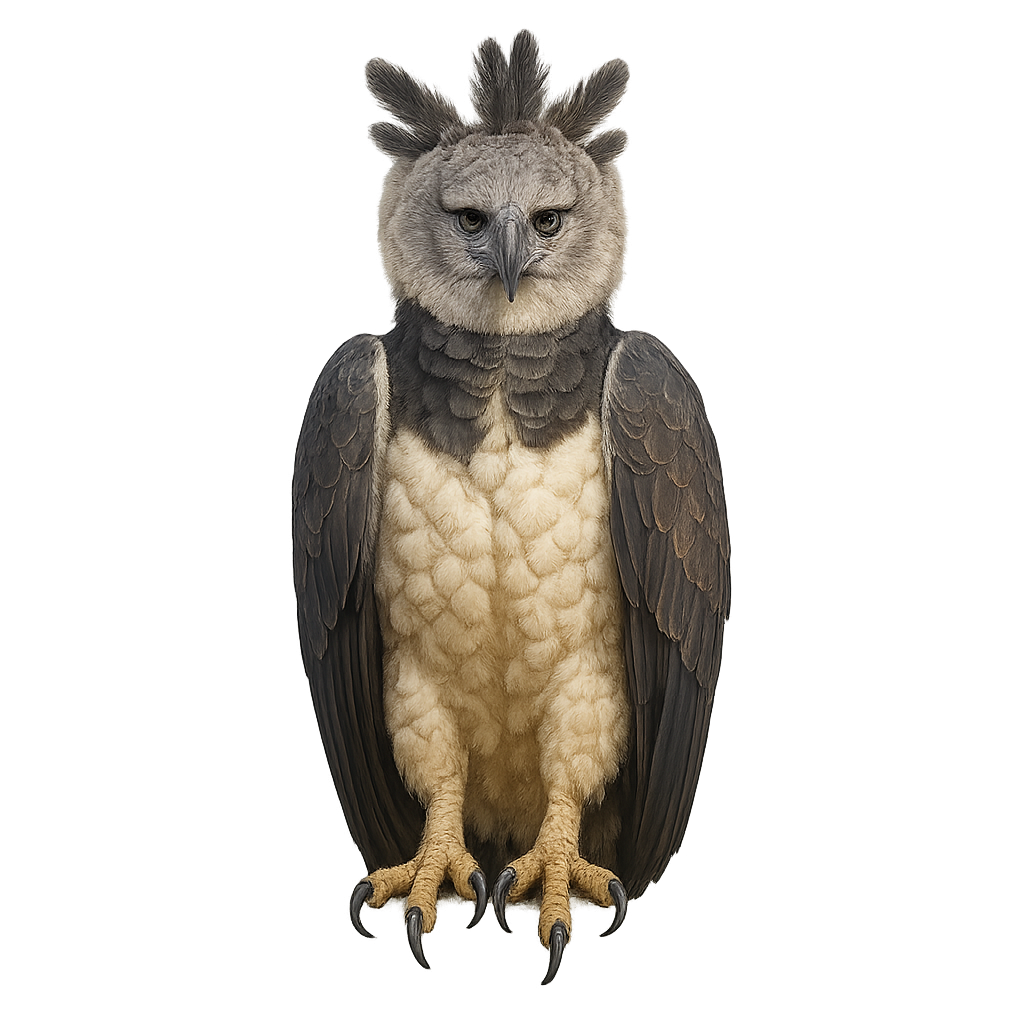
The Harpy Eagle is one of the most powerful and impressive raptors in the world, easily recognizable by its large size and distinctive crest of feathers on its head. It measures between 86 and 107 cm in length, with a wingspan of 2 to 2.3 meters, and weighs between 6 and 10 kg. Its plumage is primarily dark gray and black, with white spots on the wings and belly, and a head adorned with a crest of feathers, giving it an imposing appearance. The Harpy Eagle primarily inhabits the tropical rainforests of Central and South America, notably in Mexico, Panama, Colombia, and Brazil. Carnivorous, it primarily feeds on mammals such as monkeys, sloths, and coatis, which it captures in flight or on trees with its powerful talons. Although the Harpy Eagle is not yet critically endangered, its population is threatened by deforestation, habitat loss, and illegal hunting.
The Heliangelus amethysticollis, or Amethyst-throated Sunangel, is a captivating small bird from the Trochilidae family. This hummingbird is distinguished by its striking violet throat, which beautifully contrasts with its metallic green plumage. It is primarily found in the humid forests of the Andes, at altitudes ranging from 1800 to 3000 meters. Its slender, slightly curved beak is perfectly adapted for feeding on flower nectar, which it gathers with remarkable agility. In addition to its nectarivorous diet, it also consumes small insects to supplement its nutrition. The Amethyst-throated Sunangel is a territorial bird, often observed vigorously defending its territory against other hummingbirds. Its breeding season generally extends from November to March, and the female builds a cup-shaped nest where she lays two eggs.