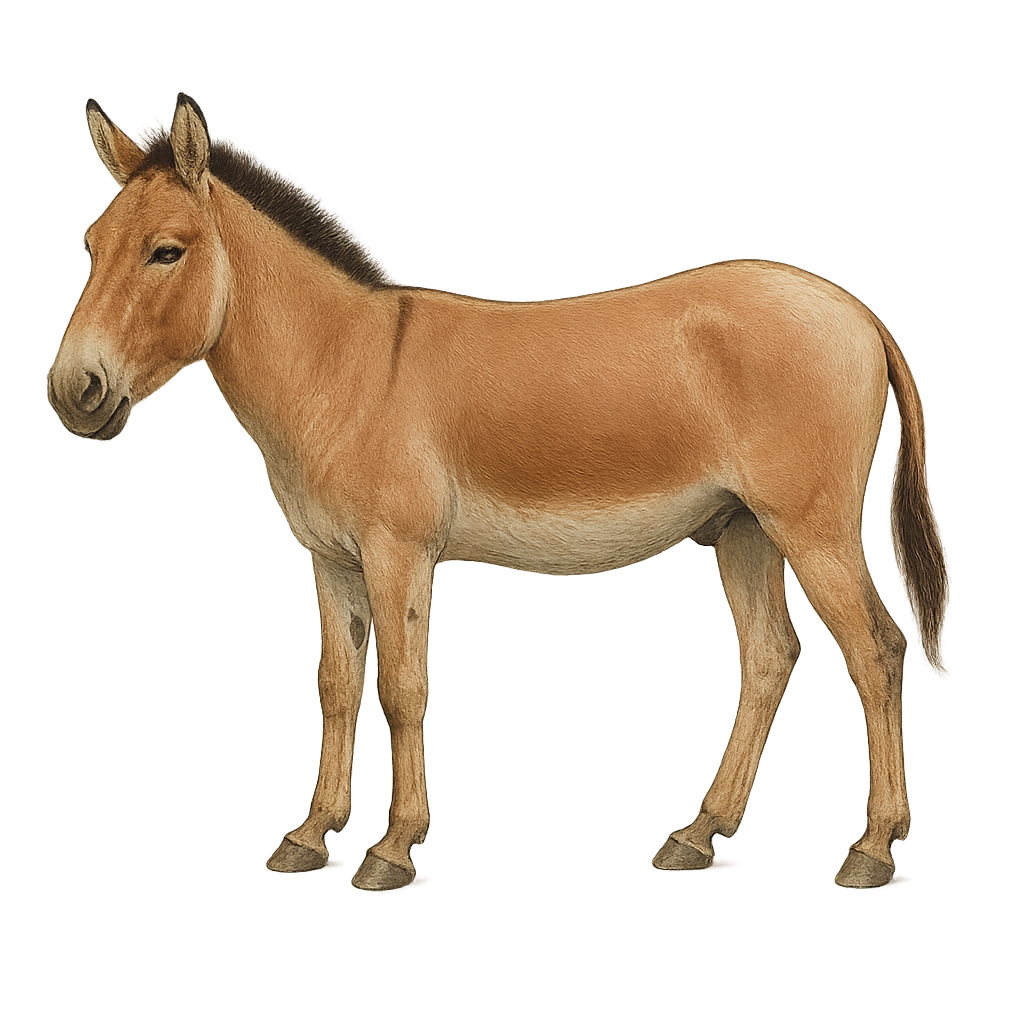
The Equus hemionus, commonly known as the onager or Asiatic wild ass, is a wild equid native to Central Asia. Adapted to arid and semi-arid environments, such as deserts and steppes, it has a light brown coat that becomes paler in winter, and a short, upright mane. Onagers are social animals that live in groups, often led by a dominant male. They primarily feed on grasses but can also consume shrubs and herbs. Although their population has declined due to hunting and habitat loss, conservation efforts are underway to protect this iconic species.
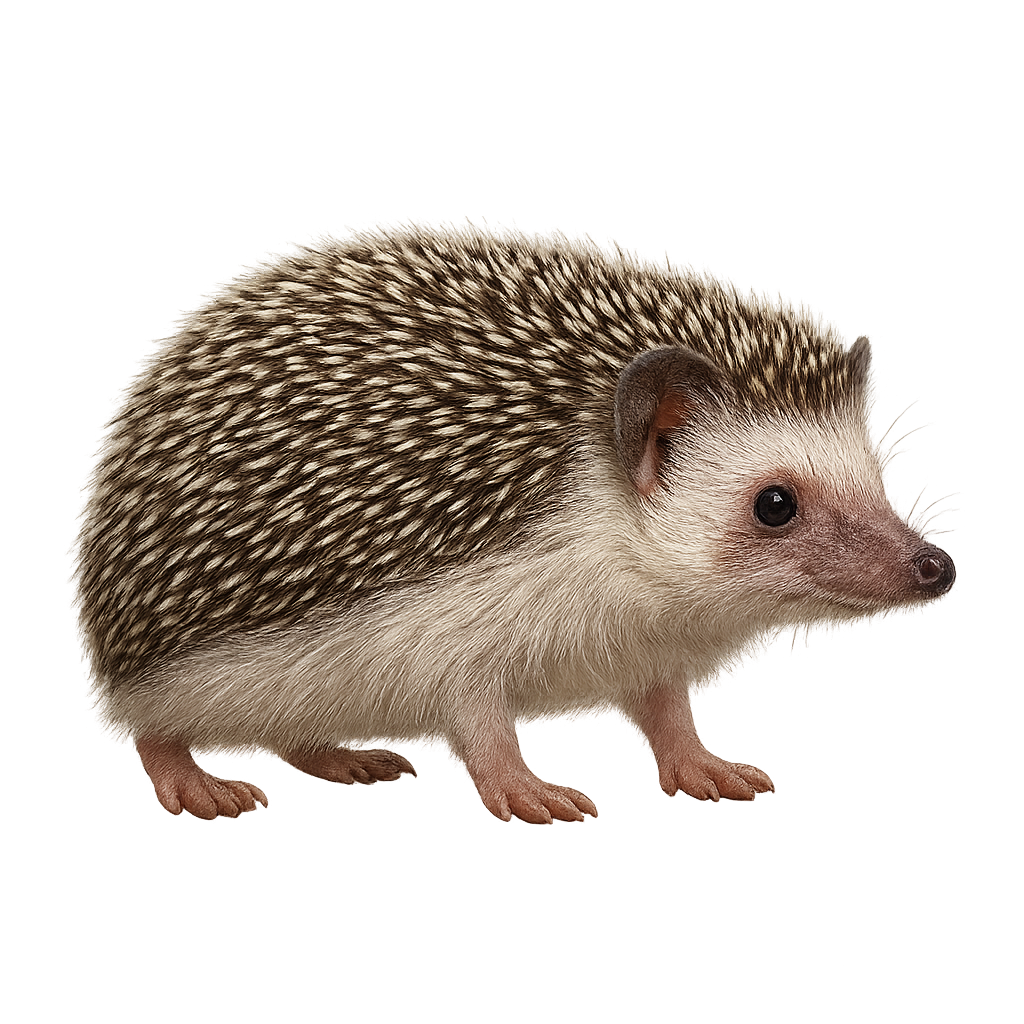
The African Pygmy Hedgehog, scientifically known as Atelerix albiventris, is a small insectivorous mammal native to sub-Saharan Africa. It is easily identifiable by its spiny back and white belly. This hedgehog measures about 15 to 25 cm in length and weighs between 300 and 600 grams. Primarily nocturnal, it feeds on insects, small invertebrates, and occasionally fruits. In captivity, it is often kept as a pet due to its compact size and generally docile nature. However, it requires specific care, including a suitable habitat and balanced diet to remain healthy.
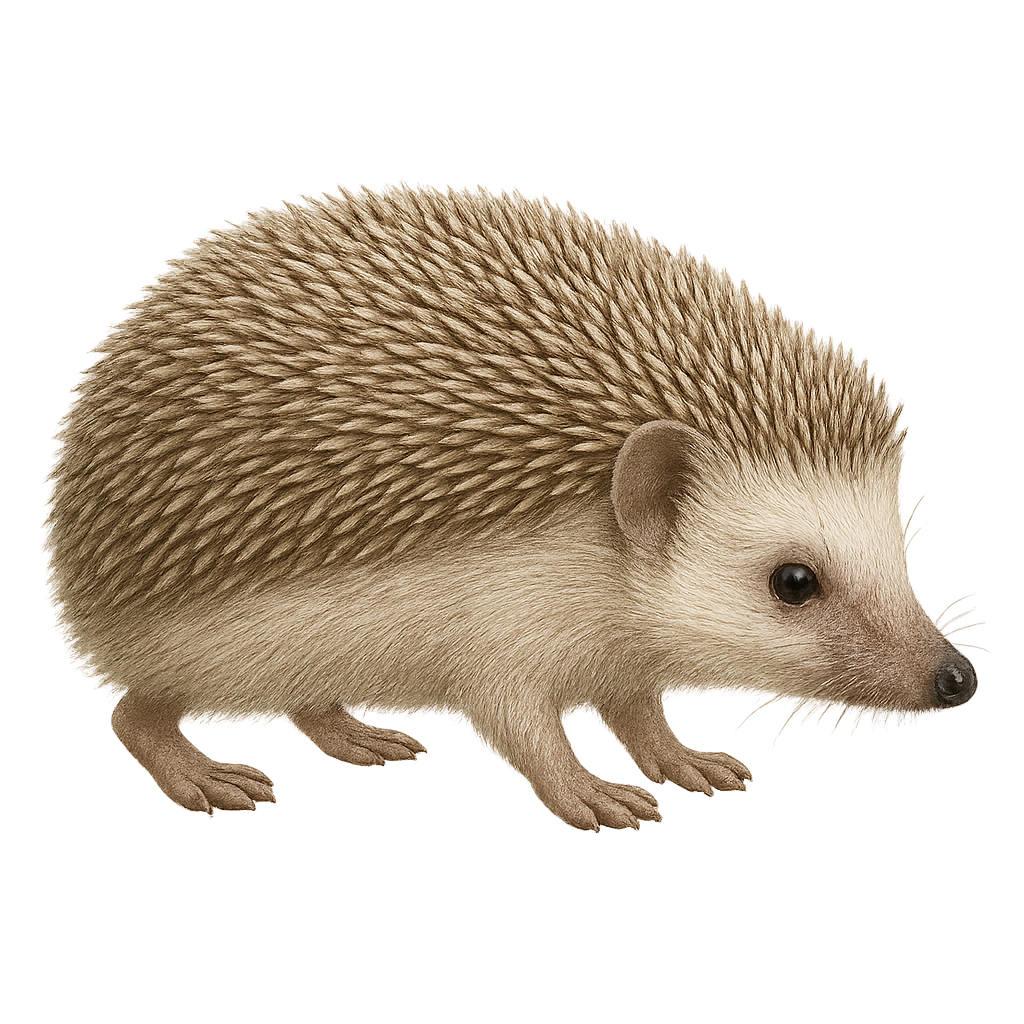
The North African Hedgehog, Atelerix algirus, is a small insectivorous mammal found mainly in North Africa and parts of southern Europe. It is characterized by its short spines and light-colored face. This hedgehog is well adapted to arid and semi-arid climates, preferring open areas with sparse vegetation. It is primarily nocturnal, feeding on insects, small invertebrates, and occasionally fruits. Its ability to roll into a ball to protect itself from predators is well known. Although generally solitary, it can be observed in small groups during the breeding season. Its population is stable, but it is threatened by habitat loss and road collisions.
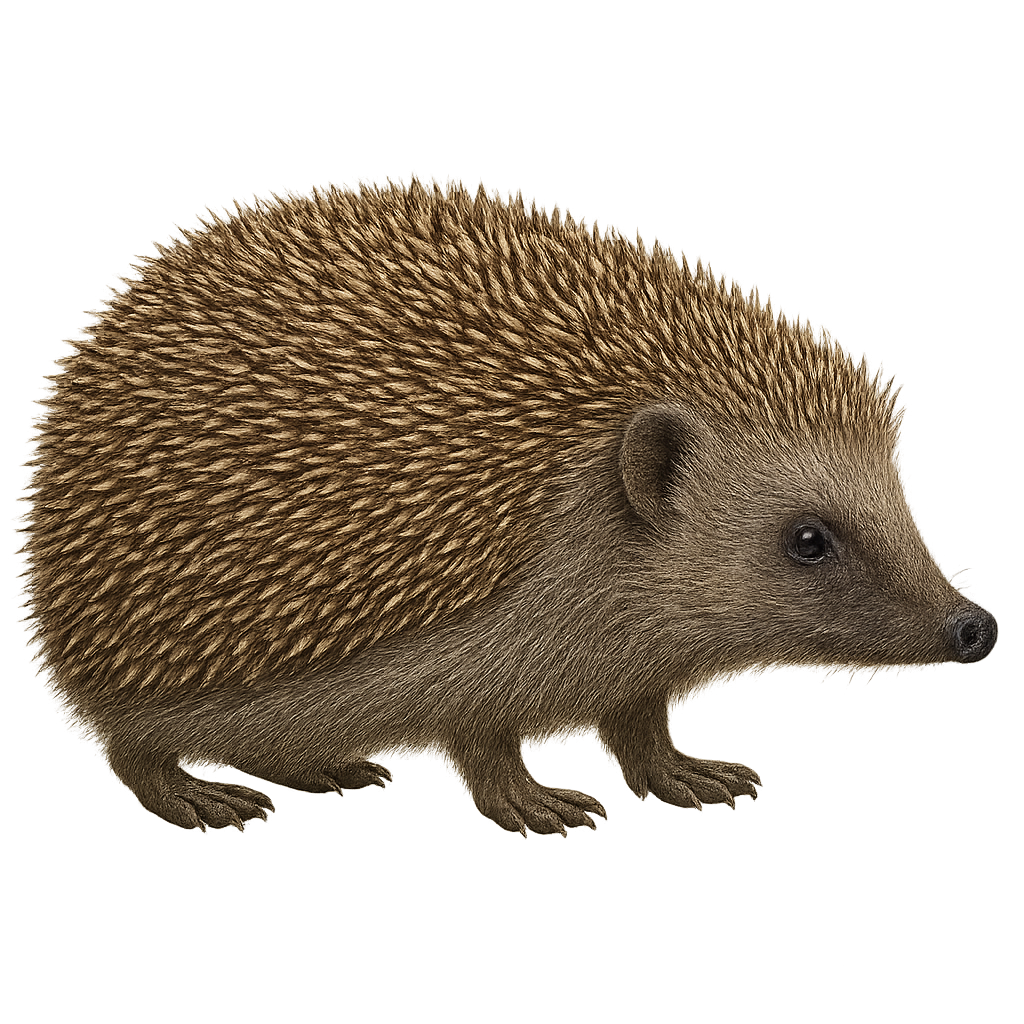
The Eastern Hedgehog, or Erinaceus concolor, is a small insectivorous mammal found primarily in Eastern Europe and Asia Minor. It is recognizable by its stiff spines covering its back, providing effective protection against predators. This hedgehog is nocturnal, spending its days resting in nests made of leaves and branches. It mainly feeds on insects, worms, and sometimes fruits. Although generally solitary, the Eastern Hedgehog can be observed in small groups during the breeding season. It is capable of hibernating during the winter months, reducing its metabolic activity to survive the cold temperatures.
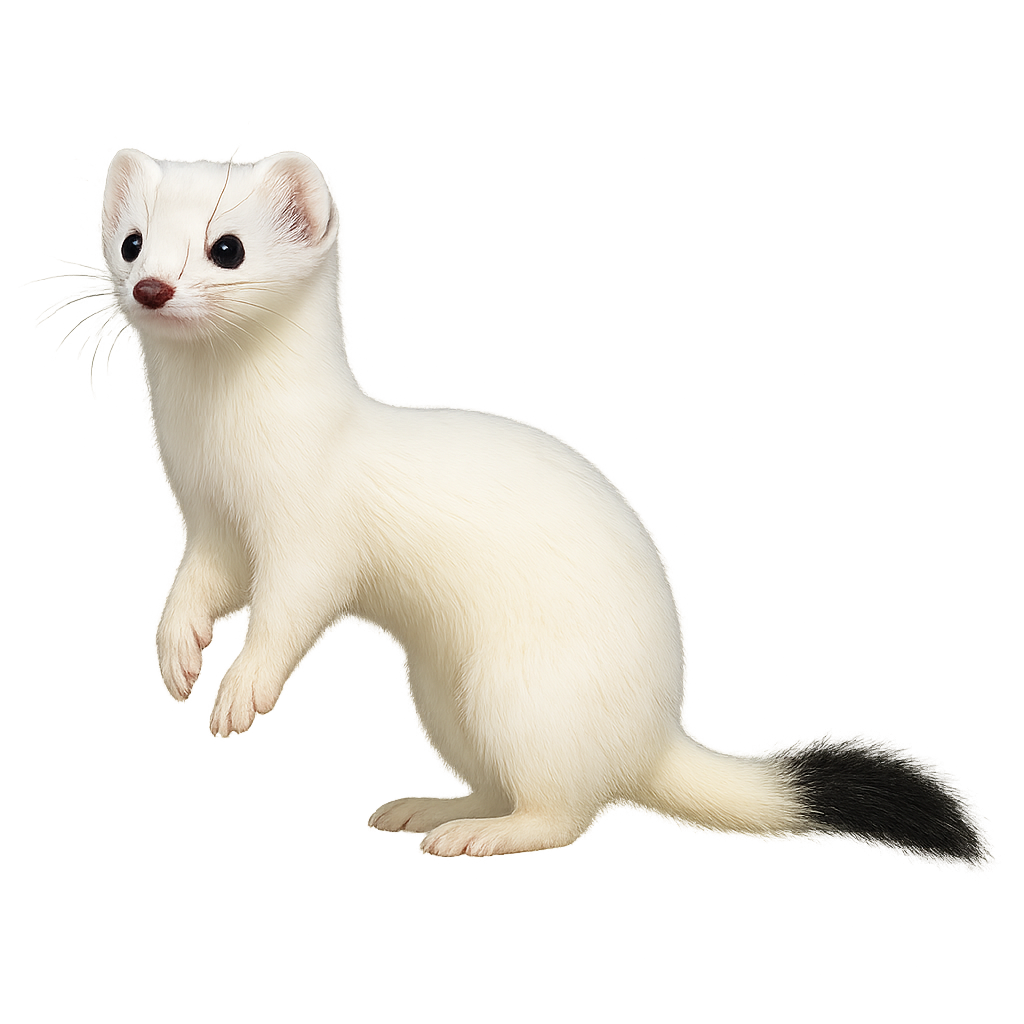
The Ermine is a small carnivorous mammal of the weasel family, easily recognizable by its immaculate white winter coat, which contrasts with its black-tipped tail. It measures about 25 to 35 cm in length, with a tail that can reach up to 10 cm, and weighs between 100 and 350 g. During the summer, its coat is typically brown with a lighter belly, but it turns completely white in winter, except for the black tip of its tail. The Ermine primarily inhabits forests, grasslands, and mountainous areas across Eurasia and North America. It is an excellent hunter, feeding mainly on small mammals such as mice, voles, but also on birds and eggs. The Ermine uses its hunting skills to capture prey with great agility and speed. While it is not endangered, the Ermine can be affected by habitat loss and climate change, particularly affecting the color of its fur.
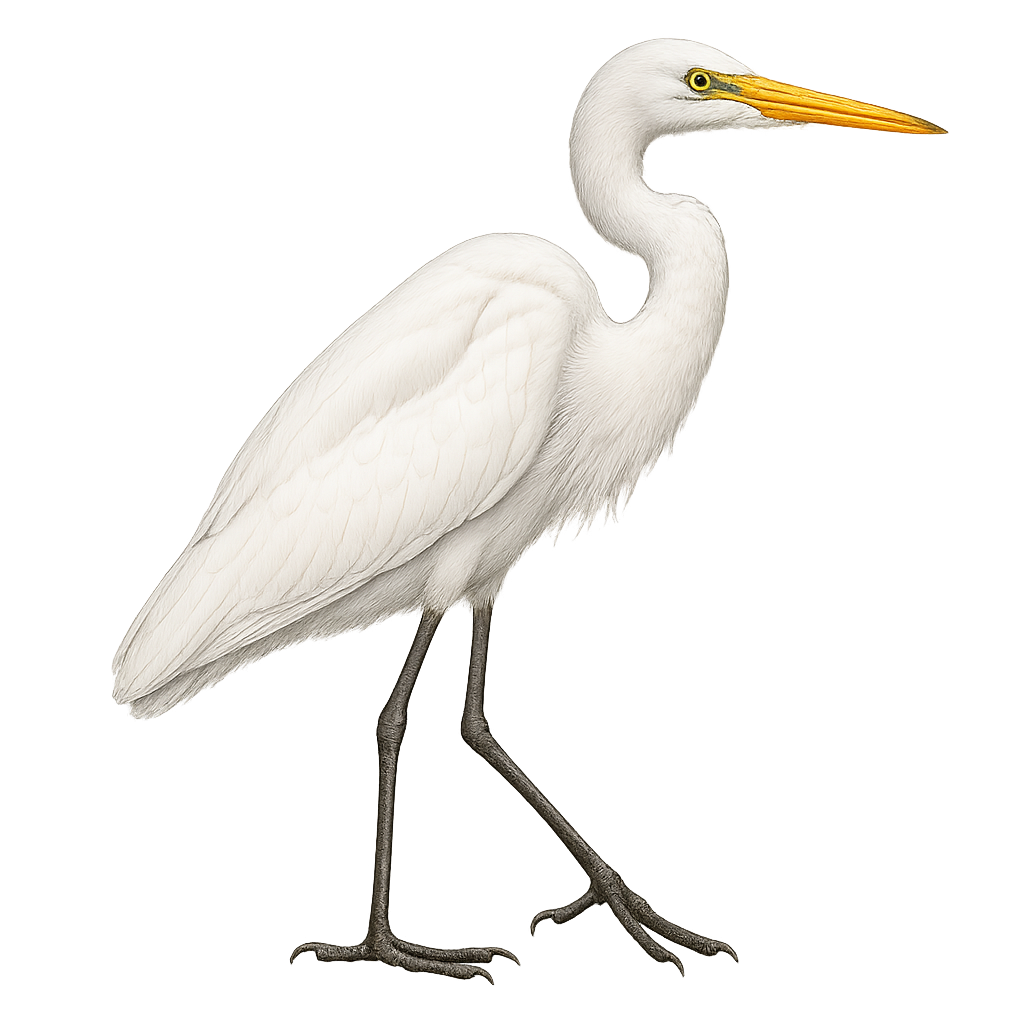
The Yellow-billed Egret, or Ardea brachyrhyncha, is a graceful and slender bird, primarily white with a distinctive yellow bill. It primarily inhabits the wetlands of sub-Saharan Africa, favoring marshes, rivers, and lakes. Its immaculate white plumage contrasts with its long black legs, ideal for wading in shallow waters in search of prey. This heron is an opportunistic hunter, feeding mainly on fish, amphibians, and aquatic insects. Although generally solitary, it can be seen in small groups during the breeding season. Its flight is graceful, with slow wing beats and a retracted neck.
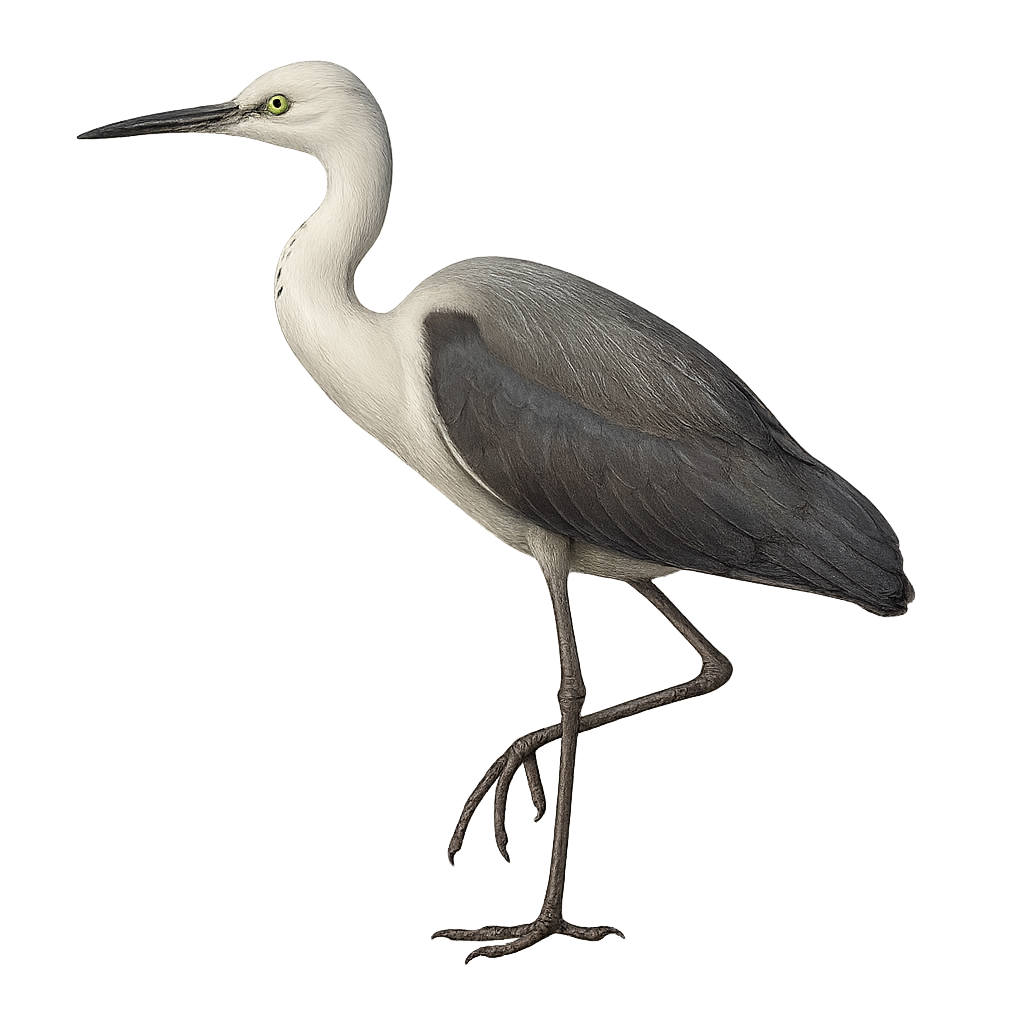
The White-faced Heron is a graceful and slender bird, identifiable by its bluish-grey plumage and distinctive white face. It is common in Australia, New Zealand, and parts of Southeast Asia. This heron frequents a variety of wetland habitats, including marshes, rivers, and coasts. It primarily feeds on fish, aquatic insects, and small crustaceans. Its flight is graceful, with slow and steady wing beats. The White-faced Heron is often seen alone or in small groups and is known for its ability to remain still for long periods while waiting for prey.
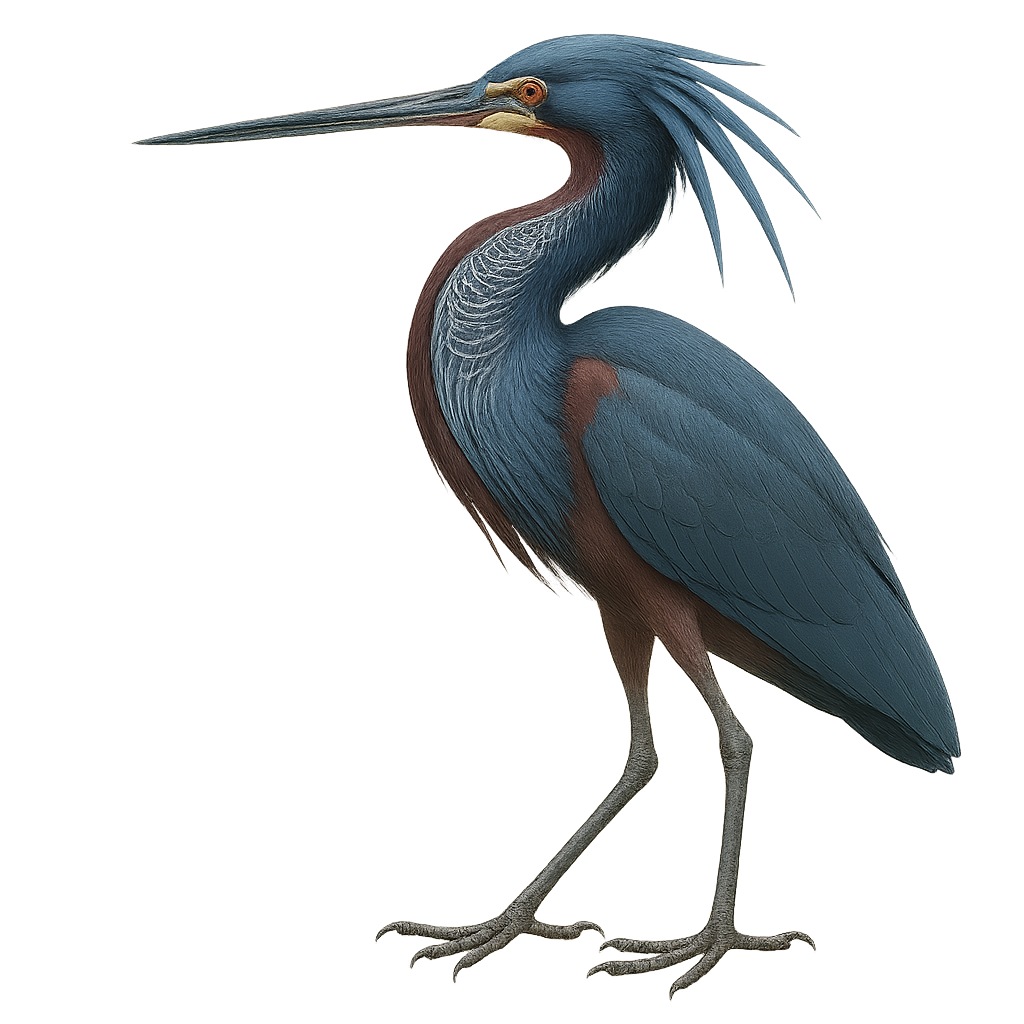
The Agami Heron, or Agamia agami, is a unique and fascinating heron known for its exceptionally colorful plumage and slender silhouette. This large bird, measuring about 66 to 76 cm in length, sports a plumage with varied hues ranging from deep blue to brown, with metallic reflections. Its neck is long and thin, often folded in an S-shape, and its beak is sharp, ideal for capturing aquatic prey. The Agami Heron is primarily observed in the humid tropical forests of Central and South America, where it frequents rivers and swamps. Discreet and solitary, it is often difficult to spot, preferring to move slowly and silently through dense vegetation.
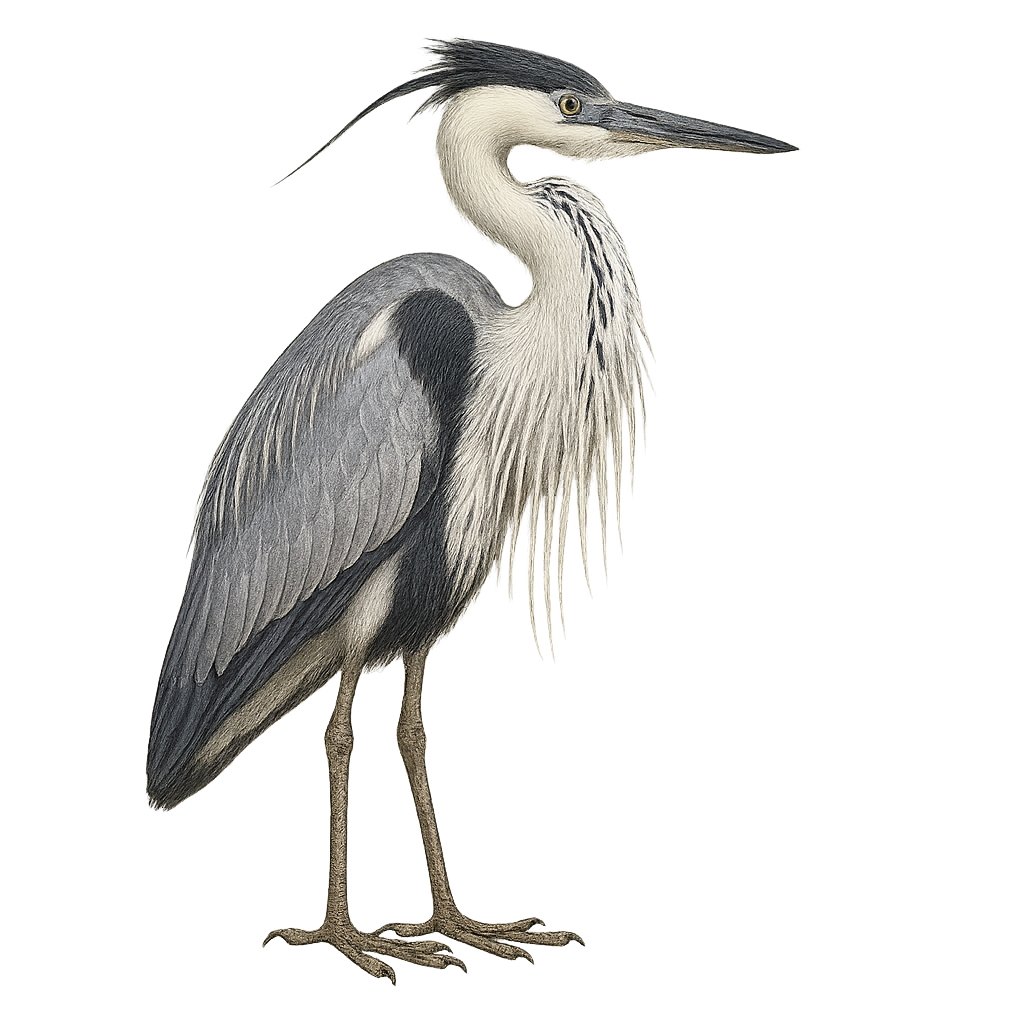
The Grey Heron is a large wading bird, easily recognizable by its slender silhouette, long neck, and large legs. It stands about 90 cm tall, with a wingspan of 1.5 to 1.9 meters, and weighs between 1.5 and 2 kg. Its plumage is primarily gray, with white markings on the belly and underside of the wings, and a white head adorned with distinctive black feathers. It has a long, pointed yellow beak, adapted for capturing its prey, primarily fish, amphibians, insects, and occasionally small mammals. The Grey Heron inhabits wetlands, marshes, rivers, and lakes across Europe, Asia, and North Africa. It is an excellent hunter, patiently waiting by the water's edge to capture its prey with its beak. Although the species is not endangered, it can be vulnerable to water pollution, habitat loss, and human disturbance.
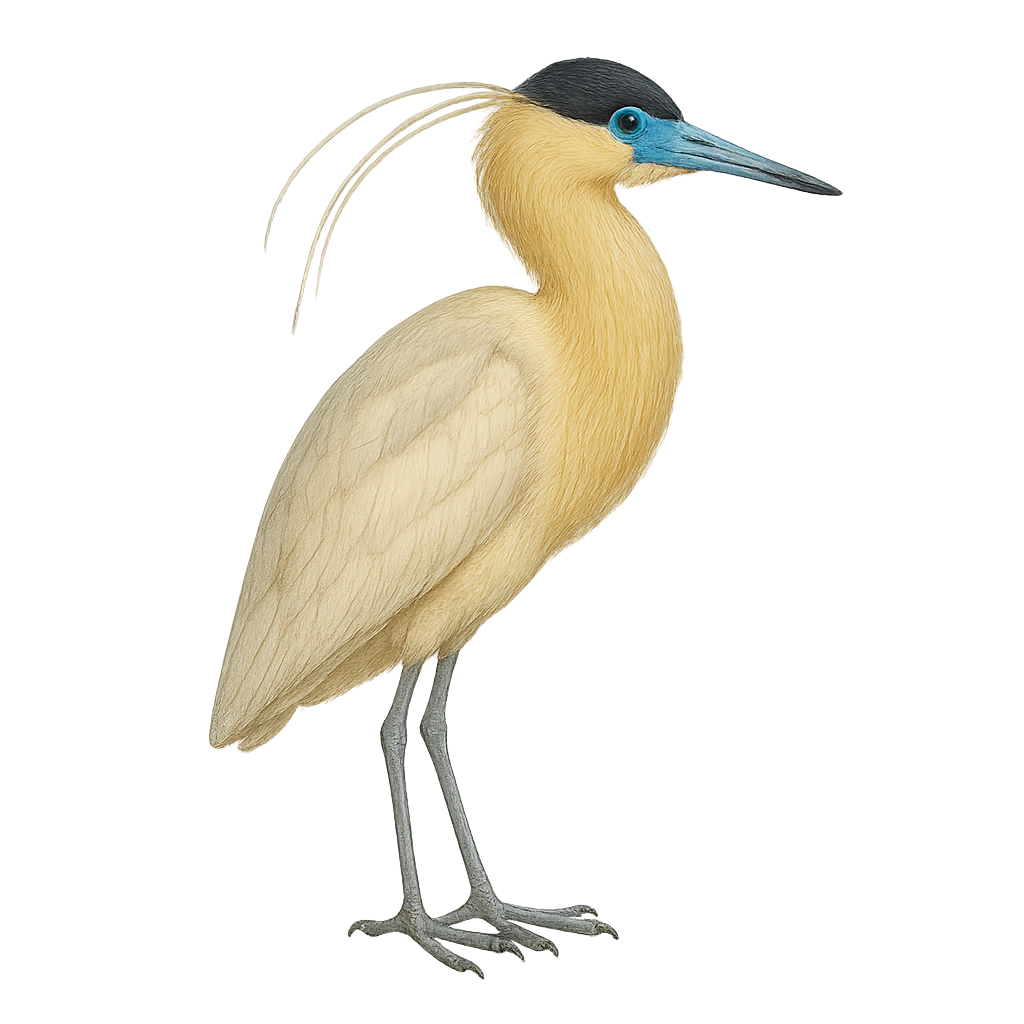
The capped heron, or Pilherodius pileatus, is an elegant and distinctive bird, recognizable by its black head contrasting with its white body and long blue bill. It primarily inhabits the humid tropical forests of Central and South America, often near slow-moving rivers and swamps. This solitary bird is often seen fishing, using its patient hunting technique to catch fish and small invertebrates. Its breeding season varies by region but is generally associated with the rainy season when food is abundant. Although its conservation status is currently stable, deforestation and habitat loss pose potential threats to its populations.
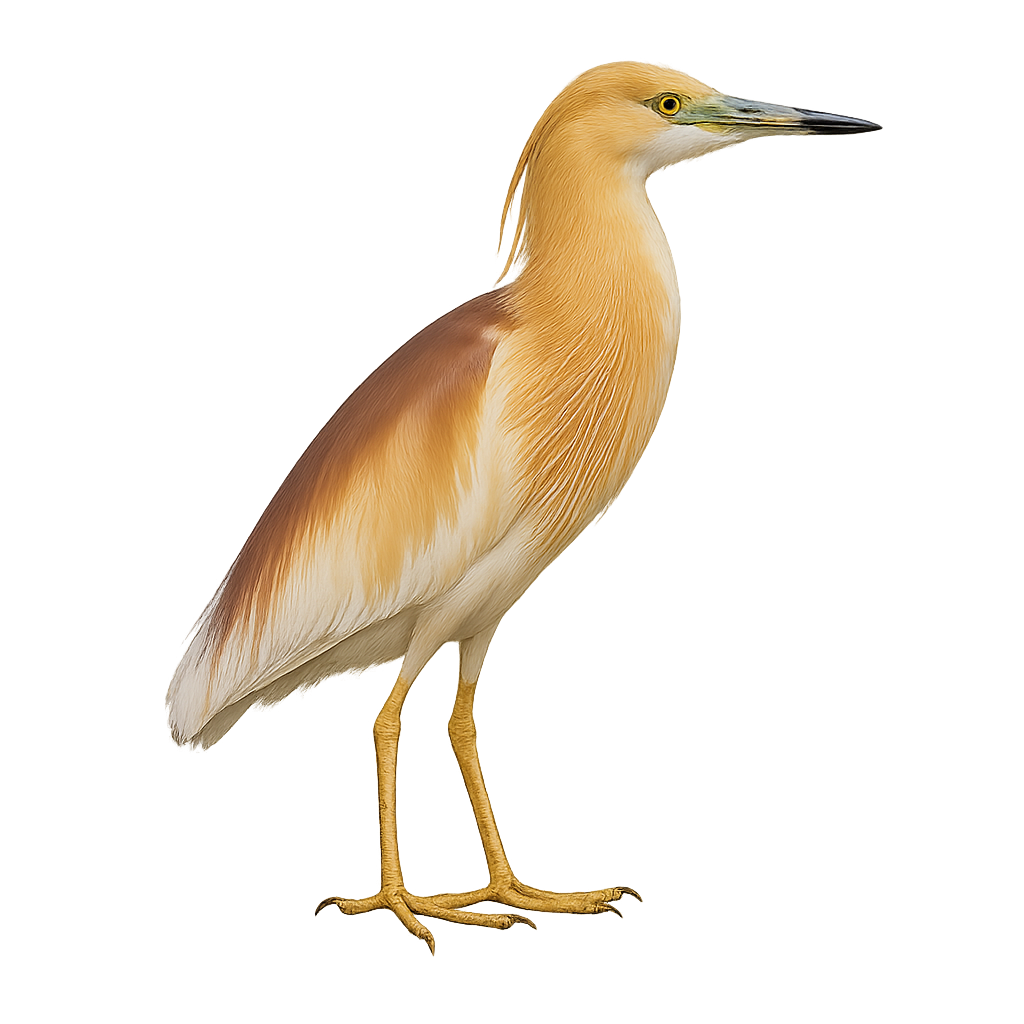
The Indian pond heron is a small heron of about 45 cm, with buff-brown plumage and white flight feathers visible in flight. It inhabits freshwater wetlands, rice paddies and riverbanks, standing motionless before striking fish, amphibians and insects with a quick bill thrust. During breeding, it builds a stick nest in waterside shrubs and the male performs courtship displays by raising neck feathers.
The Purple Heron, or Ardea coromanda, is a large, slender wading bird distinguished by its rich reddish-brown plumage and long neck. It inhabits rice fields, swamps, wooded wetlands, and lake edges across East and Southeast Asia. This heron is partially migratory, with seasonal movements depending on climate conditions. Typically solitary, it hunts slowly in shallow waters, feeding mainly on fish, amphibians, and aquatic invertebrates. The population is considered stable overall, although local declines may occur due to wetland loss.
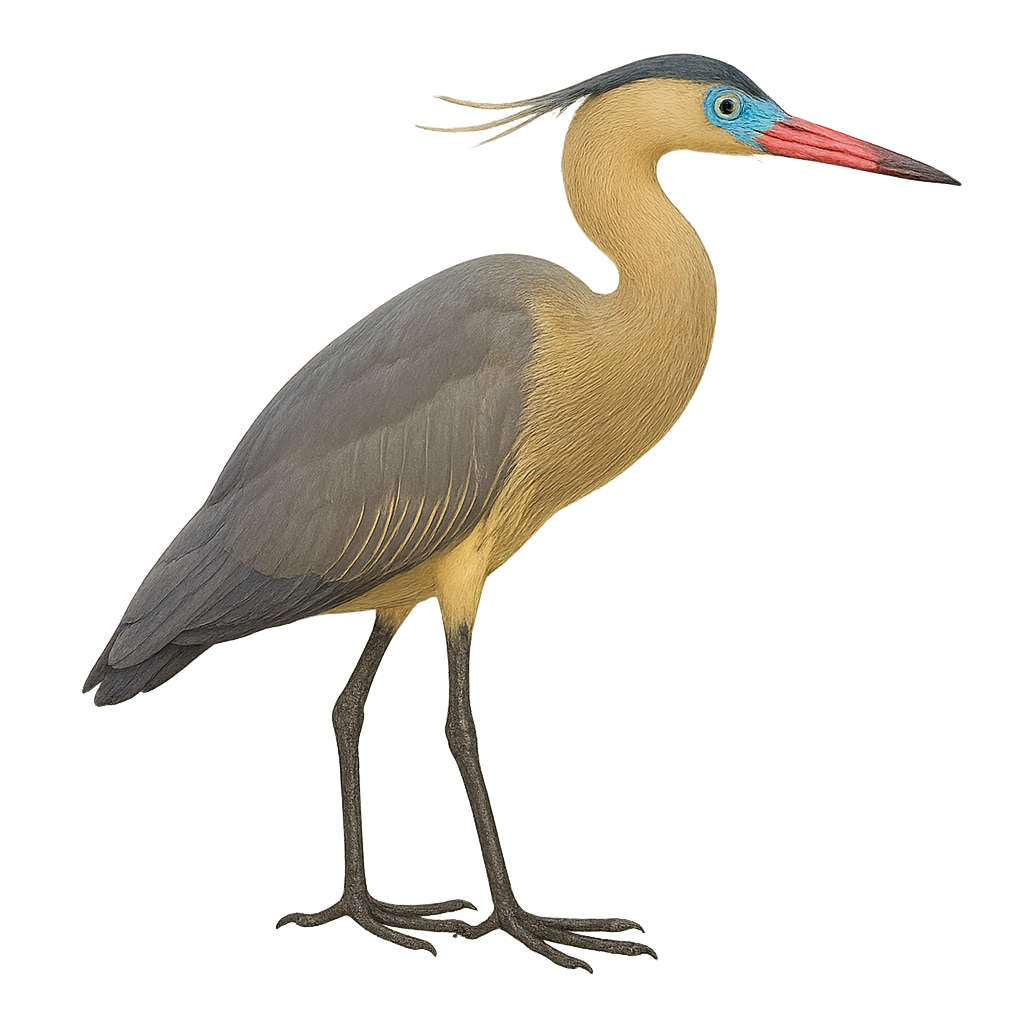
The Whistling Heron, Syrigma sibilatrix, is an elegant and distinctive bird, recognizable by its pastel-colored plumage and long, graceful neck. It features a blue-gray head with a black crown, while its body displays shades of beige and pink. This heron is often found in wetlands, marshes, and flooded grasslands of South America, where it primarily feeds on small fish, insects, and crustaceans. Its name comes from its characteristic call, a melodious whistle that echoes through its natural habitat. Although generally solitary, it can be seen in small groups during the breeding season.
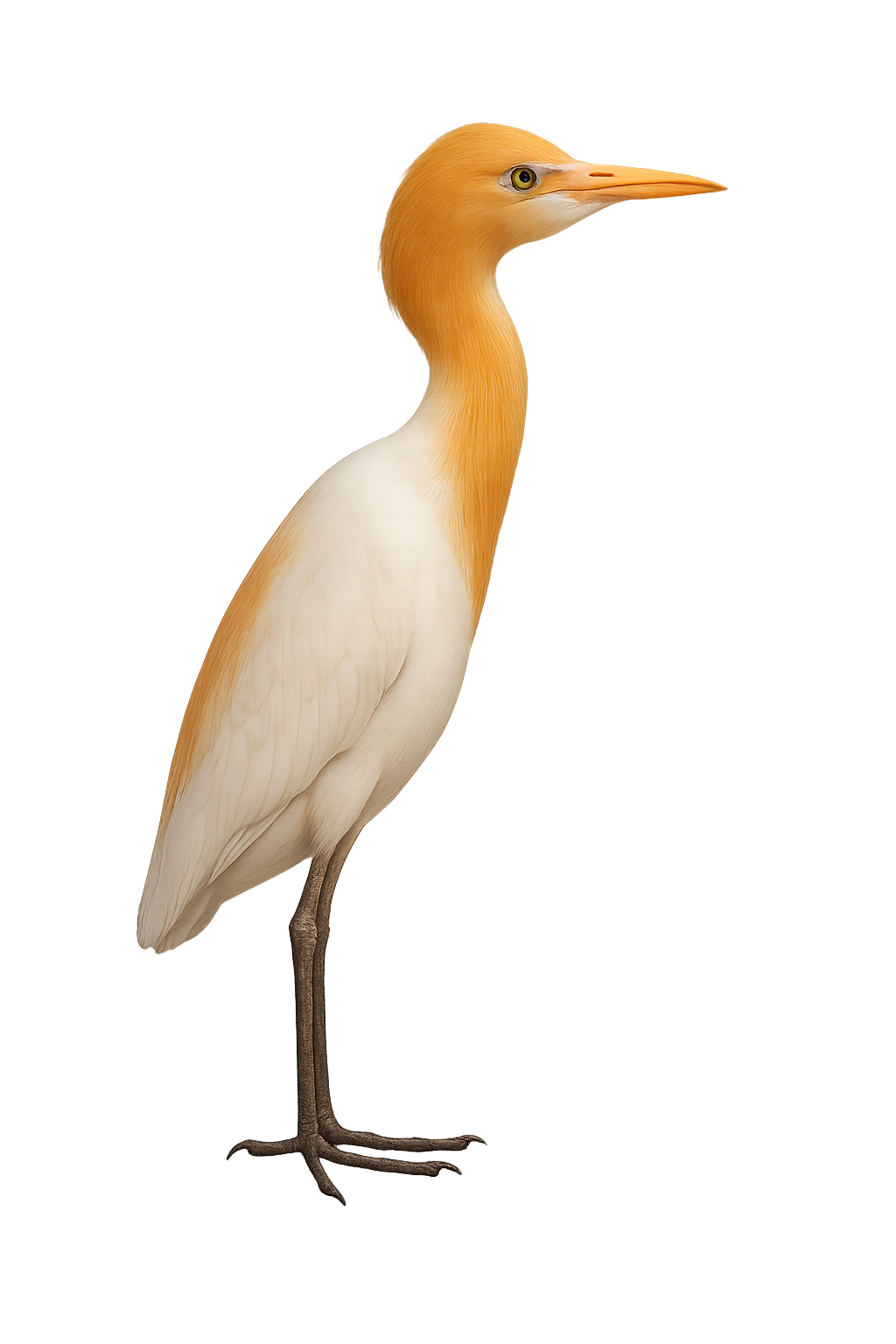
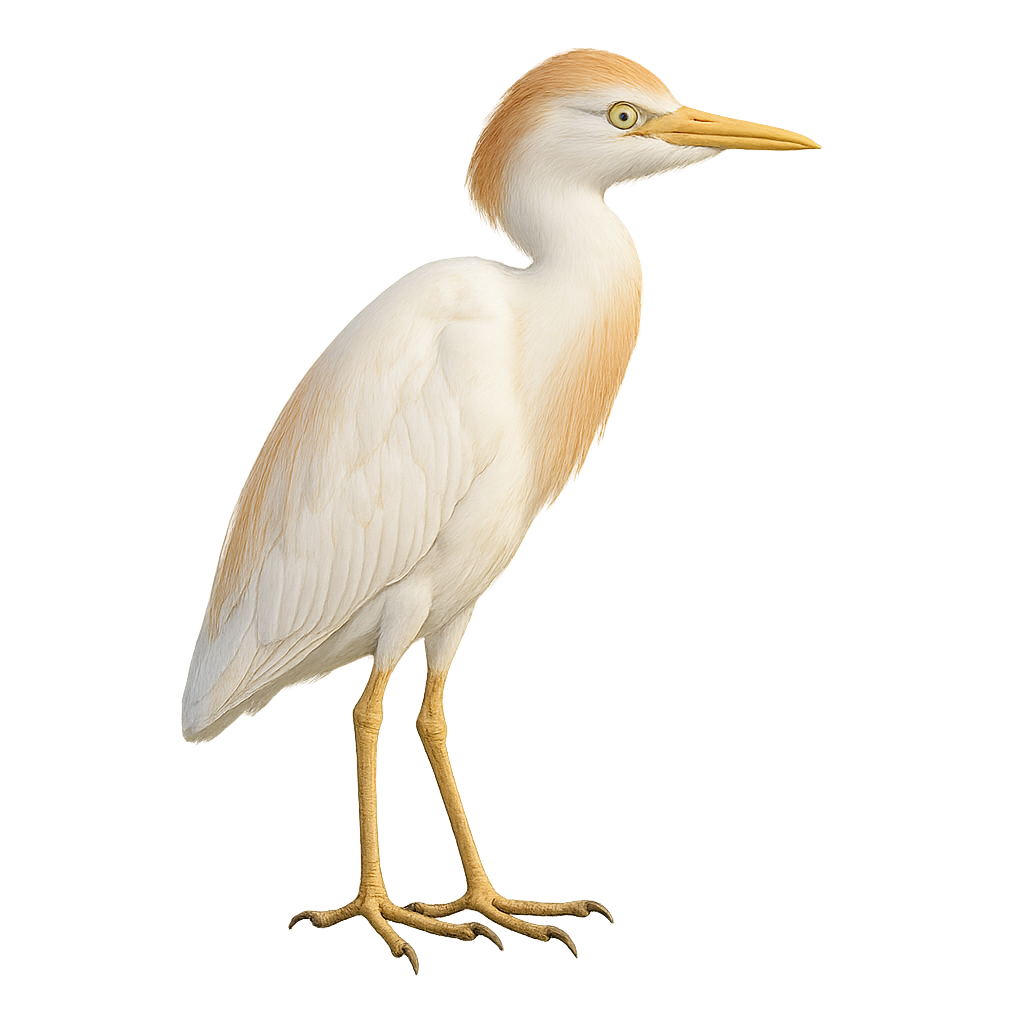
The Cattle Egret is a small heron with primarily white plumage, featuring touches of yellow on the neck and head during the breeding season. It measures about 55 to 60 cm in length, with a wingspan of 90 to 100 cm, and weighs between 300 and 500 g. This heron is notable for its social behavior, often seen in the company of large herds of cattle or near farm animals, hence its name "cattle egret." It takes advantage of the presence of these animals to hunt insects, worms, and other small animals disturbed by the movement of livestock. The Cattle Egret primarily inhabits Africa, Asia, and parts of Europe, such as the Mediterranean. It feeds mainly on small invertebrates, insects, and occasionally small fish, and is particularly efficient in agricultural and wetland areas. Although the species is widely spread, it may be vulnerable to habitat loss and changes in farming practices.
The White-bellied Heron, Ardea insignis, is a rare and majestic bird primarily found in the Himalayan regions. It is distinguished by its grey-blue plumage and white belly, contrasting with its long neck and slender legs. Standing up to 127 cm tall, it is one of the largest herons in the world. Preferring high-altitude rivers and lakes, it is often solitary and discreet, making it difficult to observe. Its population is declining, mainly due to habitat loss and human disturbance. Conservation efforts are crucial to ensure its survival, as it is classified as critically endangered by the IUCN.
The Purple Heron is a large wading bird, easily recognizable by its colorful plumage, ranging from purple to reddish, with shades of brown and blue. It measures about 80 to 100 cm in length, with a wingspan of 1.3 to 1.5 meters, and weighs between 600 and 1,200 g. Its beak is long, thin, and pointed, with a yellowish-green color, while its legs are long and gray. During the breeding season, the Purple Heron sports decorative plumes on its head and neck. It primarily inhabits wetlands, marshes, rivers, and lakes across Europe, Africa, and Asia, where it feeds on fish, crustaceans, small mammals, and occasionally insects. It primarily hunts at night or during twilight, using its great agility to capture prey in the water. Although the species is not immediately endangered, it is vulnerable to habitat loss, water pollution, and human disturbance.
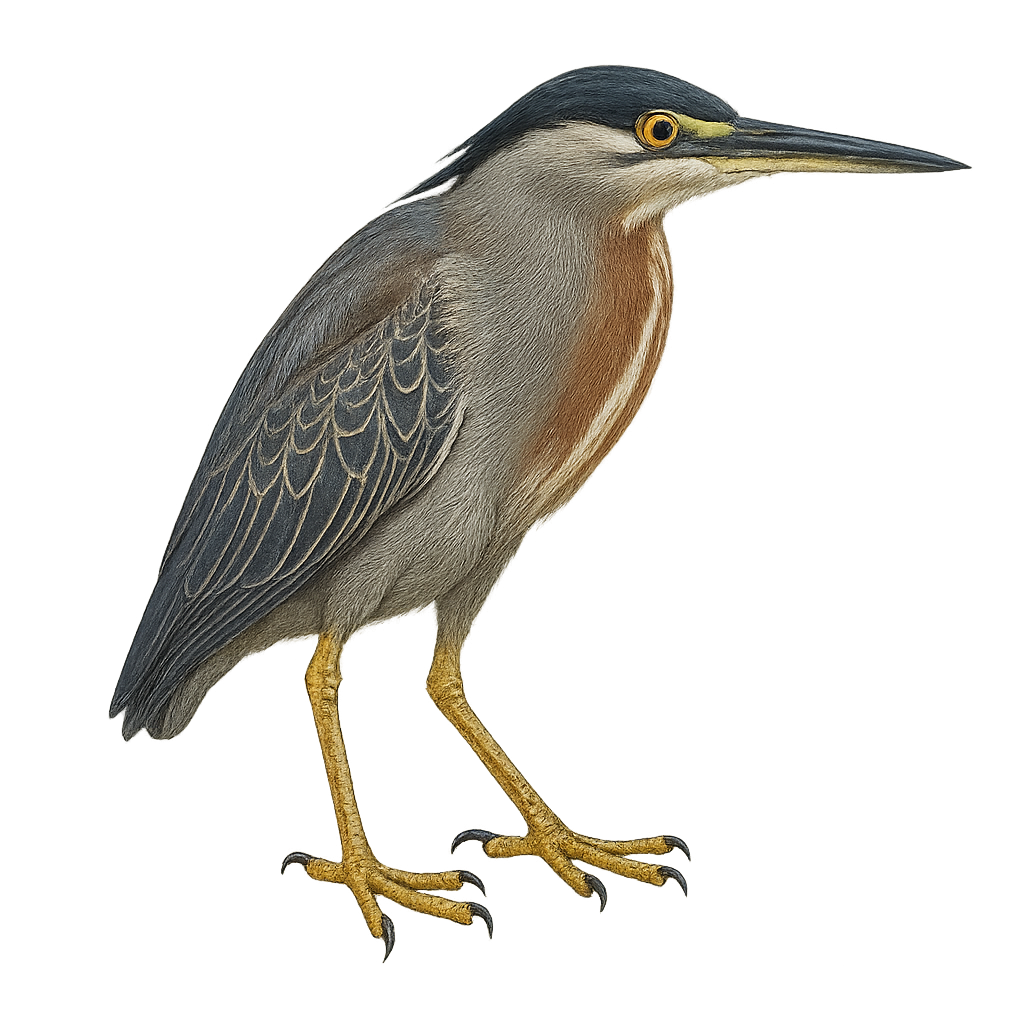
The Striated Heron, or Butorides striata, is a small heron with predominantly grey-green plumage, a black cap, and yellow legs. It is often seen in wetlands, mangroves, and along rivers. This heron is an opportunistic feeder, primarily consuming fish, insects, and small crustaceans. It employs a unique hunting technique, remaining still before quickly striking its prey. Although generally solitary, it can sometimes be seen in small groups. Its ability to adapt to various aquatic habitats allows it to inhabit a wide range of geographical regions, from tropical to temperate areas.
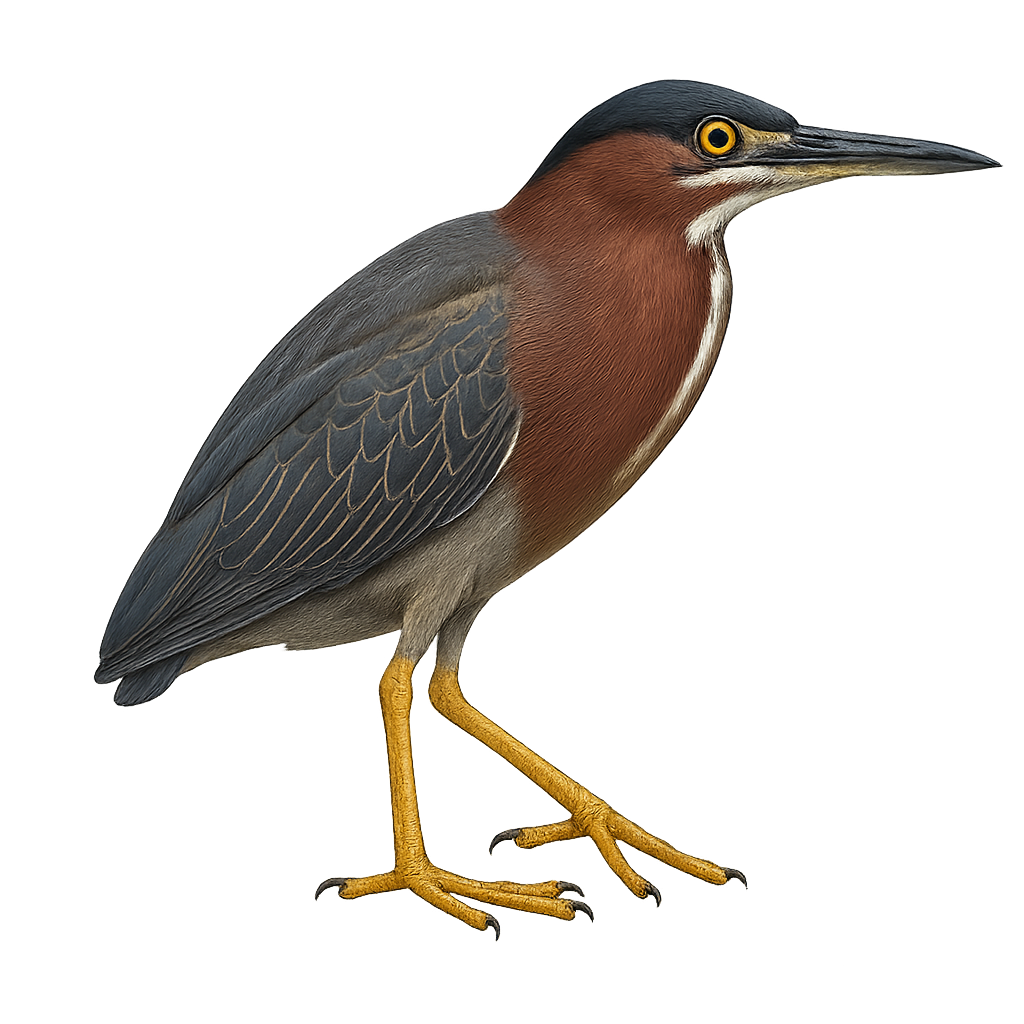
The Green Heron, Butorides virescens, is a small heron with dark green plumage and bluish-gray wings. It is characterized by its dark head and long, pointed bill. This heron is often found in wetlands, marshes, and along the shores of water bodies in North and Central America. Known for its clever hunting technique, it uses bait to lure fish. The Green Heron is a solitary bird but can be seen in small groups during migration. It is generally discreet and blends well into its environment. Its breeding season extends from spring to summer, where it builds its nest in trees or shrubs near water.
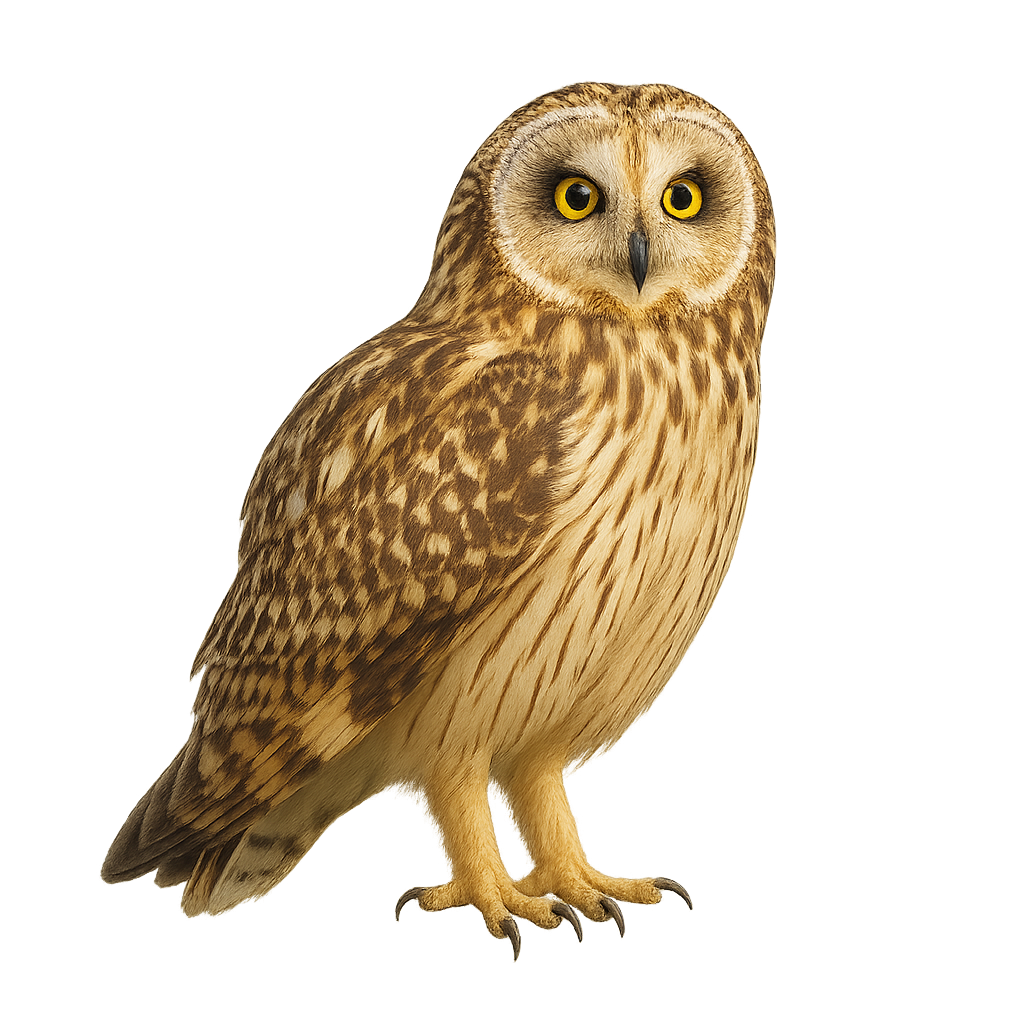
The Short-eared Owl is a small nocturnal raptor, easily recognizable by its pale yellowish plumage and large, piercing yellow eyes. It measures about 34 to 40 cm in length, with a wingspan of 80 to 95 cm, and weighs between 180 and 400 g. Its face is disc-shaped, like that of other owls, and its plumage, which is cream or brown, is speckled with dark spots that provide excellent camouflage in the grasslands and marshes where it resides. The Short-eared Owl primarily inhabits open areas, such as marshes, grasslands, and farmland, across Europe, Asia, and North America. It mainly hunts small mammals, such as voles and mice, as well as birds and insects. This raptor is an excellent nocturnal hunter, using its very sensitive ears and sharp vision to locate prey in the dark. Although the species is not immediately endangered, it is vulnerable to habitat loss, water pollution, and human disturbance.
The Cape Owl, Asio capensis, is a species of nocturnal bird of prey belonging to the Strigidae family. This owl is characterized by its brown plumage speckled with white and black, allowing it to blend seamlessly into its natural habitat. It has long tufts on its head, often erect, and piercing yellow eyes. It is primarily found in the wetlands, marshes, and savannas of sub-Saharan Africa. This owl is an opportunistic hunter, feeding mainly on small mammals, birds, and insects. Although its conservation status is concerning due to habitat loss, it remains relatively widespread in some areas.
The Long-eared Owl is a medium-sized nocturnal raptor, easily recognizable by its large tufts of feathers shaped like "ears" on its head. It measures about 35 to 40 cm in length, with a wingspan of 85 to 100 cm, and weighs between 250 and 400 g. Its plumage is generally gray or brown with dark banded patterns, allowing it to blend perfectly in wooded and open forest areas. It has large yellow eyes and a disc-shaped face, like other owls, which helps it capture sound in the dark. The Long-eared Owl primarily inhabits forests, woodlands, and heathlands across Europe, Asia, and North Africa, where it primarily feeds on small mammals, such as voles, mice, and occasionally birds. It generally hunts at dusk, using its sharp vision and keen hearing to detect its prey. While the species is not endangered, it is vulnerable to deforestation and habitat loss.
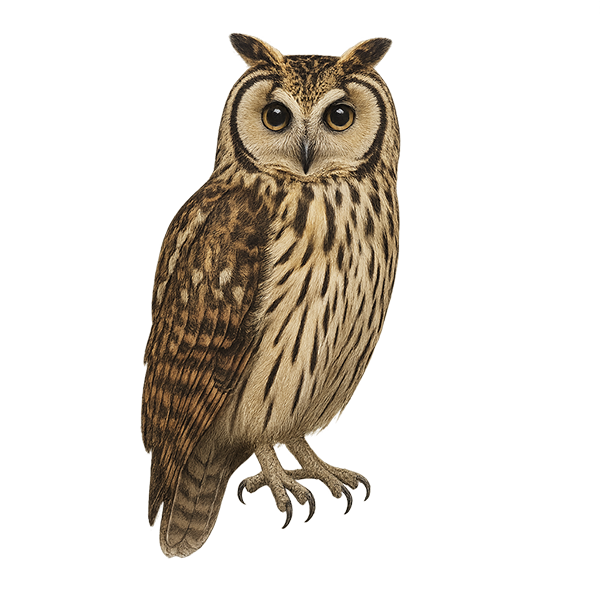
The Striped Owl, or Asio clamator, is a medium-sized nocturnal raptor known for its prominent ear tufts and brown and white streaked plumage. It primarily inhabits wooded areas and savannas in Central and South America. This owl is an opportunistic hunter, feeding mainly on small mammals, birds, and insects. Its flight is silent, allowing it to surprise its prey. Although primarily nocturnal, it can be seen at dawn or dusk. The Striped Owl is a solitary bird, except during the breeding season when it forms pairs.
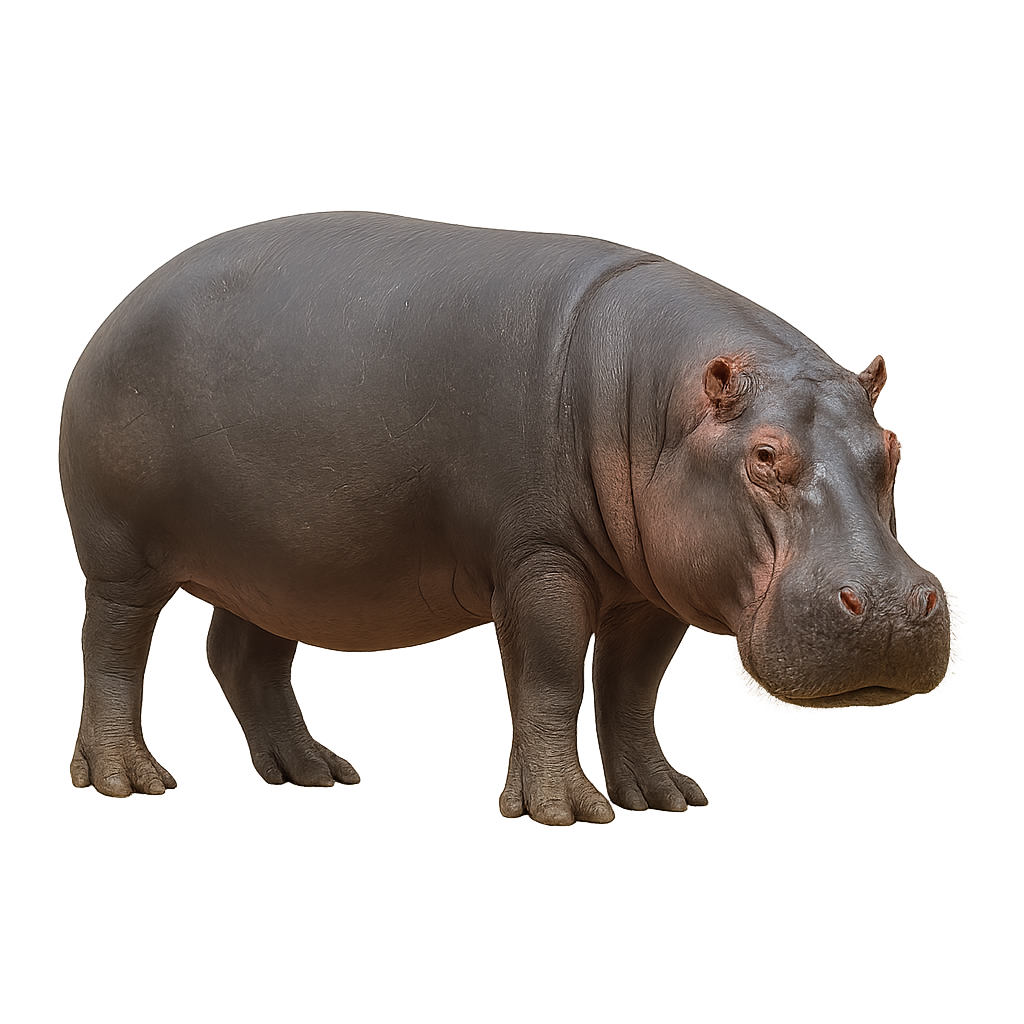
The Common Hippopotamus is a large semi-aquatic mammal, easily recognizable by its massive body and thick skin. It measures between 3.3 and 4.5 meters in length, with a weight reaching 1,500 to 1,800 kg, or more. Its body is primarily gray, with pink skin underneath the belly and ears and eyes positioned high on its head, allowing it to see and hear while submerged in water. Hippos are primarily herbivores, feeding on grass and aquatic vegetation in large quantities, mostly at night. They spend most of their time in the water to regulate their body temperature and prevent dehydration, while still being able to move quickly on land. The Common Hippopotamus primarily inhabits sub-Saharan Africa, in rivers, lakes, and swamps. Although it is a powerful and territorial animal, it is threatened by habitat loss, hunting, and conflicts with human populations.
The Pygmy Hippopotamus is a smaller species of hippopotamus, much smaller than its cousin the Common Hippopotamus, with an adult size measuring about 1.5 to 1.75 meters in length and weighing between 180 and 275 kg. Its coat is gray-olive or dark brown, with smooth and thick skin. Unlike the Common Hippopotamus, the Pygmy Hippopotamus primarily inhabits the forests of West Africa, particularly in Liberia, Sierra Leone, Guinea, and Côte d'Ivoire, and prefers shallow rivers and swamps rather than vast expanses of water. It is primarily herbivorous, feeding on aquatic vegetation and foliage, but unlike its cousin, it does not spend all its time in the water and can be more active on land. The Pygmy Hippopotamus is a nocturnal and solitary species, often elusive and difficult to observe. Although it is less exposed to threats than the Common Hippopotamus, it is still endangered due to habitat loss, hunting, and human disturbance.
The hirola, or Beatragus hunteri, is a rare and endangered antelope native to the dry savannas of Kenya and Somalia. Recognizable by its lyre-shaped horns and light brown coat, the hirola is often called the "four-eyed antelope" due to the prominent preorbital glands located under its eyes. These glands play a crucial role in olfactory communication among individuals. Hirolas live in small herds, usually consisting of females and their young, while adult males are often solitary or form small bachelor groups. This species is diurnal, feeding mainly on grasses and foliage. Unfortunately, the hirola is critically endangered, primarily due to habitat loss, hunting, and diseases transmitted by domestic livestock.
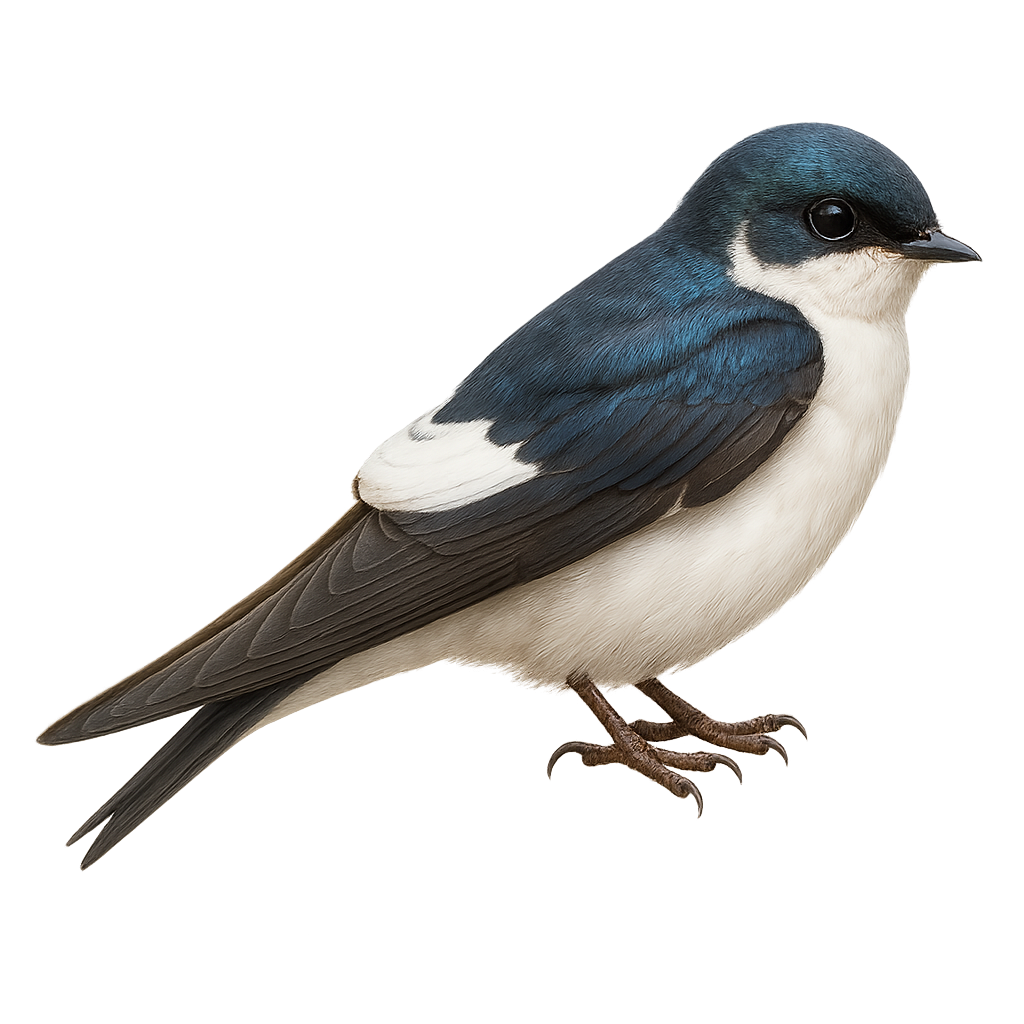
The White-winged Swallow, Tachycineta albiventer, is a passerine bird species in the Hirundinidae family. It is easily identified by its striking plumage, featuring a metallic blue-green back and a bright white belly. This swallow is commonly found near water bodies such as rivers, lakes, and marshes in South America, where it feeds primarily on flying insects. Known for its agile and swift flight, it often moves in small groups. Although its habitat is relatively stable, it can be impacted by deforestation and water pollution. It typically nests in natural or artificial cavities, like tree holes or human structures.
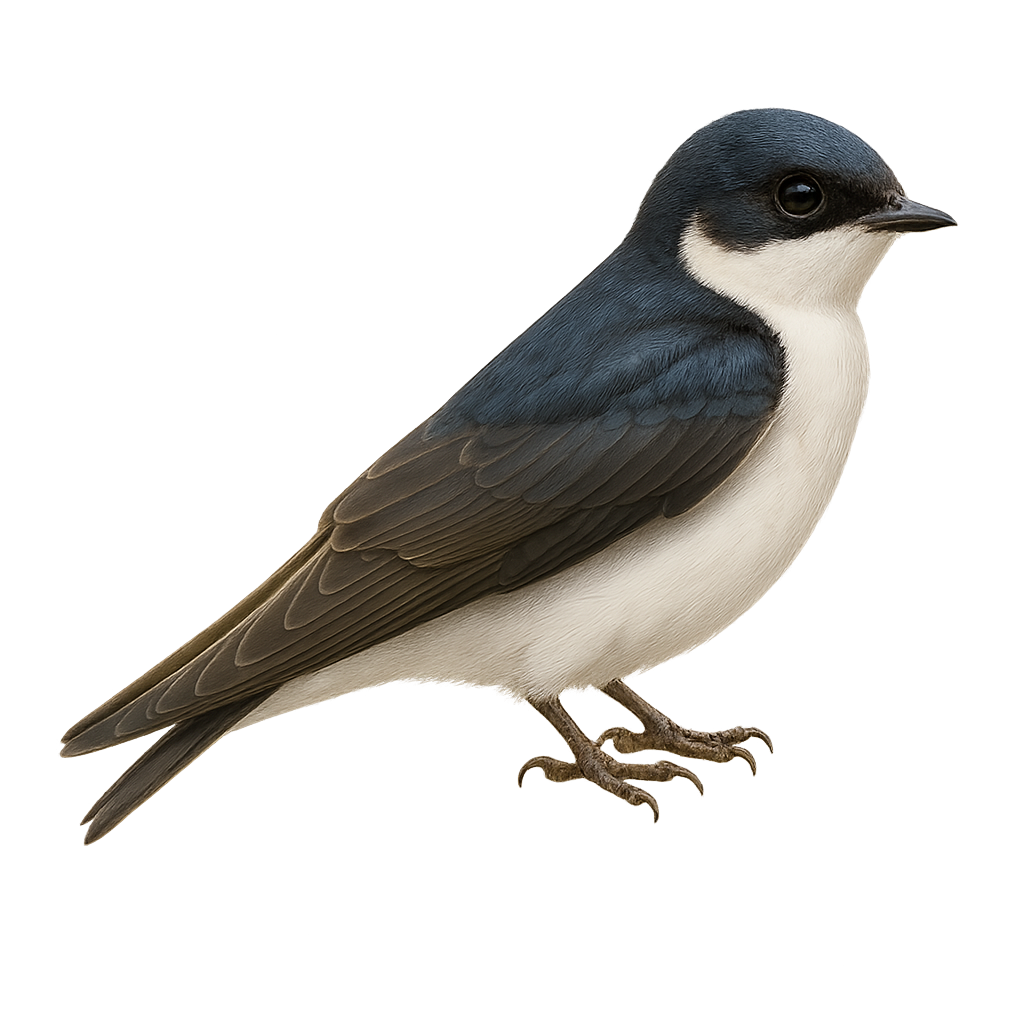
The White-banded Swallow is a small, elegant bird, easily recognizable by its distinctive black and white plumage. It features a characteristic white band on its wings, contrasting with its black back and white belly. This species is often seen in swift, agile flight over water bodies, where it hunts insects. It is widespread in tropical regions of South America, particularly along rivers and lakes. The White-banded Swallow is a sociable species, often seen in small groups. It builds its nest in natural or artificial cavities, using mud and grass for reinforcement.
The White-rumped Swallow, or Tachycineta leucorrhoa, is an elegant and agile bird, recognizable by its metallic blue back and white belly. It is often seen in swift flight, catching insects in mid-air. This species is widespread in South America, especially in open areas and near water bodies. It typically nests in natural or artificial cavities, such as nest boxes. Pairs are monogamous and jointly raise their young. Although its conservation status is currently stable, habitat loss could pose a future risk.
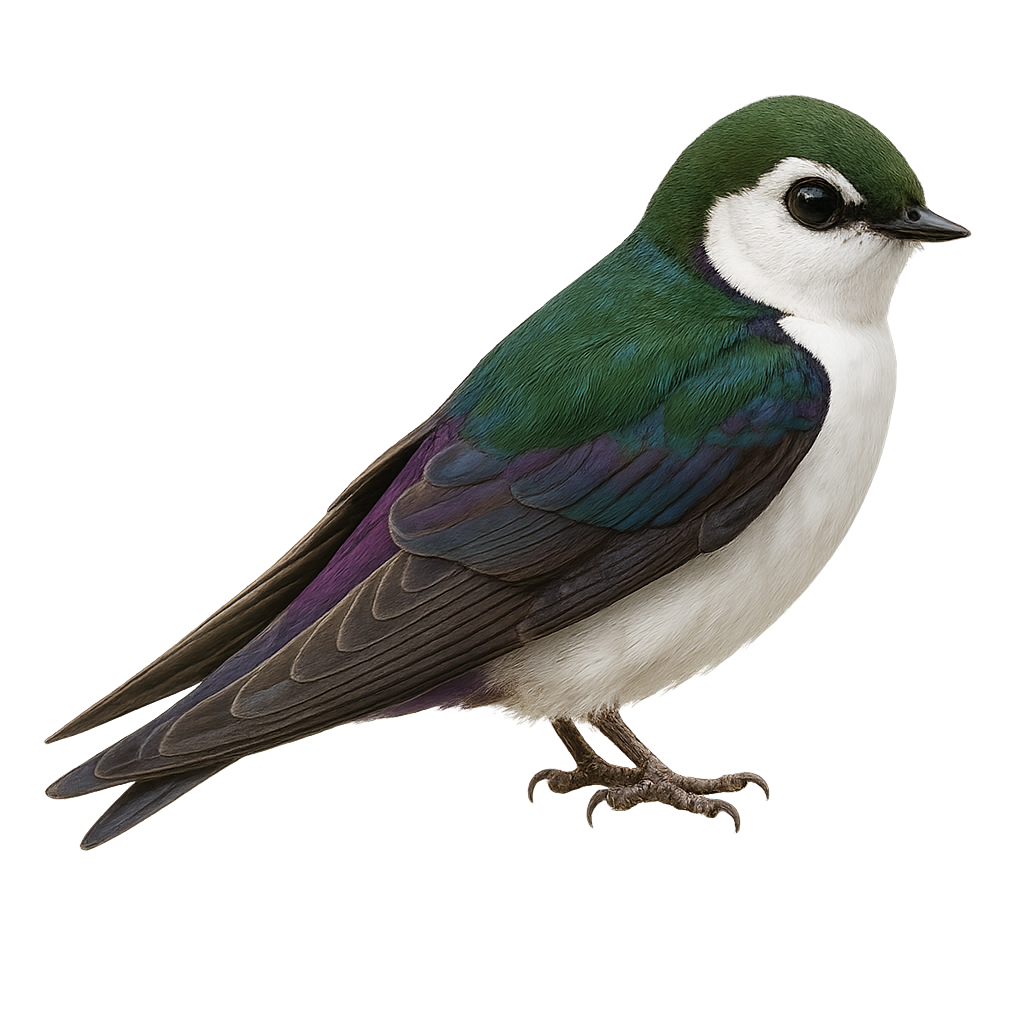
The Violet-green Swallow, or Tachycineta thalassina, is a small migratory bird belonging to the Hirundinidae family. It is distinguished by its iridescent green and violet plumage on the back, contrasting with a white face and belly. It primarily inhabits wooded areas and open spaces near water, where it hunts flying insects. Its flight is agile and fast, allowing it to catch prey with precision. It often nests in natural cavities or artificial nest boxes. During the breeding season, it is very social and can form small colonies. Its presence indicates healthy aquatic ecosystems, as it relies on the availability of aquatic insects for food.
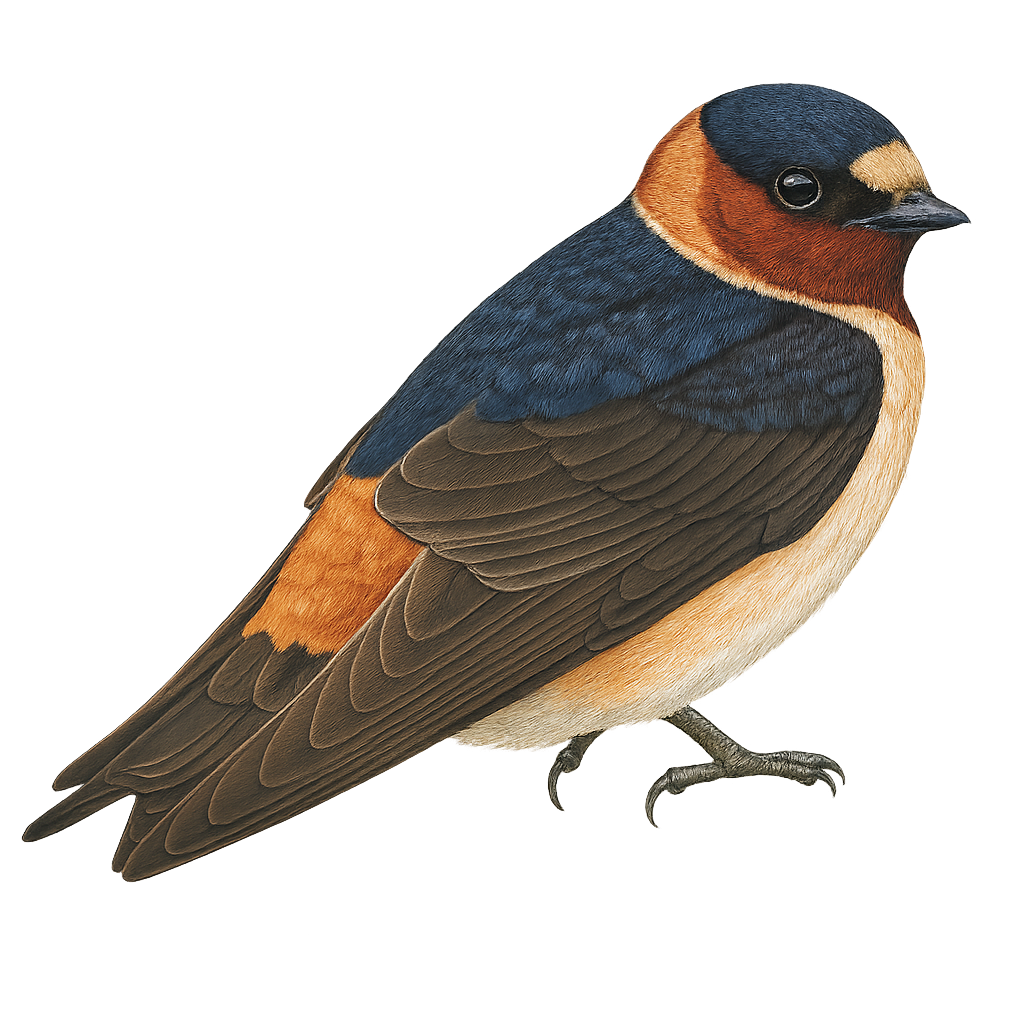
The American Cliff Swallow, Petrochelidon pyrrhonota, is a small migratory bird belonging to the Hirundinidae family. It is easily recognizable by its distinctive white forehead, dark blue back, and beige belly. These swallows are often seen in large groups, nesting under bridges, ledges, and cliffs. They build gourd-shaped nests using mud and saliva. Their diet mainly consists of flying insects, which they catch in mid-air. They are highly social and communicate through various songs and calls. Their range extends from North America to South America, where they spend the winter.